
Why Platforms Like @Dusk Trade Are Defining the Institutional On-Chain Future
The conversation around tokenization has matured. We are no longer in the phase where tokenized assets are viewed as experimental wrappers around traditional instruments. Today, tokenized securities are increasingly recognized as a structural upgrade to how ownership, settlement, compliance, and market access can function in a digital world.
But there is one truth that serious market participants already understand:
Tokenized securities do not succeed on technology alone they succeed on regulated infrastructure.
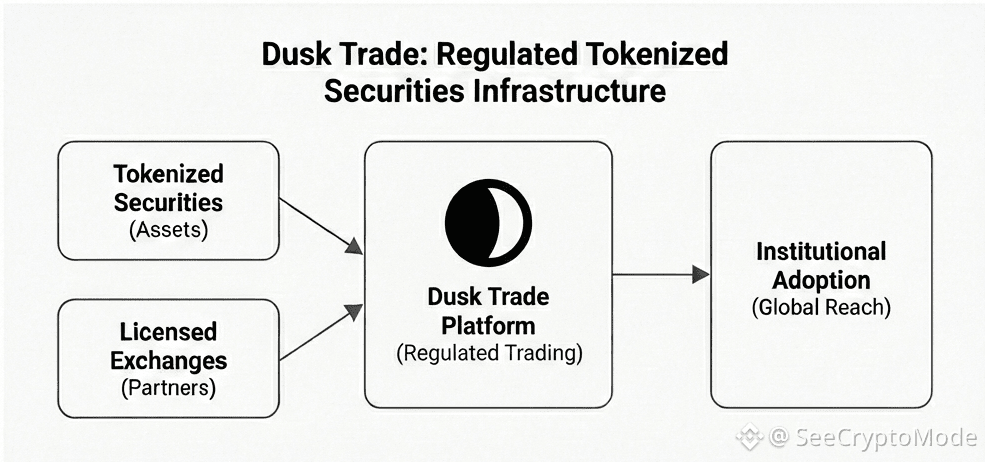
Without compliant trading venues, licensed exchange partnerships, audit-ready processes, and institutional grade execution layers, tokenization remains a concept not a market. This is exactly why platforms like Dusk Trade are drawing attention: they are not simply building token rails; they are building regulated trading infrastructure designed specifically for tokenized securities, in partnership with licensed exchanges.
This is the difference between experimentation and adoption. Between pilots and pipelines. Between retail curiosity and institutional participation.
Let’s unpack why regulated infrastructure is the real unlock for tokenized securities and why this layer will determine which projects actually scale.
Tokenization Is Not the Finish Line It’s the Starting Line
Over the past few years, “tokenization” has become one of the most frequently used terms in digital asset discussions. Real world assets, such as equities, bonds, funds, real estate, and commodities, are increasingly being represented as tokens on blockchain networks.
The benefits are widely understood:
Faster settlement
Programmable ownership
Fractional access
Automated compliance
Global distribution
Transparent audit trails
Reduced intermediaries
But tokenizing an asset is only step one.
A tokenized security without a regulated marketplace is like a stock certificate without an exchange. It exists but it cannot function efficiently in a capital market.
Institutional investors don’t just need tokenized assets. They need:
Regulated trading venues
Recognized counterparties
Compliance enforcement
Legal clarity
Custody frameworks
Settlement guarantees
This is where most tokenization narratives fall short and where regulated platforms like Dusk Trade step in.
Why Institutions Cannot Trade on Unregulated Rails
Institutional capital operates under constraints that retail participants often underestimate. Pension funds, asset managers, regulated brokers, and financial institutions cannot simply move into new markets because the technology looks promising.
They must answer critical questions:
Is the venue regulated?
Is trading supervised?
Are counterparties verified?
Are disclosures standardized?
Is compliance enforced automatically?
Is the reporting regulator-ready?
Are investor protections embedded?
If the answer is no, participation is blocked.
This is not hesitation. This is a fiduciary responsibility.
For tokenized securities to move beyond niche adoption, they must trade on platforms that mirror or improve the safeguards of traditional exchanges. That is the design philosophy behind regulated token trading platforms such as Dusk Trade, built in partnership with licensed exchanges rather than in isolation.
That partnership model matters. It bridges innovation with legality instead of trying to bypass it.
The Infrastructure Gap Most People Ignore
Much of crypto discussion focuses on asset creation and protocol innovation. Far less attention is given to market structure infrastructure yet that is where institutional adoption is won or lost.
Market structure includes:
Order matching systems
Market surveillance
Trade reporting
Compliance screening
Settlement finality
Dispute resolution
Audit trails
Access controls
Traditional exchanges invested decades building this. Token markets must do the same, but with modern architecture.
Without this layer:
Liquidity remains fragmented
Institutions stay sidelined
Regulators push back
Risk premiums stay high.
Regulated token trading platforms close this infrastructure gap. They make tokenized securities tradable in environments that institutions can legally access.
This is not cosmetic compliance; it is functional compliance.
Why Partnership With Licensed Exchanges Changes Everything
There is a massive difference between a platform that claims regulatory friendliness and a platform built with licensed exchange partners.
Licensed exchanges bring:
Regulatory approval pathways
Operational standards
Market surveillance expertise
Investor protection frameworks
Established reporting systems
Legal enforceability
When tokenized security platforms integrate with licensed exchange partners, they inherit structural credibility. They align with the existing financial system instead of fighting it.
This partnership approach accelerates:
Approval cycles
Institutional onboarding
Asset issuer confidence
Broker participation
Custodian integration
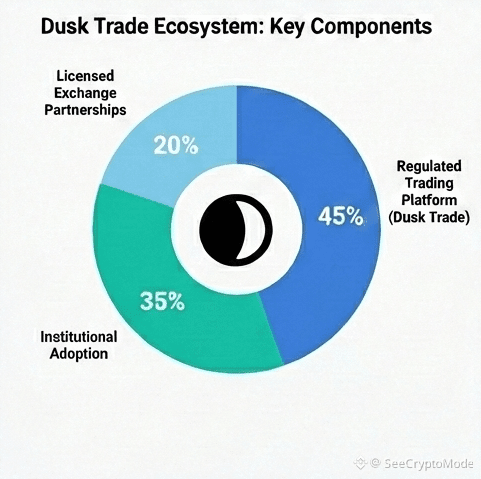
#dusk Trade’s positioning around regulated trading infrastructure built alongside licensed exchange frameworks signals exactly this kind of alignment-first strategy.
It’s not about replacing markets.
It’s about upgrading them.
Compliance by Design Not Compliance by Patch
One of the biggest mistakes early blockchain projects made was treating compliance as an add-on. A layer applied later. A filter bolted on after launch.
Institutional systems don’t work that way.
Compliance must be embedded at the architecture level:
Identity-aware trading
Rule-based transfer restrictions
Jurisdiction filters
Investor qualification checks
Automated reporting
Policy driven settlement
Tokenized securities require programmable compliance rules enforced at the transaction layer, not just at the user interface.
This is where specialized security token infrastructure differs from general-purpose chains. Regulated trading platforms are designed with compliance logic integrated into execution flows.
That dramatically reduces:
Operational risk
Legal ambiguity
Regulatory friction
Post-trade violations
Markets scale when rules are enforced by design, not by exception.
Liquidity Needs Legal Confidence
Liquidity is not just about buyers and sellers. It is about confidence.
Institutional liquidity providers ask:
Are trades enforceable?
Are the records admissible?
Are counterparties verified?
Are disputes resolvable?
Are the rules standardized?
If legal confidence is weak, spreads widen, and participation drops.
Tokenized securities often promise liquidity improvements but without regulated venues, liquidity providers hesitate. Regulated infrastructure creates the legal confidence layer required for serious market making.
This is how spreads tighten.
This is how volume grows.
This is how markets mature
Settlement Efficiency Is Only Valuable If It’s Recognized
One of the strongest advantages of tokenized securities is faster settlement potentially near instant finality compared to traditional T+2 cycles.
But faster settlement only matters if institutions can recognize and rely on it legally.
Regulated platforms make token settlement:
Legally recognized
Operationally integrated
Accounting compatible
Custody aligned
Without that, fast settlement is technically impressive but commercially underutilized.
Infrastructure turns speed into usable efficiency.
The Convergence of Traditional Finance and OnChain Markets
We are entering a convergence phase, not a replacement phase.
Traditional finance is not disappearing. It is digitizing. Tokenizing. Automating. Integrating.
The winning platforms will be those that connect:
On-chain efficiency
Offchain legality
Digital execution
Regulatory recognition
Regulated token trading platforms serve as convergence bridges.
They allow:
Traditional issuers to tokenize
Institutions for trade
Regulators to supervise
Investors to access
Markets to function
This is not disruption by destruction. It is disruption by integration.
Why This Model Attracts Serious Issuers
Asset issuer companies, funds, and structured product creators will not tokenize securities unless distribution and trading are credible.
They need:
Regulated distribution channels
Recognized trading venues
Compliant investor onboarding
Standardized disclosure frameworks
When infrastructure like $DUSK Trade provides a regulated marketplace environment, issuers gain confidence that tokenization will lead to real investor access, not stranded digital instruments.
Issuance follows infrastructure. Always.
Market Evolution Follows Infrastructure, Not Hype
Every financial innovation follows the same pattern:
Concept appears
Experiments launch
Failures occur
Infrastructure develops
Regulation integrates
Institutions adopt
Markets scale
We are moving from phase 3 to phase 4 in tokenized securities.
The conversation is shifting from:
“What can we tokenize?”
to
“Where can we trade this compliantly?”
That shift marks maturity.
Professional Capital Watches Infrastructure First
Retail markets often chase narratives. Professional capital studies infrastructure.
Infrastructure answers:
Can this scale?
Can this survive regulation?
Can this support volume?
Can this manage risk?
Can this be integrated legally?
Regulated token trading platforms check these boxes. That is why they attract institutional attention even when retail conversations are quiet.
Smart money follows rails, not noise.
Risk Reduction Is the Real Adoption Catalyst
Institutional adoption rarely comes from upside alone. It comes from downside control.
Regulated infrastructure reduces:
Counterparty risk
Compliance risk
Operational risk
Legal risk
Settlement risk
When risk drops below the threshold, participation begins.
This is the real unlock. $DUSK

Final Perspective: Regulated Infrastructure Is the True Engine of Tokenized Securities
Tokenized securities are not a technology trend they are a market structure upgrade. But upgrades only deploy when infrastructure supports them.
Regulated trading platforms are the support layer.
They transform tokenization from:
A technical possibility
intoA tradable reality
From:
A pilot
intoA marketplace
From:
A narrative
intoA system
Platforms like Dusk Trade, built with licensed exchange partnerships and compliance-first architecture, represent the kind of infrastructure that enables institutional participation rather than merely inviting it.
The future of tokenized securities will not be decided by who tokenizes the most assets. #dusk
It will be decided by who builds the most trusted markets for them to trade. @Dusk