
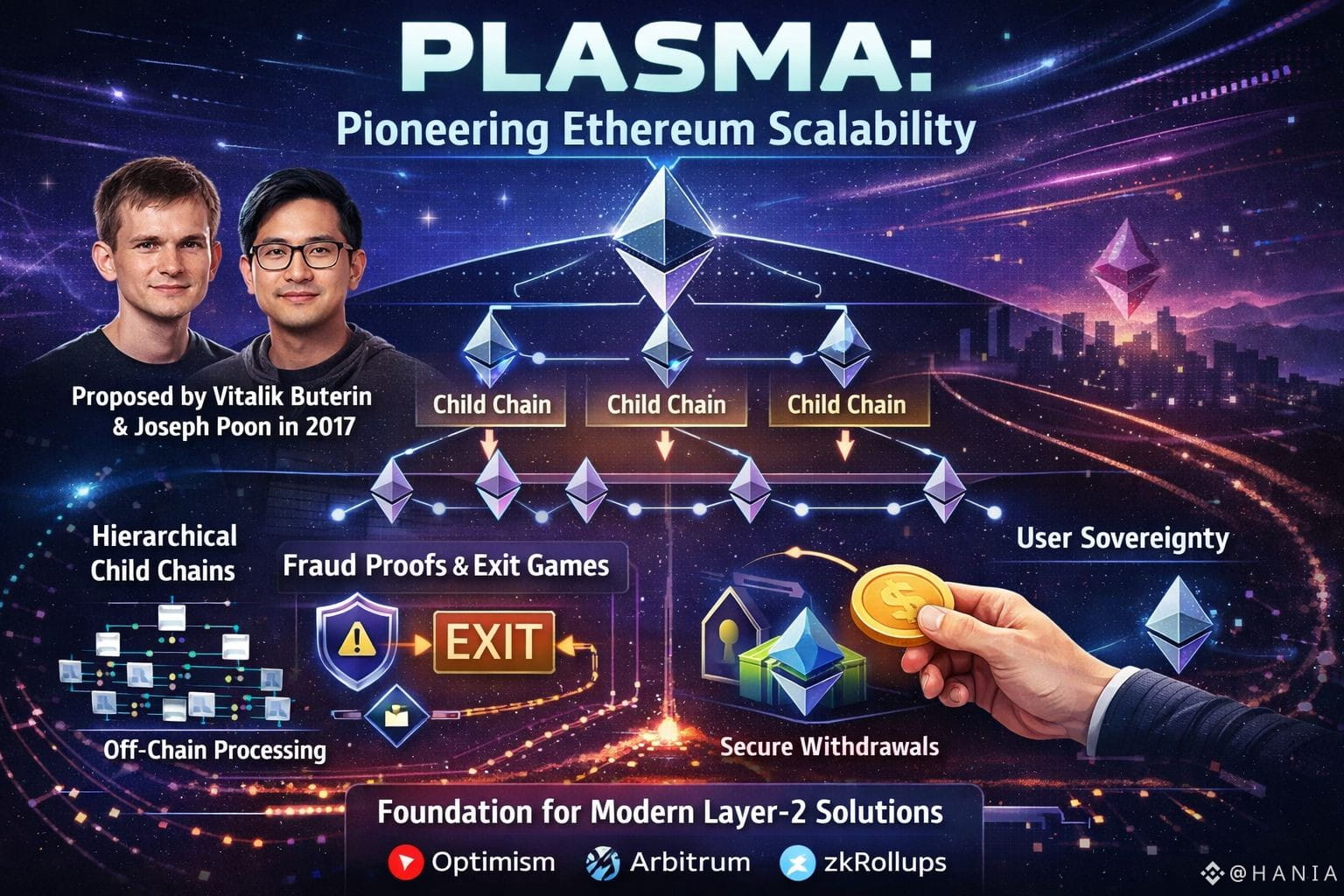
 Before rollups became the dominant narrative in Ethereum scaling, Plasma stood as one of the ecosystem’s most ambitious ideas. Proposed in 2017 by Vitalik Buterin and Joseph Poon, Plasma was not just a technical solution—it was a conceptual leap. It introduced a framework for building scalable blockchain systems while preserving Ethereum’s core promise: decentralized security anchored to a robust base layer.
At its heart, Plasma was designed to solve a fundamental limitation of early blockchains—throughput. Ethereum’s base layer, while highly secure, was never intended to process thousands of transactions per second. Plasma addressed this by introducing child chains, separate blockchains that operate independently but periodically commit their state back to Ethereum. This architecture allowed computation and storage to move off-chain while Ethereum remained the ultimate court of arbitration.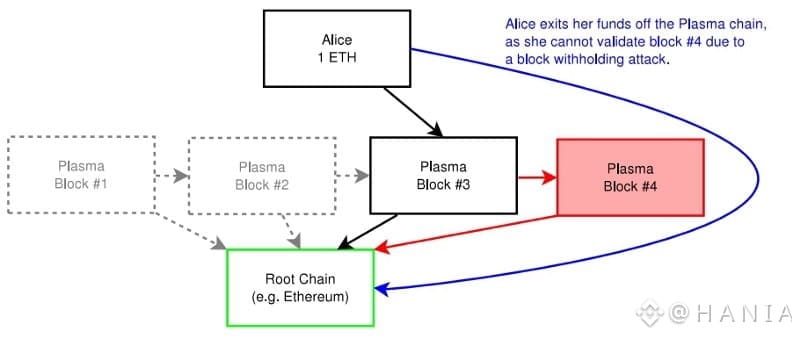
Child Chains and Hierarchical Scaling
One of Plasma’s most powerful ideas was hierarchical scaling. Instead of a single off-chain environment, Plasma chains could spawn additional child chains, forming a tree-like structure. Each child chain inherited security from its parent, while Ethereum sat at the root. This design allowed theoretically massive scalability without congesting the main network.
Transactions on Plasma chains were fast and inexpensive because they did not require immediate validation on Ethereum. Only cryptographic commitments—Merkle roots representing batches of transactions—were submitted to the main chain. This reduced on-chain data requirements dramatically, a concept that would later become foundational to rollups.
Fraud Proofs: A Lasting Contribution
Perhaps Plasma’s most enduring contribution is the introduction of fraud proofs. Plasma assumed that operators might behave dishonestly, so it empowered users to challenge invalid state transitions. If a malicious transaction was detected, users could submit proof to Ethereum and trigger penalties or chain exits.
This “optimistic” assumption—that activity is valid unless proven otherwise—was revolutionary at the time. Today, fraud proofs are a cornerstone of Optimistic Rollups, demonstrating how Plasma’s ideas continue to shape modern Layer-2 systems.
Exit Games and User Sovereignty
Plasma placed strong emphasis on user custody and safety. Users retained the ability to exit a Plasma chain back to Ethereum at any time by presenting cryptographic proof of ownership. These mechanisms, known as exit games, ensured that users were never fully dependent on the honesty or uptime of Plasma operators.
While exit games were complex and sometimes slow, they represented a serious attempt to solve one of blockchain’s hardest problems: how to allow off-chain scaling without sacrificing trustlessness. Plasma made it clear that scalability should never come at the cost of user sovereignty.
Limitations That Informed the Next Generation
Despite its groundbreaking design, Plasma faced real challenges. The complexity of exit games made user experience difficult. Data availability—ensuring users could always access transaction data—was another unresolved issue. Additionally, Plasma was better suited for payments and simple transfers than for general-purpose smart contracts.
However, these limitations were not failures. They became lessons. Rollups emerged by directly addressing Plasma’s weaknesses—improving data availability, simplifying exits, and enabling full smart contract support—while retaining its core principles.
Plasma’s Influence on Modern Scaling
Plasma’s true legacy lies in its influence. Concepts like off-chain execution, on-chain settlement, Merkle commitments, and fraud proofs all trace their roots back to Plasma research. Modern Layer-2 solutions such as Optimism, Arbitrum, and even zk-based systems build upon the same foundational insight: Ethereum should be the security layer, not the execution bottleneck.
In many ways, Plasma changed how developers think about blockchain architecture. It shifted the conversation from “How do we scale the base layer?” to “How do we build systems around it?” That shift now defines Ethereum’s roadmap.
A Vision Ahead of Its Time
Plasma may no longer be the headline scaling solution, but its importance cannot be overstated. It was a visionary framework that explored the boundaries of what decentralized systems could become. By daring to separate execution from security, Plasma paved the way for the modular blockchain .