

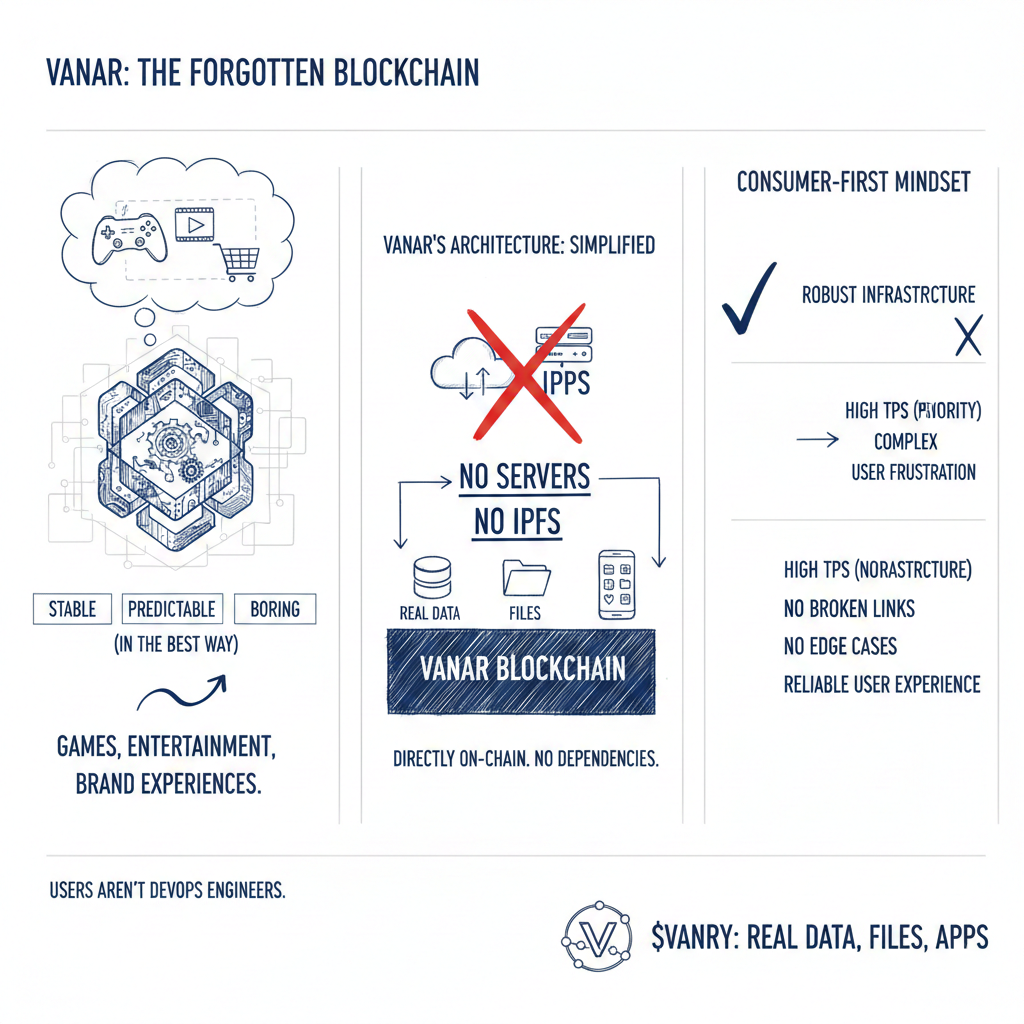
If I try to describe Vanar in a way that feels real (not “crypto brochure” real), I’d say it’s aiming to be the kind of blockchain you can forget you’re using. Not because it hides the chain, but because the chain is supposed to behave like normal infrastructure: stable, predictable, and boring in the best way—so games, entertainment apps, and brand experiences can sit on top without forcing users to become part-time DevOps engineers.
The little line that gives away their mindset is the “no servers, no IPFS” stance. Vanar isn’t just saying “we’re faster” or “we’re cheaper.” They’re basically saying: “we don’t want your app to be a Rube Goldberg machine of dependencies.” Their $VANRY page literally frames the vision as bringing “real data, files, and applications directly onto the blockchain” with “no servers” and “no IPFS.” That’s a very consumer-product way of thinking, because consumer products die from edge cases and broken links, not from slightly higher TPS.
Where it gets more interesting (and honestly, more opinionated) is Neutron. A lot of chains treat data like a suitcase tag: you don’t store the suitcase, you store a label that points to the suitcase somewhere else. Neutron is trying to turn the suitcase into something that can actually live in the system without becoming ridiculously heavy. Vanar describes Neutron as compressing something like 25MB down to around 50KB by using semantic + heuristic + algorithmic layers, and turning raw files into cryptographically verifiable “Neutron Seeds.” The part I like about that framing is it’s not “compression for cheap storage,” it’s “compression so the data can be used.” In other words: less “archive,” more “ingredient.” Like reducing a whole cookbook into a spice mix you can actually cook with.
Then Kayon feels like the grown-up layer people don’t talk about enough. “AI reasoning” can sound fluffy until you notice the language they emphasize: “Compliance by design,” “monitor rules across 47+ jurisdictions,” “automate reporting,” and “enforce compliance natively on-chain.” That’s not a meme-coin audience pitch—that’s a “please don’t get my company fined” pitch. If Vanar is serious about real-world adoption, that’s exactly the stuff that makes brands and enterprises breathe easier, because it turns “we’ll figure it out later” into “it’s built into the rails.”
I also appreciate that they’re not pretending an L1 by itself is an ecosystem. Their Kickstart program reads like Vanar admitting the truth: teams fail because they can’t stitch together wallets, KYC, audits, listings, data tooling, and distribution fast enough. Kickstart is basically a curated menu of partner services and perks to reduce that friction, framed as “tools, resources, and exclusive offers” to help projects launch faster. Even the examples on the page lean into “builder practicality” (AI tooling, game publishing support, etc.), which fits the whole “consumer-ready” angle.
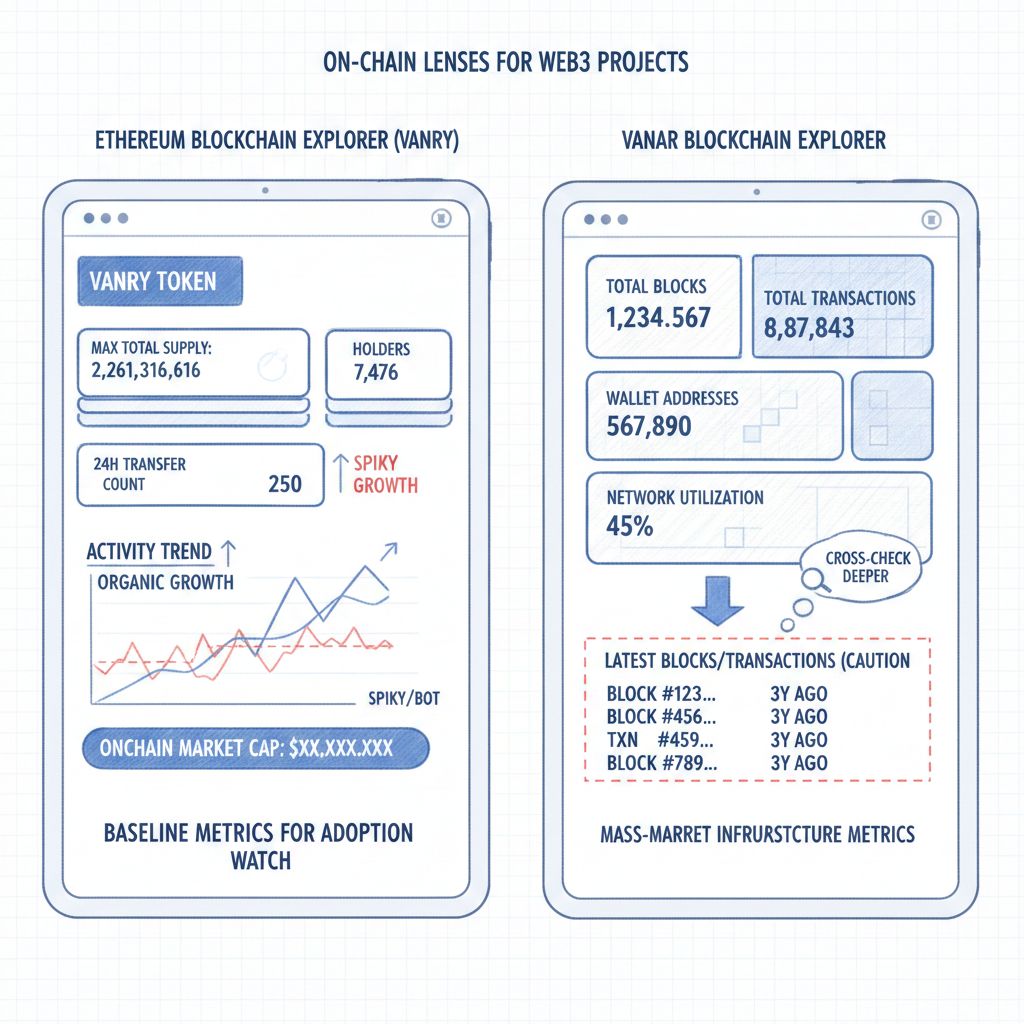
On-chain, there are two simple lenses worth using if you want something more grounded than vibes. First, the Ethereum-side token page: Etherscan shows VANRY’s max total supply (2,261,316,616), holders (7,476), and a 24h transfer count (250), plus an onchain market cap figure on that page. None of those numbers “prove adoption,” but they’re a baseline you can watch. If Vanar’s consumer-facing stack starts pulling real users through games and mainstream apps, you’d expect that holder/transfer activity to trend upward in a way that looks organic, not spiky.
Second, Vanar’s own explorer surfaces big-picture network stats—total blocks, total transactions, wallet addresses, and utilization. Those are exactly the kind of metrics you’d want to track for a chain positioning itself as mass-market infrastructure. At the same time, the explorer page also shows “latest blocks/transactions” with “3y ago” timestamps in the UI, so I’d treat the front-page “latest” feed cautiously until it’s cross-checked deeper in the explorer. (The totals can still be useful; I just wouldn’t build a narrative off the “latest” widget alone.)
Zooming out, the story that feels most coherent to me is this: Vanar is trying to make blockchain feel less like a special destination and more like a background utility—like electricity in a stadium. People don’t go to a concert because the power grid is amazing. They go because the show is great. Vanar’s bet is that if data can live on-chain in a more usable way (Neutron) and if the system can answer “are we allowed to do this?” in a way compliance teams can accept (Kayon) , then the “next 3 billion users” don’t need to be convinced by ideology. They just show up because the experience doesn’t punish them.
And that’s really the make-or-break test: not whether Vanar can sound different, but whether the products built on it feel smoother than the alternatives. If Neutron Seeds become a normal building block for apps (not a demo feature) , and if Kickstart actually reduces time-to-launch for teams , then VANRY stops being “the token of a chain” and starts acting like a meter for a platform people actually use.