
Imagine you are walking through a busy marketplace where everything feels natural. You tap to pay, you receive your item, you move on. Nobody stops to explain the plumbing under the floor. Nobody asks you to understand the wiring in the walls. It just works. That is the emotional destination Vanar is chasing, a blockchain that tries to disappear into the experience so ordinary people can participate without feeling like they have entered a technical maze.
Vanar was shaped by a very specific kind of pressure. Not the pressure of traders staring at charts, but the pressure of everyday users who hate friction. People who will abandon an app if it feels confusing, slow, or unpredictable. That kind of pressure changes what you build. It forces you to care about costs that stay stable, flows that feel intuitive, and performance that holds up when the crowd arrives. Vanar positions itself as an L1 built for real adoption, with a clear focus on mainstream verticals like games, entertainment, and brand driven experiences, and it runs on the VANRY token.
One of the most practical ideas in Vanar is also one of the most human ones. Predictability.
Many chains behave like a highway where the toll changes minute to minute. You can plan a trip, then suddenly discover the cost has doubled. That is not how normal consumer products behave, and it is not how businesses want to budget. Vanar leans into a fixed fee philosophy where the goal is to keep transaction costs stable and understandable. The deeper meaning is trust. People do not build habits on systems that surprise them. If Vanar can consistently deliver predictable costs at scale, it is not just offering cheap transactions. It is offering confidence, and confidence is the real bridge from curiosity to routine.
Now comes the more ambitious part of Vanar’s story, the direction it has been pushing recently. Vanar is no longer describing itself only as a chain that moves tokens efficiently. It is framing itself as an AI native infrastructure stack, with layers built around memory and reasoning. In simpler human terms, the vision is that on chain activity should not be blind. Systems should remember context, interpret information, and help automate decisions in a way that can be verified. That matters because the next era of apps is drifting toward agent like behavior. Not just apps that wait for a button press, but systems that can act, check, and adapt under clear rules.
This is where the idea becomes more than marketing if it is executed well. A lot of blockchain applications rely on off chain logic to read documents, interpret conditions, and decide what to do next. That off chain glue can work, but it is fragile and hard to audit. Vanar’s direction implies a different architecture where more intelligence can live closer to the network itself. If that becomes real in developer hands, it could reduce the distance between a real world event and a trustworthy on chain action. Not just a transaction, but a transaction that happens because the system understands enough context to act safely.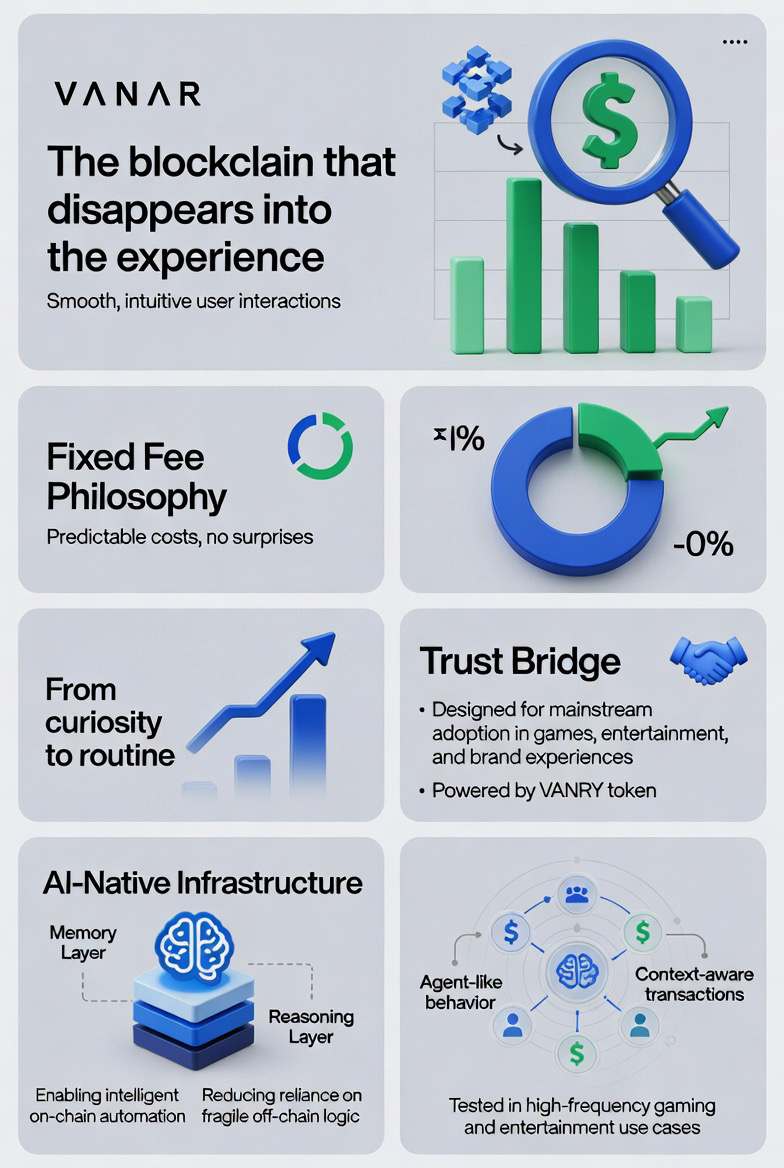
Vanar’s consumer roots still matter here. Gaming and entertainment are not side quests.
They are training grounds. They force smoothness. They force speed. They force the kind of user experience discipline that makes everything else easier later. A chain that can support high frequency user actions without psychological pain is better prepared for payments, loyalty systems, and other mass use cases. It is one thing to run a network in ideal conditions. It is another thing to keep it calm while thousands of ordinary people click at once and expect the result to feel instant and fair.
The VANRY token sits at the center of this. In the healthiest version of the story, VANRY becomes less like a mascot and more like fuel. Something necessary, consistent, and quietly reliable. The paradox of mainstream adoption is that the best infrastructure becomes emotionally invisible. People do not fall in love with the concept of gas fees. They fall in love with experiences that do not interrupt their day. If Vanar can keep the experience smooth, VANRY benefits not because of hype, but because it is the unit that powers real usage.
The real test ahead is coherence.
Vanar is aiming for a wide bridge, connecting consumer experiences, brand use cases, intelligent automation, and future payment style flows. That can become powerful if the pieces reinforce each other. It can also become noisy if everything is promised at once but nothing feels sharper than the rest. The winning move would be to make the stack feel like a single story you can touch. Not a list of features, but a simple feeling developers and users can recognize. It is cheaper and predictable. It is easy to build on. It supports intelligent workflows. It stays stable when people actually show up.
If Vanar succeeds, the outcome may look almost boring from the outside, and that would be the point. A person plays a game and never has to learn the word blockchain. A fan collects a digital item and never worries about whether the fee will spike. A brand runs a campaign and can predict costs like any normal digital platform. A system triggers an action because the rules are understood and verifiable, not because someone manually babysat the process. The chain becomes less like a stage and more like a sidewalk.
That is the bet. Not to impress the room with complexity, but to make Web3 feel ordinary enough that billions of people can walk into it without realizing they have crossed a frontier.
