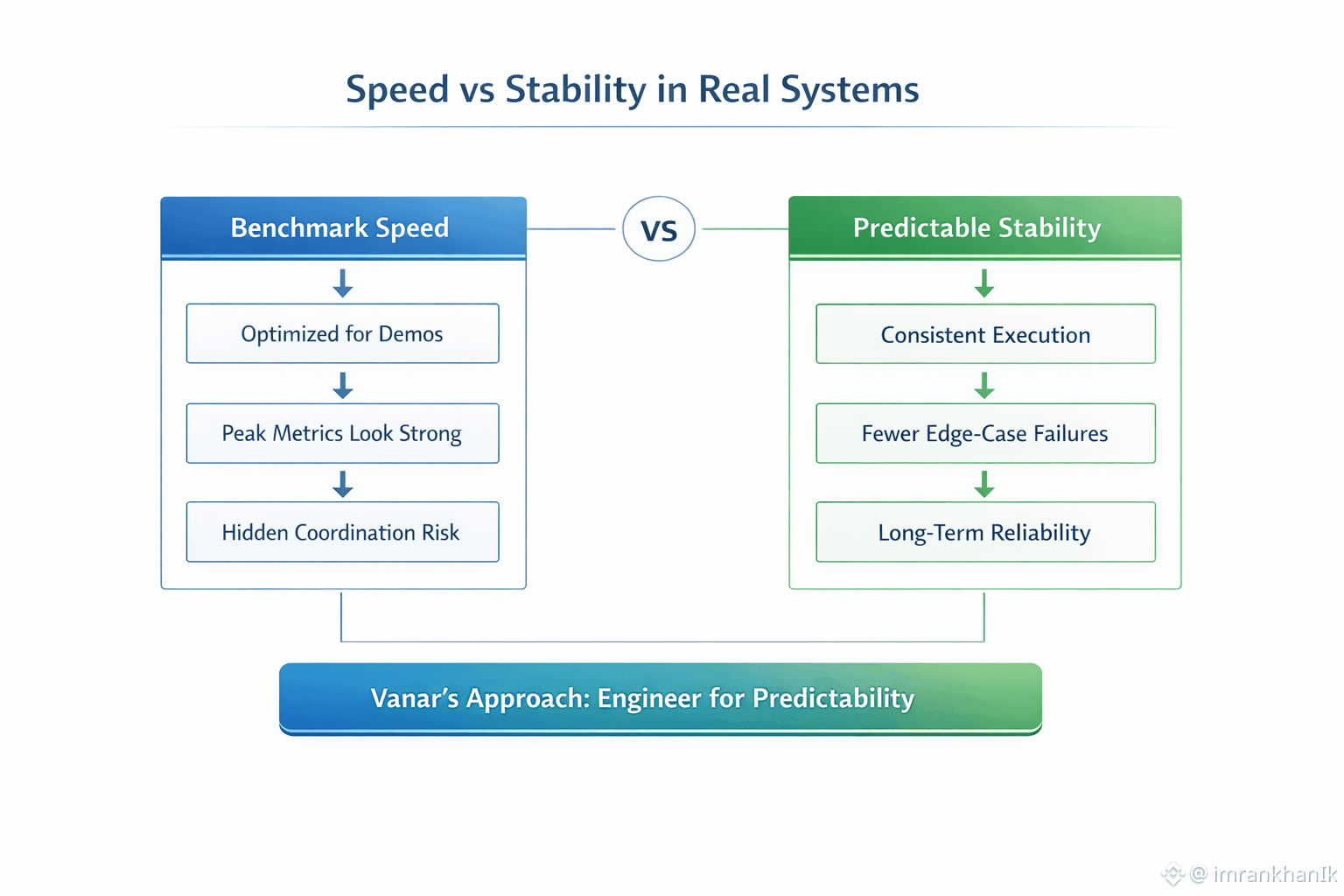
Everyone in crypto talks about speed.
Higher TPS. Faster finality. Lower latency. Bigger numbers every quarter.
And to be fair, I get it. Speed is easy to understand. It looks good on charts. It makes comparisons simple. If something is faster, it must be better at least that’s the surface logic.
But lately I’ve been thinking about something else.
What actually happens after the benchmark tweet fades?
What happens when real people rely on that speed every single day not in a clean demo environment, but in messy, unpredictable conditions where traffic spikes at the wrong time and integrations don’t behave perfectly?
That’s where Vanar Chain started to feel interesting to me.
From the outside, speed feels like progress. It’s visible. It’s measurable. You can point to it. But from a systems perspective, speed is often the easiest thing to optimize early on and the hardest thing to maintain responsibly as complexity grows.
In controlled environments, performance improves quickly. You tighten execution paths. You reduce redundancy. You assume ideal validator behavior. The metrics look sharp.
Real environments don’t cooperate like that.
Users don’t behave predictably. Traffic doesn’t scale smoothly. External services fail halfway through processes they weren’t supposed to fail in. Integrations introduce edge cases nobody anticipated.
Under those conditions, raw throughput becomes less important than something far less glamorous: consistency.
The real test isn’t how fast a system moves when everything goes right.
It’s how it behaves when assumptions quietly start breaking.
That’s where Vanar’s architectural direction stands out. It doesn’t seem obsessed with headline speed. Instead, it leans toward predictability especially in areas like interactive applications, gaming assets, stablecoin transfers, and AI-driven workflows.
Those workloads aren’t just “transactions.” They’re coordination problems.
In interactive environments, one action can trigger thousands of dependent updates. AI processes add conditional logic. Stablecoin flows add financial sensitivity. Timing irregularities that seem minor in isolation can multiply under pressure.
In my experience, distributed systems rarely fail because they weren’t fast enough.
They fail because coordination becomes brittle.
And brittleness almost always traces back to early shortcuts.
An optimization made to boost early performance metrics can quietly shape the system for years. It becomes embedded in tooling, validator incentives, developer assumptions. Later, changing it isn’t just technical it becomes social, economic, ecosystem-wide.
That cost compounds.
There are usually two paths infrastructure takes.
One path starts broad. Be flexible. Support everything. Adapt as new use cases appear. Over time, layers accumulate. Abstractions grow. Complexity becomes reactive.
The other path defines its operating environment early. Narrow the assumptions. Engineer deeply within those constraints. Accept that not everything will fit perfectly, but ensure what does fit behaves predictably under stress.
Vanar feels closer to that second approach.
By aligning around interactive digital environments and AI-supported workflows, it narrows its scope. And narrowing scope reduces ambiguity.
Ambiguity is where fragility hides.
Designing for stability isn’t about being conservative. It’s about being disciplined. It means accepting that you might not win every benchmark comparison. It means some experimental features move slower. But it also means fewer subtle inconsistencies creeping in as usage grows.
In distributed systems, fragility doesn’t usually show up as dramatic collapse. It shows up quietly rare synchronization issues, odd state mismatches, edge cases that only appear under load. Each one manageable. Together, exhausting.
As those issues grow, maintenance starts consuming innovation. Teams spend more time stabilizing than building.
Markets reward visible acceleration.
Engineering rewards systems that stay coherent when stressed.
Those timelines rarely match.
If Vanar’s emphasis on predictability continues to hold as more complexity piles on more integrations, more developers, more real-world use then that architectural choice will matter more than any isolated speed metric ever could.
Because in the long run, the question isn’t whether a chain can move fast.
It’s whether, as real usage compounds, it becomes more fragile.. or more stable.
That’s the question that decides whether infrastructure lasts.