

Everyone celebrates scaling.Almost no one talks about what quietly breaks when scale arrives.That difference is where real infrastructure is defined.
In crypto, growth is treated like proof of strength. More users. More transactions. More integrations. If activity increases, the assumption is that the system is healthy. But after spending years around distributed systems, I’ve learned that growth and health are not the same thing.
Growth amplifies design decisions. Hygiene determines whether they survive.
When I say “hygiene,” I don’t mean surface-level polish. I mean the unglamorous parts of infrastructure: how state is reconciled under load, how failures are isolated, how retries are handled, how coordination behaves when timing assumptions drift. These details rarely make headlines. They don’t fit neatly into benchmark screenshots. But they determine whether a system scales cleanly or accumulates instability.
This is the part that often gets ignored in blockchain conversations.
Most discussions focus on speed, throughput, or composability. Those are important variables, but they describe capability under ideal conditions. They say little about what happens when thousands of real users behave unpredictably, when third-party integrations are imperfect, when an AI-driven workflow branches unexpectedly, or when interactive applications generate cascading state updates.
Scale is not just volume.
Scale is coordination under pressure.
That’s where Vanar becomes interesting to me.
Vanar doesn’t position itself purely around headline metrics. Instead, its architectural emphasis appears to be on predictable execution across interactive digital systems and AI-integrated processes. That choice signals a different priority. It suggests that consistency of behavior matters more than momentary acceleration.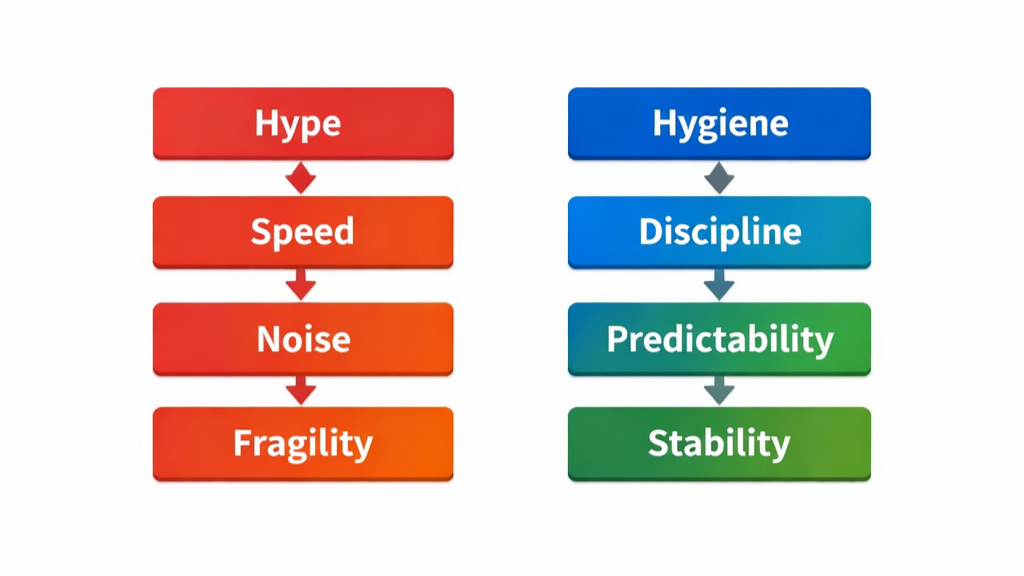
Interactive environments are structurally messy. A single event can trigger dependent updates across assets, logic, and external services. In AI workflows, execution paths are conditional and multi-step. Timing matters. Determinism matters. Retry logic matters. These are coordination-heavy workloads.
In those contexts, fragility doesn’t show up as a dramatic crash. It shows up as small mismatches. Slight delays in state propagation. Rare edge cases during peak activity. Individually manageable. Collectively expensive.
I’ve seen systems where early shortcuts taken to improve performance metrics quietly hardened into long-term constraints. Over time, they became embedded in tooling, developer assumptions, and validator behavior. Changing them later required migrations, compatibility layers, and ecosystem-wide coordination. The cost wasn’t just technical. It was organizational.
That’s why early architectural posture matters.
There are generally two paths infrastructure can take. One starts broad and flexible. Build something general-purpose. Adapt incrementally as new use cases appear. This preserves optionality, but complexity accumulates. Layers interact in ways no one fully predicted at launch.
The other path defines a primary operating environment early and engineers deeply within it. It accepts constraints in exchange for coherence. It may sacrifice some theoretical flexibility. But it reduces ambiguity.
And ambiguity is where fragility hides.
Vanar appears closer to that second model. By leaning into interactive digital systems and AI-supported workflows, it narrows its assumptions. That narrowing is not about limitation. It is about alignment. Design decisions can be evaluated against a consistent workload profile rather than an undefined future.
This does not eliminate tradeoffs. Designing for hygiene clean coordination, predictable execution, constrained failure domains can limit extreme benchmark claims. It can slow certain experimental optimizations. It requires architectural discipline.
But hygiene compounds.
When retry logic is clear, developers build faster. When state behavior is predictable, integrations are less brittle. When failure domains are constrained, incidents are isolated rather than systemic. Over time, the system spends less energy defending itself and more energy enabling growth.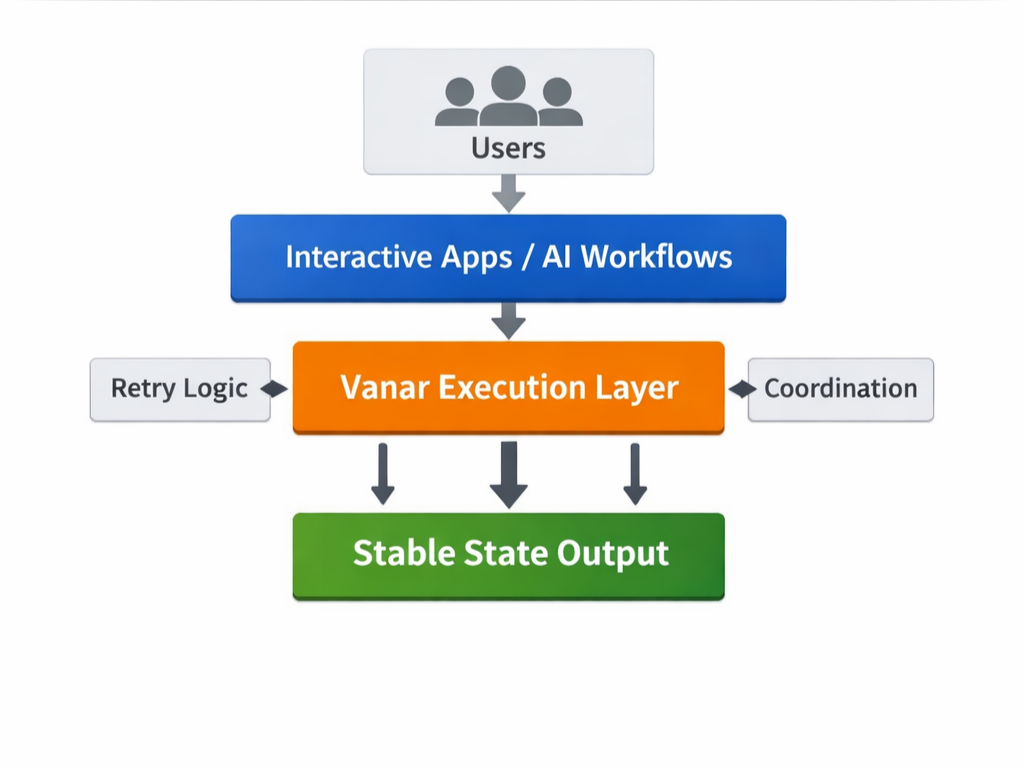
Markets often reward visible acceleration.
Engineering reality rewards coherence under stress.
The difference only becomes obvious after cycles turn and usage compounds.
For Vanar and the broader VANRY ecosystem forming around it the meaningful evaluation is not how fast it can move this quarter. It is whether its coordination model remains intact as interactive workloads grow more complex and AI integrations deepen.
Because in distributed systems, what scales is rarely the feature set.
What scales is the discipline beneath it.
The real question isn’t how quickly Vanar expands.
It’s whether its architectural hygiene still holds five years from now when complexity has doubled and ideal conditions are gone.
That question, more than any benchmark, determines what lasts.
#vanar $VANRY @Vanarchain