
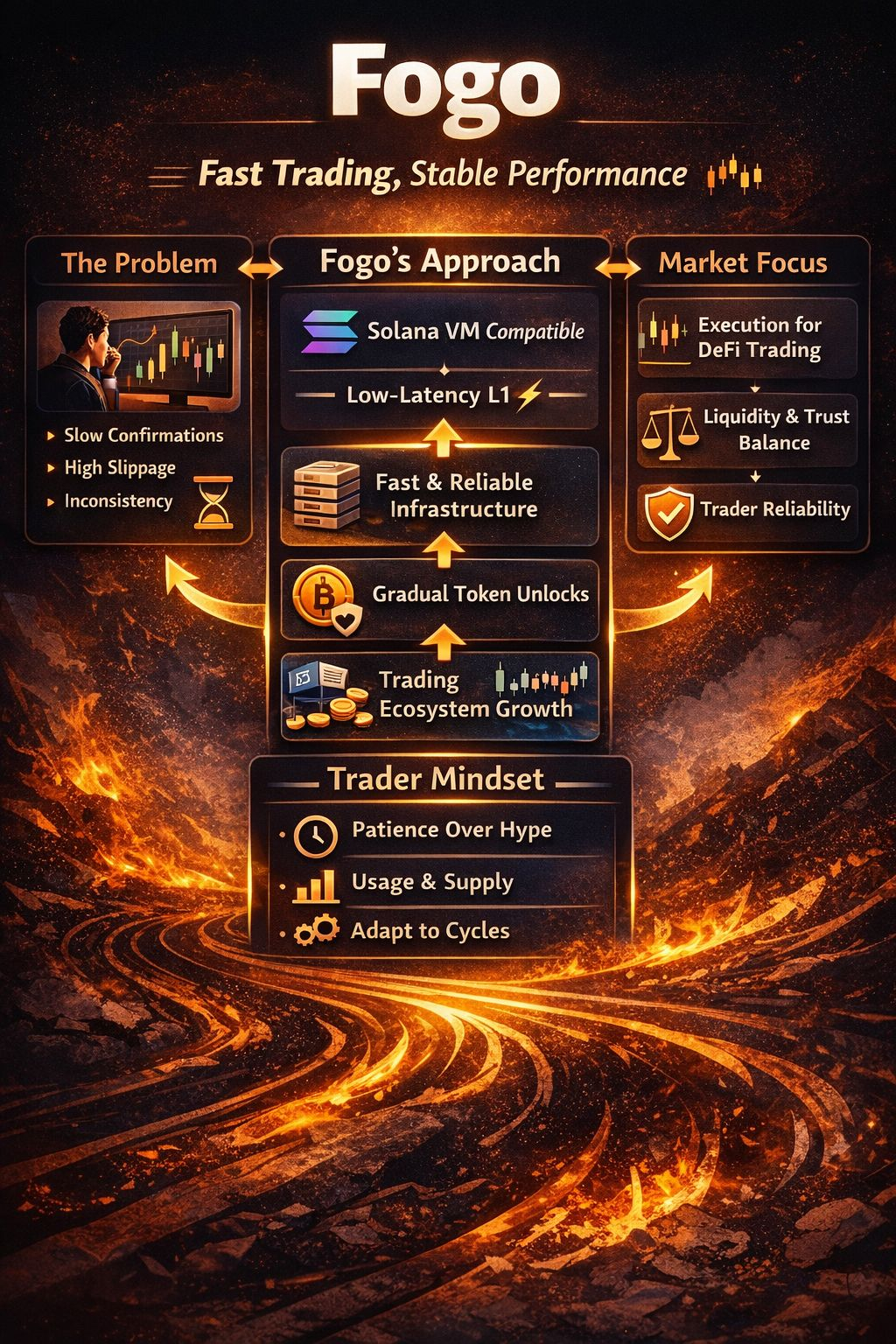
Every trader has felt that small moment of tension when placing an order on-chain. You see a price, you click, and then you wait. In that short gap, the market can move, fees can change, and what looked simple suddenly feels uncertain. Most people don’t describe it this way, but that delay creates emotional friction. It makes on-chain trading feel fragile. Fogo exists inside that gap. It is a high-performance Layer-1 built around the Solana Virtual Machine, and its goal is not abstract innovation. Its goal is to make execution feel steady, predictable, and closer to what traders expect from professional markets.
The real problem Fogo is addressing in this crypto cycle is not that blockchains are incapable. Crypto already proved it can run smart contracts and move value globally. The issue now is consistency under pressure. Modern DeFi is no longer just simple swaps. It includes leveraged trading, automated strategies, order books, and complex liquidity systems. These environments punish slow confirmation times and unpredictable latency. When a chain stutters during volatility, traders don’t see a technical explanation. They feel stress. They remember missed entries and bad fills. Over time, that memory pushes them back toward centralized platforms. Fogo’s design starts from a simple belief: if decentralized markets want to compete seriously, the base layer must stop feeling like a weak link.
From an infrastructure perspective, Fogo takes a pragmatic route. It uses the Solana Virtual Machine instead of inventing a new execution model. That decision may not sound glamorous, but it is practical. Developers already understand SVM tooling. Existing knowledge transfers. Migration becomes easier. In crypto, friction kills ecosystems more often than bad ideas do. By staying compatible with an established environment, Fogo lowers the barrier for builders while focusing its innovation on performance and network behavior. The chain is engineered for low-latency execution and high throughput, but more importantly, it aims for predictable performance during market spikes. Traders care less about peak speed and more about reliability when conditions get ugly.
Comparisons help explain Fogo’s position. Solana itself remains the closest reference: massive ecosystem gravity and strong performance history, but also periods where heavy demand exposes network stress. Ethereum and its Layer-2 landscape dominate capital and composability, yet latency and transaction costs still shape user experience, especially for active trading. Other modern high-performance chains chase speed with new architectures, but each introduces learning curves and ecosystem resets. Fogo’s angle is narrower and more focused. It is not trying to be everything for everyone. It is targeting the segment of DeFi where milliseconds change outcomes and where execution quality becomes a competitive feature.
Token design is where ideals meet market reality. Any performance chain still lives inside economic cycles. Supply schedules, unlock timing, and liquidity incentives influence price behavior more than slogans ever will. Fogo’s token structure reflects a staged approach where a large portion of supply unlocks gradually over years while a smaller portion circulates early to support ecosystem growth. For traders, this is not a moral issue. It is a mechanical one. Unlocks create supply pressure. Incentives create bursts of activity. Understanding that rhythm matters more than emotional reactions to charts. Every serious participant learns that price is a negotiation between narrative and schedule.
Ecosystem growth is often oversold in crypto marketing, but the foundations are usually simple. A chain becomes usable when its plumbing works. Reliable infrastructure, wallets that feel safe, indexing services that don’t break, and at least one credible trading venue matter more than flashy announcements. Fogo appears to be leaning into that infrastructure-first mindset. A trading-focused chain cannot rely on hype alone. It needs tools that builders trust and interfaces that don’t punish new users. When those invisible layers hold together, the user experience feels smooth. Most people never praise infrastructure. They only notice when it fails. Silence, in this case, is a good sign.
Market positioning is where narrative meets behavior. Fogo naturally sits in the “execution layer for on-chain trading” category. That story is powerful because it can be measured. Latency can be tested. Reliability can be observed during volatile sessions. Liquidity depth is visible on the screen. The challenge is not speed alone; it is attracting enough real activity to create self-sustaining markets. Liquidity follows confidence. Confidence follows repeated proof. If traders consistently experience cleaner execution and fewer surprises, word spreads quietly. If performance claims outpace real conditions, the market punishes exaggeration quickly. Crypto is unforgiving in that way.
Here is a contrarian thought that deserves attention. Faster chains do not automatically create fairer markets. When execution becomes extremely efficient, sophisticated players gain sharper advantages. Early ecosystems with shallow liquidity can become dominated by actors who understand microstructure better than everyone else. Retail traders may lose not because the chain is slow, but because it becomes ruthlessly efficient before protective tools mature. A high-performance network must grow alongside education, risk controls, and ecosystem balance. Otherwise speed turns into an amplifier for inequality. This tension exists in every advanced market. Ignoring it does not make it disappear.
Risks around Fogo are grounded and familiar. Performance-focused systems often rely on architectural trade-offs that raise questions about decentralization and validator structure. Bridging capital between chains always introduces external fragility. Early ecosystems can look active on social media while lacking deep liquidity resilience. Trust is fragile during the first serious stress event. One outage or structural failure can overshadow months of smooth operation. Traders remember pain longer than they remember promises. A chain built for execution must survive its worst days, not just its best benchmarks.
From a trader’s perspective, approaching a new performance chain requires emotional discipline. Admiration for technology should not automatically translate into oversized positions. Crypto cycles repeat patterns. First comes the excitement phase, where expectations move faster than fundamentals. Then comes the measurement phase, where real usage becomes visible through fees, activity, and retention. Finally comes the sorting phase, where the market decides whether the project becomes infrastructure or a temporary narrative. Patience matters. The best entries often appear after noise fades and behavior stabilizes.
A practical accumulation mindset focuses on conditions rather than predictions. Compression after hype, improving liquidity structure, and steady ecosystem growth are stronger signals than price spikes. Watching supply mechanics prevents emotional surprises. Unlock schedules are not secret weapons; they are public information that shape long-term behavior. Traders who respect these mechanics tend to survive cycles longer than those chasing momentum alone. This is not about pessimism. It is about respecting the rhythm of markets.
The realistic outlook for Fogo is balanced. It is aiming at a genuine need: making decentralized trading feel professional instead of experimental. Its compatibility with the Solana Virtual Machine gives it a pragmatic foundation. Its performance focus targets a segment of the market that truly cares about execution quality. Success would likely look quiet at first. Traders would simply start preferring it. Builders would ship without fighting infrastructure. Liquidity would grow because conditions reward staying. Failure, if it happens, would not be dramatic. It would look like insufficient traction, fragile liquidity, or trust cracks under pressure. Markets rarely collapse loudly; they fade when confidence leaves.
As a final reflection, performance chains live under a different kind of spotlight. They cannot hide behind storytelling. Traders judge them every day with real money. A beautiful roadmap does not matter if execution disappoints during volatility. Fogo’s future will not be decided by marketing cycles. It will be decided by how the chain behaves when the market is chaotic and emotions run high. Consistent performance in those moments earns loyalty in a way announcements never can. That is the standard professional markets demand, and it is the standard any execution-focused chain must meet if it wants to last.
