
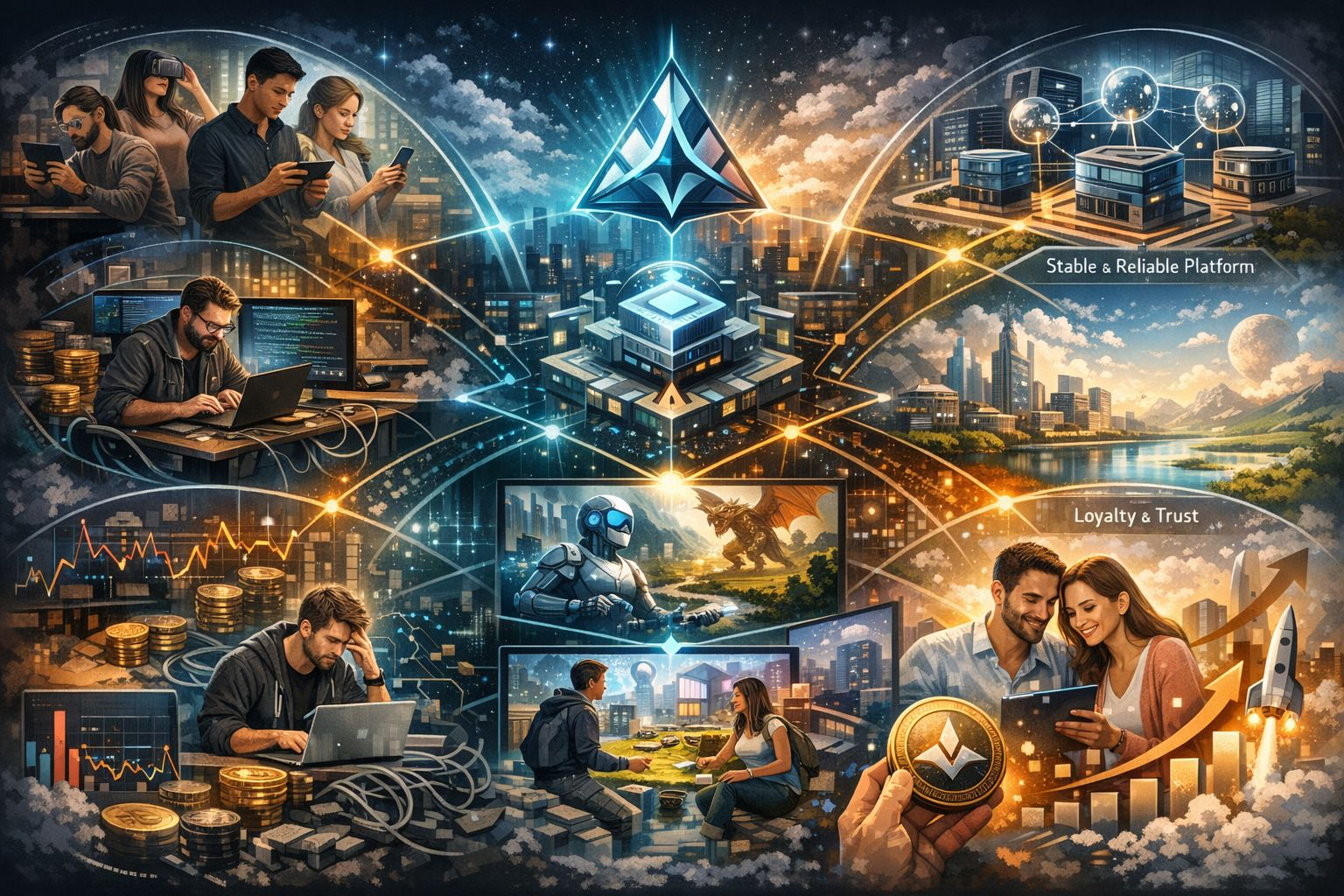
Most people don’t dream about blockchains. They dream about smooth apps, fun games, and digital experiences that just work. Crypto often forgets that. It celebrates complexity while everyday users quietly walk away the moment something feels confusing. When I look at Vanar, what stands out is not speed numbers or buzzwords. It’s the attempt to close that emotional gap between technology and comfort. Real adoption doesn’t start with excitement. It starts with trust. It starts with the moment a user clicks a button and nothing breaks.
This cycle has exposed a simple truth: crypto is powerful, but it’s exhausting. Users are tired of learning new wallets, new rules, new risks every time they try something. Developers are tired of patching together systems that were never designed for real consumer scale. The industry proved it can build advanced infrastructure. What it hasn’t fully solved is how to make that infrastructure invisible. Vanar is trying to answer that problem by focusing on environments where failure is not tolerated. Gaming, entertainment, and brand platforms don’t give second chances. If a transaction lags or an asset disappears, the user doesn’t blame the app. They blame the entire ecosystem. Vanar’s thesis is that mainstream adoption depends less on innovation and more on emotional reliability.
From an infrastructure perspective, Vanar is structured around the idea that the next wave of applications will mix blockchain with AI-driven logic. Instead of treating AI as a marketing layer, the chain is being shaped to support AI-native workloads from the base. That matters because future consumer apps won’t just move tokens. They will store memory, adapt to behavior, personalize experiences, and run intelligent systems that need stable execution. Vanar’s layered design suggests an attempt to keep those heavy tasks inside the ecosystem rather than constantly pushing them off-chain. For developers, that can reduce friction. For users, it can mean apps that feel consistent instead of fragile.
The human side of infrastructure is rarely discussed, but it’s everything. When a chain handles semantic data, memory, and reasoning more efficiently, what the user feels is not “advanced architecture.” What they feel is speed, stability, and predictability. They feel that the app remembers them. They feel that actions respond instantly. These are emotional signals. Technology becomes trusted when it behaves like something familiar. Vanar’s direction suggests an awareness that the future of Web3 is less about teaching people crypto and more about letting them forget they’re using it.
Token design sits quietly in the background, but it anchors the system. VANRY exists to power the everyday mechanics of the network: fees, staking, and participation. There is nothing flashy about that, and that’s a good sign. Sustainable ecosystems are built on tokens that serve a function, not just a narrative. When a token is tied to real activity, its value is connected to usage rather than pure speculation. For a consumer-focused chain, that alignment is important. It forces the project to care about actual engagement. Empty ecosystems can inflate prices temporarily. Lived-in ecosystems build slower, but they tend to last longer.
Ecosystem growth is where the story becomes more tangible. Products like Virtua Metaverse and the VGN games network aren’t abstract promises. They are attempts to place blockchain inside environments people already understand. Gaming is emotional territory. Players care about ownership, progression, and identity. If blockchain can support those feelings without adding friction, it becomes an invisible enhancement rather than a burden. That’s the direction Vanar appears to be aiming for: infrastructure that strengthens experiences instead of interrupting them.
Market positioning is complicated because Vanar operates in a crowded landscape. Every cycle produces chains that promise consumer adoption. Many fail not because their technology is weak, but because distribution is brutal. Users follow familiarity. Liquidity attracts developers. Large ecosystems have gravity. Vanar’s challenge is not just technical execution. It’s attention. To compete with established gaming and consumer chains, it has to deliver experiences that feel noticeably better, not just slightly different. Small-cap networks can move fast, but they live under constant pressure. Liquidity swings harder. Sentiment changes quicker. Patience becomes a survival skill.
Here’s the uncomfortable truth: consumer crypto is harder than DeFi. Traders forgive complexity if profits exist. Mainstream users do not. They measure value in seconds saved, frustration avoided, and trust preserved. That means Vanar is choosing the harder road. It is chasing users who don’t care about crypto narratives. They care about outcomes. This is both the risk and the opportunity. If the ecosystem succeeds, adoption could look quiet and steady rather than explosive. And that creates a contrarian tension. Markets often chase loud signals, but real growth sometimes arrives silently.
A contrarian insight worth considering is that success for a consumer chain might look boring from the outside. No sudden TVL spike. No dramatic speculation wave. Instead, slow accumulation of users who simply stay. In crypto culture, boring is mistaken for weakness. But in consumer technology, boring often means stable. If Vanar prioritizes reliability over spectacle, it may not win short-term headlines. It could win long-term loyalty. That tradeoff is easy to misunderstand in a market addicted to speed.
From a trader’s perspective, projects like this require emotional discipline. Small-cap tokens swing aggressively. Excitement can pull entries too high, and fear can force exits too low. When I look at networks focused on infrastructure and adoption, I try to separate narrative from timing. I watch how price reacts around long-term support zones. I watch whether volume returns after quiet periods. Strong ecosystems tend to show accumulation behavior before they show trend behavior. That doesn’t guarantee success. It simply reveals whether patient capital believes in the direction.
The risk side cannot be ignored. Execution risk is real. AI-focused architecture is complex, and complexity can slow delivery. Consumer ecosystems demand perfect uptime, strong documentation, and developer trust. One weak link can ripple across the experience. There is also narrative risk. AI is becoming crowded, and markets can blur distinctions between serious infrastructure work and superficial branding. If Vanar fails to communicate clearly, it risks being misunderstood. In crypto, perception moves capital as much as fundamentals.
Looking forward, the realistic expectation is not instant transformation. It is gradual proof. Each working product, each stable integration, each developer choosing to stay adds weight to the story. Chains that survive cycles are not the ones that shout the loudest. They are the ones that keep building when attention fades. If Vanar continues aligning infrastructure with real consumer needs, it positions itself inside a part of the market that still feels underdeveloped but inevitable. People will not adopt crypto because they understand it. They will adopt it because it feels normal.
As a final reflection from a trader’s lens, I’m less interested in whether a project promises the future and more interested in whether it respects the present. Networks that acknowledge friction, fear, and user hesitation are building for real humans, not idealized users. Vanar’s direction suggests an understanding that adoption is emotional before it is technical. The chains that succeed long-term will not be the ones that impress engineers alone. They will be the ones that quietly earn trust, one smooth interaction at a time.
