When I revisit Fogo after studying dozens of Layer 1 architectures this year, one thought keeps resurfacing:
This chain isn’t built for hype cycles
It’s built for market structure.
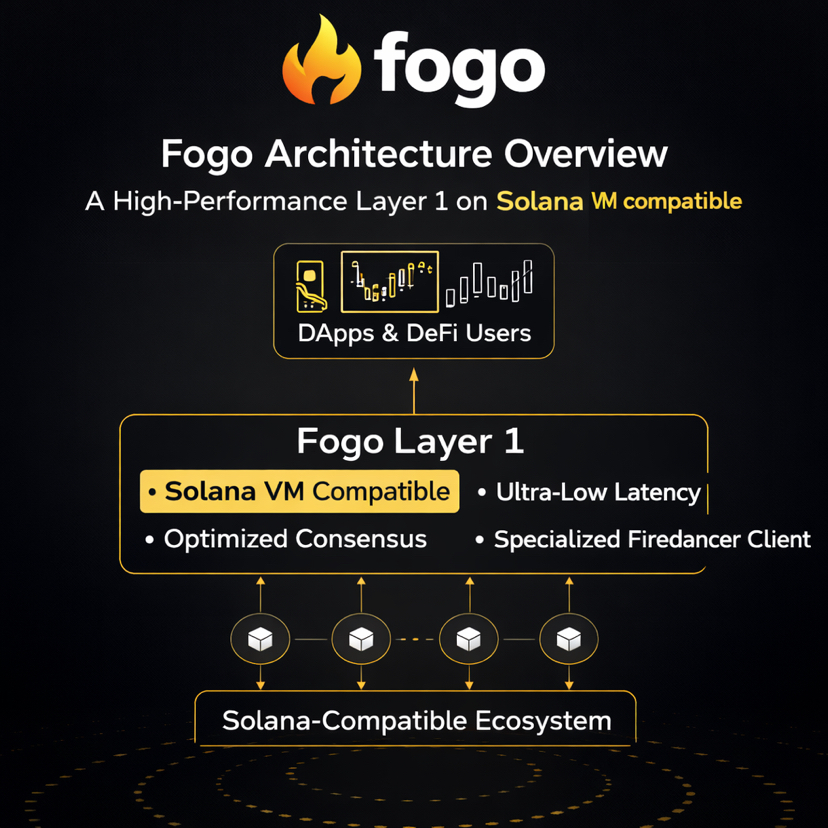
At first glance, Fogo looks familiar. It’s a high performance L1 running the Solana Virtual Machine. Developers get SVM tooling, portability, and a known execution environment.
But the deeper I went, the clearer it became execution isn’t the real story here.
Consensus is.
The Latency Problem Most Chains Ignore
Every chain claims to be fast
Very few explain why that speed should survive real market conditions
Latency isn’t just a software problem. It’s a physical one.
When validators are scattered across the globe, coordination delay becomes baked into finality. No amount of marketing can compress geography
Fogo doesn’t pretend otherwise.
Its multi-local consensus model narrows validator coordination into optimized zones. Validators are curated, performance-aligned, and designed for tight communication loops. The result is lower variance, faster finality, and predictable block production.
This isn’t maximal decentralization.
It’s deterministic infrastructures
And that tradeoff is intentional.
I respect that honesty. Too many projects promise perfect decentralization and ultra-low latency, as if physics can be negotiated.
SVM Compatibility Without Shared Congestion
Another design choice that stood out to me is separation.
Fogo runs the Solana Virtual Machine independently. That means:
Familiar execution for developers
Easy portability
No shared state
No inherited congestion from Solana mainnet.
Compatibility without dependency is rare.
lMost “aligned” chains quietly inherit the bottlenecks of the networks they attach to. Fogo isolates performance while preserving developer experience.
That’s not accidental. That’s positioning.
Who Is Fogo Actually Built For?
After analyzing the architecture, it’s clear what Fogo is not chasing.It’s not designed for meme cycles or retail speculation.
It feels engineered for:
Real-time derivatives
Auction-based liquidity systems
Latency-sensitive DeFi
Capital-intensive structured products
In these environments, predictability beats ideology.If DeFi evolves toward professional-grade market infrastructure, Fogo makes sense.If the space stays narrative driven, its strengths may go underappreciated.
How My Framework Changed
I used to judge Layer 1s by peak TPS.
Now I ask different questions:
How geographically concentrated are validators?
What happens to finality under sustained stress?
Is performance predictable — or only impressive on empty testnets?
Fogo is one of the few chains I’ve studied that feels designed around those questions from day one.
It’s not trying to win a popularity contest.
It’s trying to engineer an environment where markets don’t tolerate delay and don’t forgive unpredictability.
Whether that thesis wins or not, I respect one thing deeply:
Fogo isn’t pretending the world is smaller than it really is.