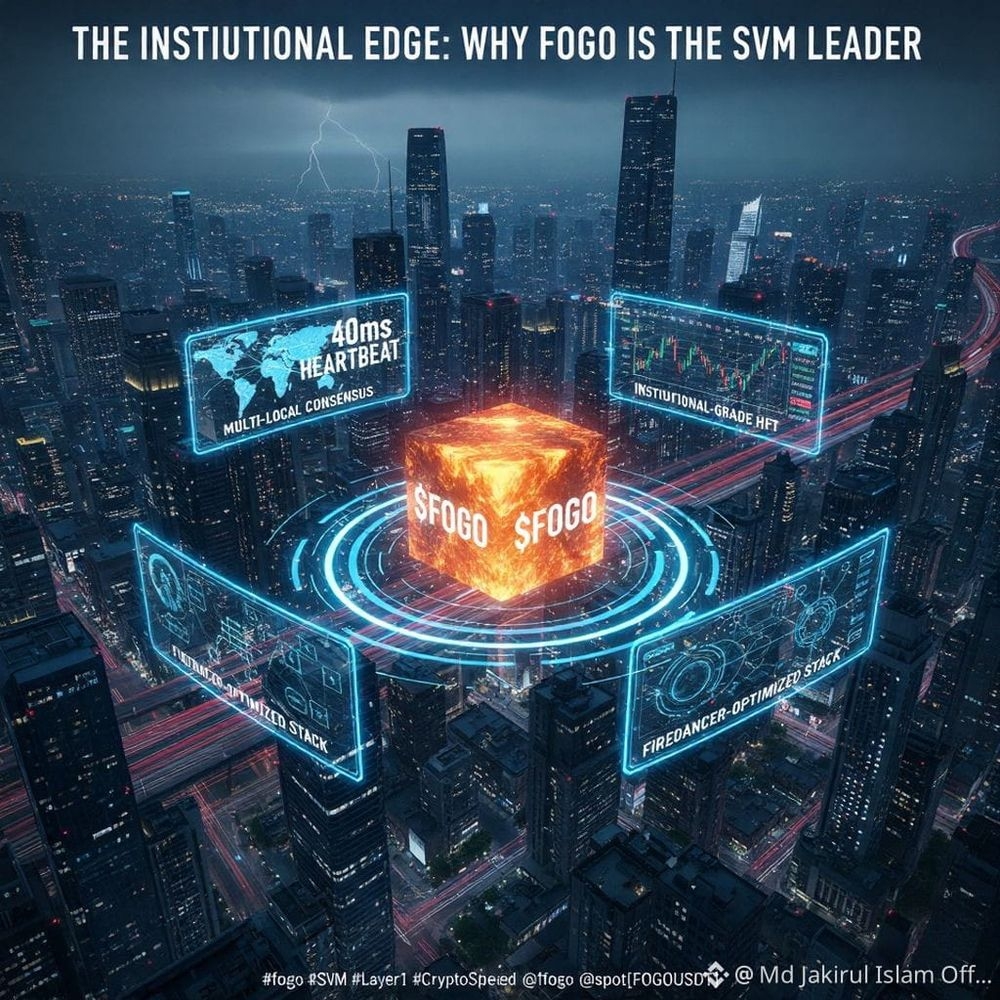
Fogo, I don’t start with throughput claims or token supply diagrams. I start with stress. I imagine blocks filling unevenly, validators operating on thin margins, and users interacting with the chain not as believers but as impatient actors trying to get something done. Fogo positions itself as a high-performance Layer 1 built around the Solana Virtual Machine, and that architectural choice alone tells me where the real analysis begins. It inherits a runtime model optimized for parallel execution and low-latency confirmation, but that performance profile comes with very specific economic and behavioral consequences.
The Solana Virtual Machine framework emphasizes explicit account access and deterministic execution. That shapes how developers design applications. It pushes them to think carefully about state layout and concurrency, because poorly structured programs won’t scale in practice. On a chain like Fogo, this is not a theoretical constraint. It shows up in how decentralized exchanges structure liquidity pools, how NFT mints are rate-limited, and how bots compete in blockspace auctions. If the runtime allows high throughput but the account model creates hotspots, real-world usage will expose it quickly. Congested accounts become silent choke points. Observing which contracts accumulate write locks and how often transactions fail under load would tell me more about the system’s maturity than any benchmark figure.
High performance at the base layer also shifts the psychology of users. When settlement feels near-instant, traders adapt their behavior. They refresh positions more aggressively. Arbitrage loops tighten. Liquidity providers adjust spreads more frequently because the feedback loop is shorter. That sounds efficient, but it changes the revenue profile of validators and the cost structure of users. If transaction fees are consistently low due to high capacity, the chain relies heavily on volume to sustain validator incentives. Volume is not a given. It is a product of real activity, and real activity is sensitive to friction elsewhere in the stack—wallet reliability, RPC stability, indexer performance. A high-throughput chain that suffers from unreliable access points will see traders revert to slower but more predictable environments.
What I pay attention to in early-stage L1s is not peak TPS, but how they behave during uneven demand. Sudden bursts—NFT launches, airdrop farming, liquidation cascades—reveal the true shape of the system. On a Solana-style runtime, prioritization fees and transaction scheduling become central. If Fogo adopts a fee market that allows users to pay for priority, the distribution of blockspace will reflect economic power more than egalitarian ideals. Bots with optimized infrastructure will consistently outbid retail users during volatile moments. That dynamic is not inherently bad; markets allocate scarce resources. But it does influence who extracts value and who absorbs slippage. Over time, that pattern affects where liquidity chooses to live.

Validator behavior is another quiet pressure point. High-performance chains demand serious hardware. Even if the official requirements are reasonable, competitive validators will over-provision to avoid missing blocks. That creates a subtle centralization vector. The more the network’s stability depends on well-capitalized operators with strong networking infrastructure, the narrower the validator set tends to become. I would watch stake concentration carefully. If the top validators accumulate disproportionate voting power, governance outcomes and software upgrade paths become less decentralized in practice, regardless of how many nodes are technically online.
Storage patterns matter more than most people admit. Fast chains encourage application developers to store more on-chain because it feels cheap. But state growth is cumulative. If Fogo allows generous account creation without meaningful rent or pruning mechanisms, the long-term storage burden increases. Validators must carry historical state, and archival nodes become expensive to operate. That doesn’t break the system overnight, but it gradually raises the barrier to entry. I’d want to see how account rent is structured, whether inactive accounts are reclaimed, and how snapshotting works in practice. These are unglamorous mechanics, yet they shape sustainability.
Token dynamics, if Fogo has a native asset for fees and staking, are tightly coupled to this infrastructure reality. In a low-fee, high-throughput environment, the token’s utility as gas depends on sustained transactional demand. If the majority of usage comes from incentive-driven activity—airdrops, short-term farming campaigns—then fee revenue will fluctuate sharply. Validators will feel that volatility first. If staking yields are supplemented heavily by emissions rather than organic fees, inflation becomes the primary incentive. That works temporarily, but it dilutes long-term holders unless real usage grows into the cost structure.
I often think about second-order effects. For example, if Fogo achieves consistent sub-second confirmations, market makers may tighten spreads on on-chain order books. Tighter spreads attract more volume, which increases fee flow and reinforces validator incentives. But the opposite can also occur. If latency is low but occasional performance hiccups cause transaction drops during high-stress events, professional traders will discount the reliability. They price in infrastructure risk. That widens spreads, not narrows them. Reliability under stress is more valuable than theoretical speed.
On-chain data would clarify much of this. I would look at transaction failure rates during volatile periods, average compute units consumed per transaction, and the distribution of fee payments across users. If a small cluster of addresses consistently pays the majority of priority fees, it suggests bot dominance. I would also examine validator skip rates and uptime statistics. In high-performance environments, missed blocks compound quickly into confidence issues. Market participants are sensitive to anything that resembles instability.
There’s also the question of developer ergonomics. The Solana Virtual Machine model is powerful but not trivial. Memory management, account serialization, and parallel execution constraints require discipline. If Fogo attracts serious developers who understand these patterns, applications will be efficient and robust. If it attracts teams chasing short-term incentives without deep runtime knowledge, we’ll see fragile contracts and frequent patches. Code quality directly impacts user trust. A single exploit in a high-velocity ecosystem can drain liquidity faster than governance can respond.

Another subtle dynamic involves MEV and transaction ordering. High throughput does not eliminate extractable value; it reshapes it. With faster blocks, arbitrage opportunities close more quickly, but they also occur more frequently. Validators or sophisticated relayers may capture this value if the protocol allows it. Whether that extraction is transparent or opaque influences trust. If users feel systematically disadvantaged by invisible ordering games, participation declines, even if the chain remains technically efficient.
What I find most interesting about infrastructure projects like Fogo is how architecture quietly nudges behavior. A chain that makes microtransactions economically viable encourages experimentation with granular pricing models—streaming payments, per-interaction fees, rapid settlement gaming mechanics. But those same features can enable spam if pricing is miscalibrated. Balancing openness with deterrence is not philosophical; it’s parameter tuning. Fee floors, compute limits, and congestion controls are levers that determine whether the network feels usable or chaotic.
Over time, the true test is mundane consistency. Are transactions confirmed when users expect them to be? Do validators remain profitable without extreme inflation? Does state growth remain manageable? Does liquidity deepen organically, without constant subsidy? These questions are not exciting, but they reveal whether the design holds up under real usage rather than curated demos.
When I step back from the architecture and think like a trader watching the order flow, I care about predictability. If I send a transaction, I want to know the likely confirmation time and cost. If I provide liquidity, I want to estimate risk without modeling erratic infrastructure behavior. A high-performance Layer 1 that consistently delivers that predictability earns trust slowly, through repetition. Not through headlines.
Fogo’s use of the Solana Virtual Machine sets a clear technical direction. The real story, though, will emerge in the unremarkable details: how fees accumulate across thousands of ordinary transactions, how validators respond to lean months, how developers structure state to avoid bottlenecks, how users adapt when speed becomes normal rather than novel. Those patterns, visible in block explorers and validator dashboards long before they appear in promotional material, are where the infrastructure either proves itself or quietly reveals its limits.