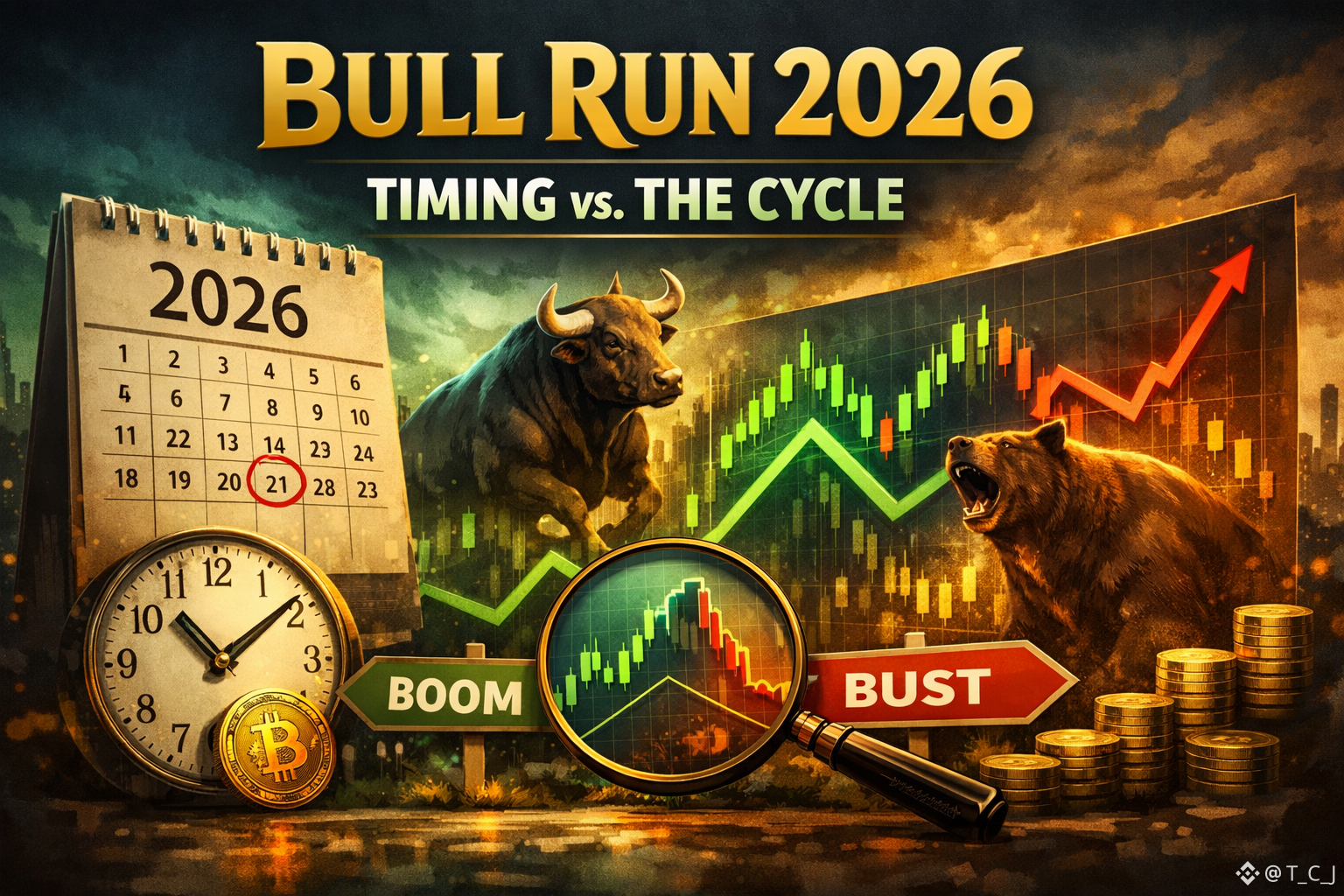
Every cycle, traders ask the same question: “When is the next bull run?”
And every cycle, the market answers in a way no one fully expects.
With 2026 being discussed more often lately, it’s worth slowing down and looking at what a so-called “bull run schedule” really means — and what it doesn’t.
Why 2026 Is Even on the Radar
Crypto didn’t invent cycles, but it exaggerates them.
Historically, Bitcoin has moved in roughly four-year cycles tied to the halving. After the halving shock, supply tightens, narratives return, liquidity flows in, and prices eventually accelerate. Then excess builds, leverage piles up, and the cycle resets.
The most recent halving happened in 2024. If history rhymes, 2025 tends to be expansion, and 2026 becomes a year where trends mature, slow down, or reverse.
That’s why traders talk about 2026 — not as a guaranteed bull year, but as a late-cycle year.
There Is No Calendar — Only Phases
One of the biggest mistakes beginners make is treating bull runs like fixed dates.
Markets don’t move because the calendar flips. They move because of liquidity, positioning, sentiment, and incentives.
A more realistic way to think about 2026 is by market phase, not price targets:
1. Early 2026: Momentum Hangover
If 2025 delivers strong upside, early 2026 often carries leftover momentum. Retail participation peaks, altcoin rotations get aggressive, and “easy money” narratives spread fast.
This is usually where risk feels lowest — and ironically, where it’s highest.
2. Mid 2026: Distribution Zone
Smart money doesn’t sell the top. It distributes into strength.
Sideways price action, sharp wicks, failed breakouts, and declining volume are common here. Fundamentals still sound bullish, but price stops responding the same way.
This phase confuses traders the most.
3. Late 2026: Reality Check
If history repeats, late-cycle exhaustion shows up. Leverage unwinds, weak projects disappear, and capital rotates back into safety. Not always a crash — but rarely euphoria.
This is where patience starts paying again.
What Experienced Traders Watch Instead of Dates
Veteran traders don’t rely on “bull run schedules.” They watch signals.
Some examples:
Liquidity conditions: Is global liquidity expanding or tightening?
Market structure: Are higher highs still clean, or getting sloppy?
Narrative fatigue: Are the same stories being recycled with less impact?
Altcoin behavior: Are rotations becoming shorter and more violent?
When these shift, the cycle is already changing — regardless of the year.
A Practical Mindset for 2026
Instead of asking “How high can we go in 2026?”, a better question is:
“Where am I in the risk curve?”
Late-cycle markets reward:
Scaling out instead of going all-in
Reducing leverage, not increasing it
Protecting capital over chasing the last 20%
There’s nothing wrong with staying bullish — but blind optimism is expensive.
Final Takeaway
The idea of a “Bull Run 2026 Schedule” is comforting, but misleading.
2026 isn’t a promise. It’s a probable phase — one where opportunity and risk sit closer together than most people realize.
The traders who survive cycles aren’t the ones who predict exact tops. They’re the ones who adapt when the market’s behavior changes.
In crypto, timing matters — but positioning and discipline matter more.
#CryptoMarket #BitcoinCycle #tradingmindset #Marketpsychology #Altcoin #RiskManagement