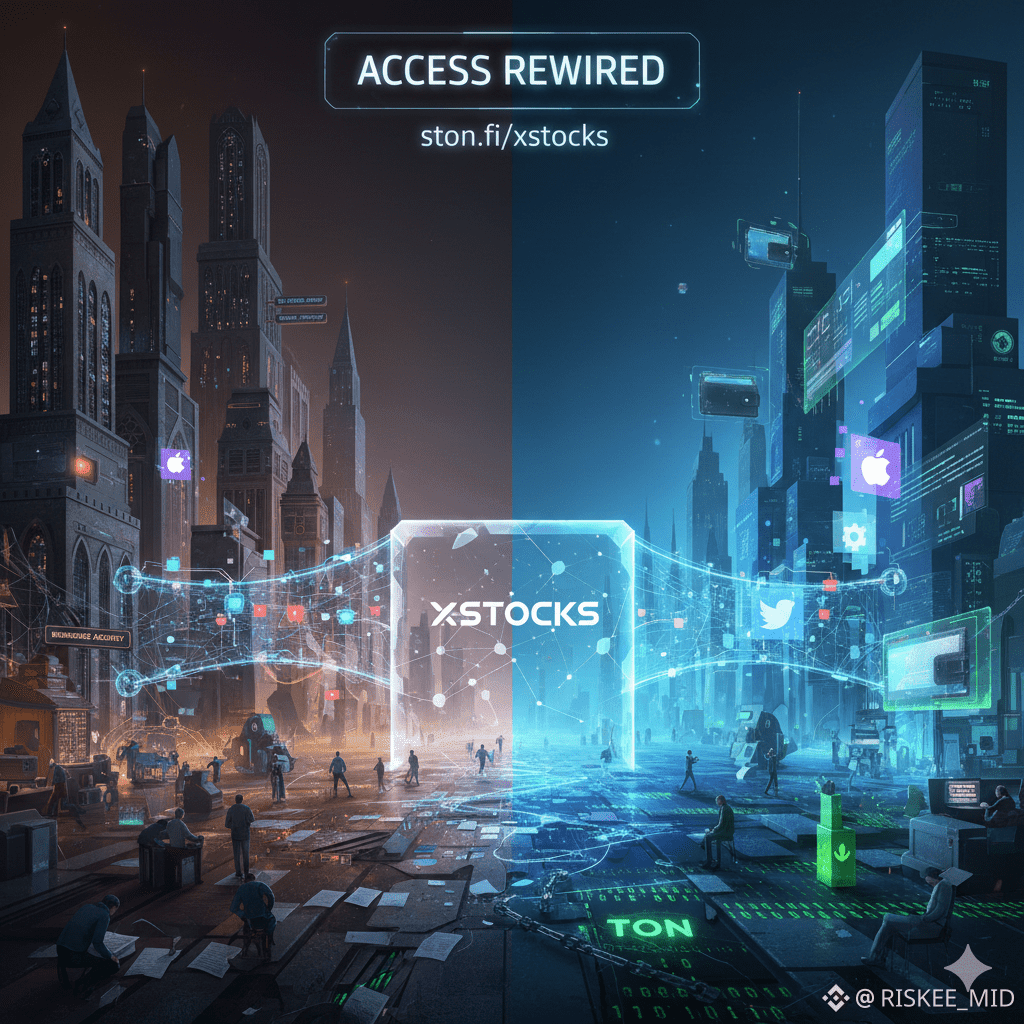
Subtitle: Changing the how without changing the what: why tokenized equities on TON make access an architectural choice, not a barrier.
Author: (RISKEE)
Date: January 4, 2026
Executive summary
xStocks do something deceptively simple: they change the structure of access to equities, not the nature of the equities themselves. The earnings, balance sheets, macroeconomic factors and company fundamentals that drive equity value remain unchanged. What shifts is the path investors take to reach that exposure — from paper-intensive brokerages and fixed trading windows to wallet-native, on-chain interactions that prioritize speed, portability and transparency. This article explains why that architectural change matters, how it works on $TON, and what it means for investors, custodians and regulators.
What exactly are xStocks?
xStocks are tokenized representations of equity exposure that live and move on a blockchain. Each token encodes — directly or through contractual links to a custodian — an economic claim on traditional equity value. In practice that means you still own exposure to corporate earnings and are still subject to the same legal and regulatory frameworks. The novelty is that the route to that exposure is native to blockchain tooling: wallets, smart contracts, and on-chain exchanges.
Access is an architectural problem, not a natural law
Most of finance’s frictions don’t come from the assets. They arise from the systems built around them: paper forms, batch settlement windows, siloed custodial relationships, and limited settlement rails. By moving the interface layer — where people interact with assets — onto a programmable, composable ledger, xStocks turn many of those frictions into engineering choices.
Want near-instant settlement? Design your token and custodian flows to support it. Want fractional shares? Make the token divisible. Want 24/7 secondary trading? Open your on-chain order books. These aren’t metaphysical changes; they're product and protocol decisions.
What stays the same: law, custody, and fundamentals
It’s crucial to be clear-eyed about what xStocks do not do. Tokenizing access:
Does not erase legal restrictions. KYC/AML, accredited investor limits, short-selling rules, insider-trading laws and securities registration remain in force.
Does not obviate custodians. Institutions still need to custody underlying assets, attest to them, and meet regulatory requirements.
Does not change fundamentals. Company earnings, interest rates, macro trends and investor sentiment still determine price.
xStocks change how exposure is delivered, but not what you own in economic substance.
Why the interface layer matters
The interface layer is often the single biggest barrier to financial participation:
Onboarding friction: opening a brokerage account can take days and paperwork. Wallet interactions can often be completed in minutes.
Settlement latency: traditional markets settle in batches; on-chain models can enable much faster finality.
Portability: once tokenized, assets can more easily move between apps, markets, and DeFi rails.
Reducing friction expands participation, but it also concentrates responsibility: easier access means more people can observe, experiment with, and learn about tokenized instruments — and more people can make mistakes.
New opportunities and composability
Because xStocks are native on-chain, they inherit the composability of the blockchain ecosystem. That unlocks use cases that were difficult or impossible in legacy systems:
Fractional ownership and micro-investing — enable smaller ticket sizes and broader participation.
Programmable dividends and automated tax reporting — smart contracts can automate flows traditionally handled by back-office teams.
Integration with DeFi — lending, collateral, and automated strategies can be built on top of tokenized equity exposure.
These are powerful advantages — but they require careful design to respect settlement finality, custodial guarantees, and legal compliance.
Risk, responsibility, and the need for education
Convenience grows the need for literacy. If assets are easier to trade and access in real time, individual investors must understand token mechanics, counterparty risk, custody attestation, and where regulatory protections still apply. User-friendly UIs can mask important details: who holds the underlying shares? How are they audited? Does the token represent legal title or an economic contract?
Projects and platforms must prioritize clear disclosures, independent audits, and education — not just beautiful product UX.
Regulatory and custodial realities
Regulators will rightly insist that legal frameworks follow economic reality. If a token is marketed as equity exposure, registration, disclosure, and investor protections become relevant. Practically, this means robust custody arrangements, proof-of-reserve or proof-of-custody mechanisms, and mechanisms to enforce restrictions (e.g., transfer locks, whitelisting) where required.
Far from being an abandonment of regulation, tokenization often requires better integration between on-chain primitives and off-chain legal structures.
Why $TON matters as a playground
Blockchains like $TON offer the throughput, programmability and developer ecosystem required to make xStocks practical. Real-time liquidity, low transaction costs, and smart contract composability let teams experiment with settlement mechanics, fractionalization models, and secondary markets while preserving the custodial relationships required by law. Observability is another advantage: token transfers and order books are visible in real time, making it easier for curious market participants to study instrument behavior and for auditors to trace flows.
Practical guidance for users who want to explore xStocks
Start with the documentation. Understand whether the token represents direct legal title or an economic claim backed by a custodian.
Check custody and audits. Look for independent attestations and clear proof-of-reserve statements.
Confirm regulatory compliance. Ensure the platform enforces KYC/transfer restrictions where necessary.
Consider counterparty risk. Tokenization reduces UX friction but does not eliminate issuer or custodian risk.
Paper the on-chain flows. Read the smart contract summaries and ask where settlement finality is guaranteed.
Explore xStocks: ston.fi/xstocks
Economic implications and market structure
xStocks could reduce frictions that currently limit liquidity and price discovery in some markets. Simultaneously, tokenization may fragment liquidity if many variants of tokenized claims (custodian A vs. custodian B, tokenized fraction vs. whole-share token) coexist. Market participants, exchanges and market makers will need to reconcile price discovery across tokenized and legacy venues.
Conclusion: an intellectual shift as much as a technical one
The real revolution of xStocks is intellectual: they make access a product choice. By moving the interface layer onto programmable rails, teams can choose how fast, how portable, and how composable equity exposure should be. That choice opens enormous opportunity — and substantial responsibility. Easier access means more people can observe markets in real time and learn; it also increases the need for clear legal linkage, rigorous custody, and investor education.
xStocks don’t change the economics of equities. They change who — and how — people participate in them. That shift is worth studying closely, especially as experiments on $TON and elsewhere scale from niche pilots to mainstream products.