
If you’ve been watching the DePIN space lately, you’ve probably noticed a major shift. We are no longer just looking at individual altcoins; we are watching the total unbundling of the traditional cloud (AWS, Google Cloud) into a decentralized, open-source stack.
Looking at STORJ, Flux, Lisk, and Fluence, a very clear picture of this new "Decentralized Cloud" is starting to emerge.
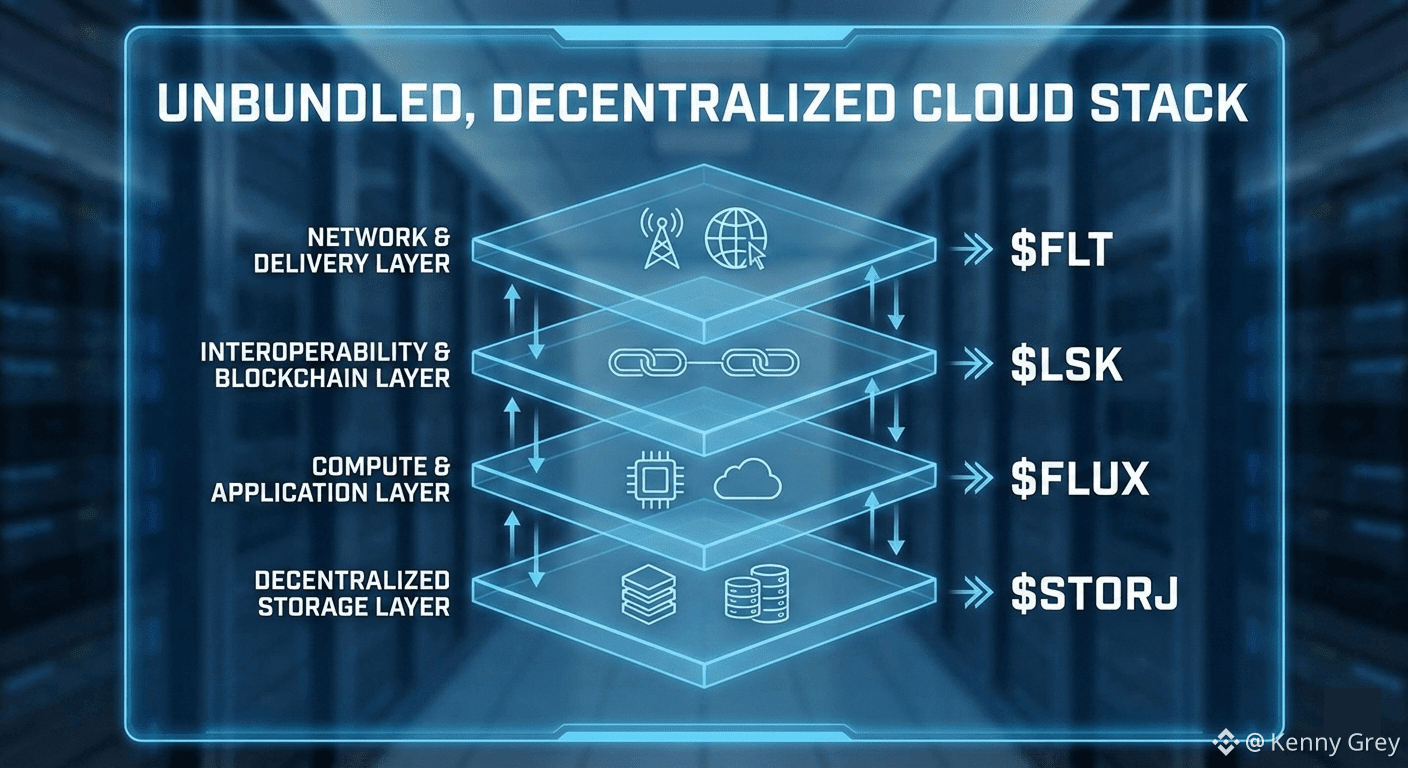
🧱 The 4 Layers of the New Stack
The Storage Base ($STORJ): Storj is the veteran here. It does one thing exceptionally well: decentralized storage. Think of it as the S3 of Web3. It’s a classic DePIN success story—taking idle disk space and turning it into a reliable resource.
The Generalized Infra ($FLUX): Flux is like the decentralized hardware rack. It’s a massive network of nodes providing raw power, virtual machines, and GPU capacity. It’s broad, ambitious, and handles the heavy lifting of hosting entire applications.
The Application Hub ($LSK): Lisk has made a smart pivot. It’s no longer just an independent chain; it’s an L2 designed specifically for DePIN and RWA (Real World Asset) projects. It’s where the apps that use this infrastructure actually live and breathe.
The Serverless Engine ($FLT): This is where Fluence stands out. While Flux provides the server, Fluence provides the serverless marketplace. It aggregates excess capacity from top-tier data centers and turns compute into a programmable, verifiable resource.
💡 Why Fluence ($FLT) is the Missing Piece
If you’re following the AI infrastructure or Decentralized Compute narrative, Fluence is doing something fundamentally different.
Most compute projects ask you to rent a machine. Fluence asks you to "run a function.
For Developers: It feels like AWS Lambda but without the vendor lock-in.
For AI Builders: It’s the perfect substrate for inference backends and data processing pipelines, workloads that need to be fast, cheap, and, most importantly, verifiable.
🌍 The Mission: A Cloudless Future
Fluence’s mission isn't just to be another provider; it’s to turn compute into a neutral, open resource.
In the old world, if you build on a cloud monopoly, they own your scale. In Fluence’s Cloudless vision, the infrastructure is a marketplace. If one provider becomes too expensive or goes offline, the network simply routes your work to another.
Summary: We are moving away from a black box cloud toward a transparent stack. $STORJ stores the data, $FLUX provides the raw nodes, $LSK hosts the logic, and $FLT provides the programmable, verifiable execution that ties it all together.
This isn't just tech, it's the architecture of a freer internet.


