


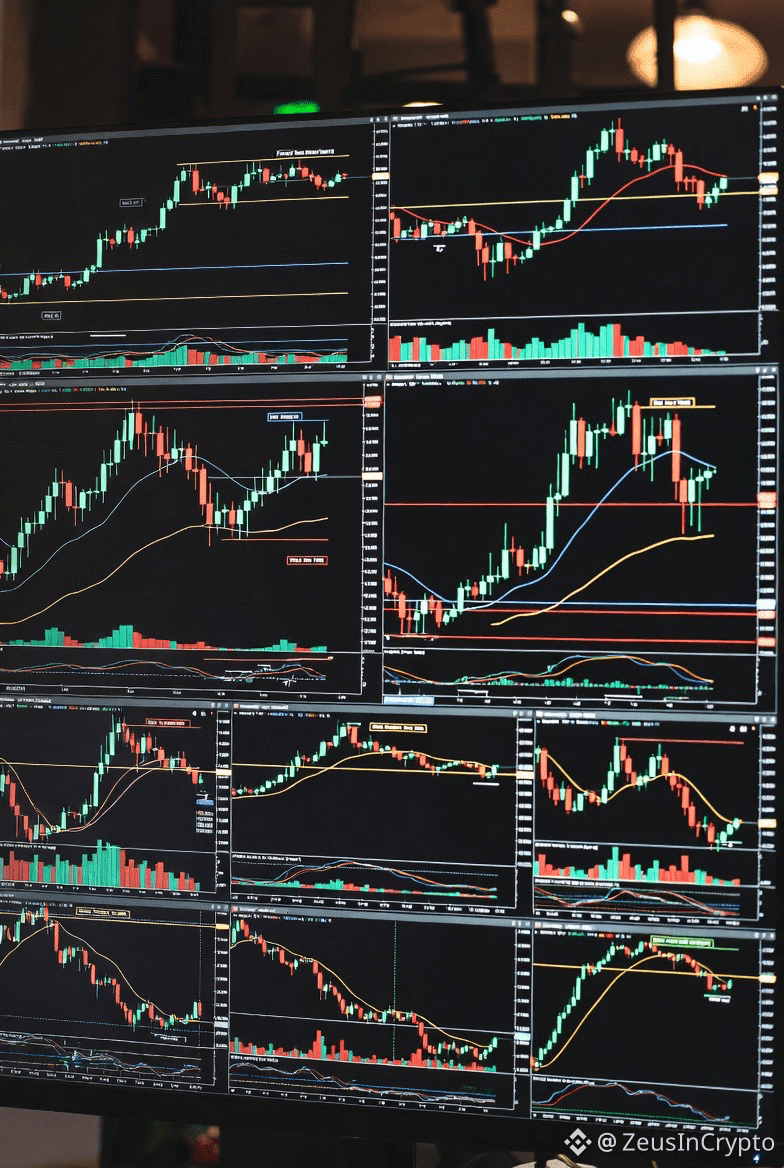
Technical analysis helps traders understand price behavior, spot trends, and time their entries and exits across markets like stocks, forex, cryptocurrencies, and commodities. Below is a clear overview of 22 fundamental concepts widely used by traders today.
1. Fibonacci Retracements
Fibonacci retracement levels are horizontal price zones derived from the famous Fibonacci sequence. Traders apply them to recent price swings to find potential areas where the price might pause, reverse, or continue after a pullback. The most watched levels are 23.6%, 38.2%, 50%, 61.8%, and 78.6%.
2. Breakouts
A breakout occurs when price moves decisively above resistance or below support, usually with increased momentum. Traders often view confirmed breakouts as signals of a new trend or the beginning of strong directional movement.
3. Reversal
Reversal patterns signal a potential change in the prevailing trend direction. Classic examples include double tops/bottoms, head and shoulders, and certain candlestick formations that appear at the end of extended trends.
4. Elliott Wave Theory
Elliott Wave is a form of technical analysis that suggests market prices move in repetitive cycles of five impulsive waves in the direction of the main trend, followed by three corrective waves against it. Understanding wave structure helps forecast future price behavior.
5. Fair Value Gap (FVG)
A Fair Value Gap appears as an imbalance or inefficiency on the chart — usually a three-candle formation where a large candle leaves a noticeable gap between the wicks of the candles before and after it. Many traders expect price to return to “fill” these gaps at some point.
6. Candlesticks
Candlestick charts display price action within a specific time period using open, high, low, and close prices. Single candles (doji, hammer, shooting star) and multi-candle patterns (engulfing, morning/evening star) provide insights into buyer-seller psychology.
7. Heikin Ashi
Heikin Ashi is a modified candlestick technique that smooths price data by averaging values. It filters out market noise, making trends easier to identify and reducing the number of false signals compared to standard candlesticks.
8. Moon Phases (Astro Trading)
Some niche traders incorporate lunar cycles into their analysis, believing that moon phases (new moon, full moon, quarters) can influence market sentiment and volatility. This approach remains highly controversial and lacks broad scientific acceptance.
9. Renko Charts
Renko charts focus purely on price movement rather than time. New bricks are drawn only when price moves a predefined amount, filtering out minor fluctuations and highlighting clean trends and key reversals.
10. Harmonic Patterns
Harmonic patterns are advanced geometric price formations based on precise Fibonacci ratios. Popular examples include Gartley, Bat, Crab, Butterfly, and Shark patterns. When properly formed, they often signal high-probability reversal zones.
11. Support and Resistance
Support is a price level where buying interest tends to emerge, preventing further declines. Resistance is the opposite — a level where selling pressure typically appears. These zones often act as psychological barriers and flip roles after breakouts.
12. Dynamic Support and Resistance
Unlike static horizontal levels, dynamic support/resistance moves with price. The most common tools are moving averages (especially the 50, 100, and 200-period versions) that act as trailing support or resistance in trending markets.
13. Trend Lines
Trend lines are straight lines drawn connecting higher lows (uptrend) or lower highs (downtrend). They help define the current trend direction and often serve as dynamic support or resistance until broken.
14. Gann Angles
W.D. Gann developed a set of angled lines (most famously 1×1, 1×2, 2×1, etc.) drawn from significant highs and lows. These angles are believed to represent important time-price relationships and potential future turning points.
15. Momentum Indicators
Momentum indicators measure the rate of change in price. They help determine whether a trend is gaining or losing strength. Popular examples include RSI, MACD histogram, Stochastic, and Momentum oscillator itself.
16. Oscillators
Oscillators are bounded indicators that fluctuate between extremes (usually 0–100 or -100 to +100). They are especially useful for identifying overbought/oversold conditions and potential reversals in range-bound markets.
17. Divergence
Divergence happens when price action and an oscillator move in opposite directions. Bullish divergence (higher lows in price, lower lows in oscillator) often signals potential upside reversal; bearish divergence warns of possible downside.
18. Volume
Volume represents the number of shares, contracts, or coins traded during a period. Rising volume during breakouts confirms strength, while declining volume during trends may indicate weakening momentum.
19. Supply & Demand
Supply and demand zones are areas where large orders were previously filled, creating strong reactions. Fresh demand zones (buying interest) often act as future support, while untouched supply zones (selling interest) act as future resistance.
20. Market Structure
Market structure refers to the overall pattern of higher highs/higher lows (bullish) or lower highs/lower lows (bearish). Understanding the current structure helps traders determine trend direction and bias.
21. BOS (Break of Structure)
A Break of Structure occurs when price breaks a previous significant high (in an uptrend) or low (in a downtrend), confirming continuation of the prevailing trend and often invalidating the opposite structure.
22. CHOCH (Change of Character)
Change of Character signals a potential shift in market behavior. It usually appears when price fails to make a new higher high (in an uptrend) or lower low (in a downtrend) and instead creates a strong move in the opposite direction — often the first clue of a trend reversal.
These concepts form the foundation of most modern technical trading strategies. Mastering a few complementary tools from this list, rather than trying to use everything at once, usually leads to clearer decision-making and better results in live markets. Practice recognizing them across different timeframes to build confidence. Happy charting!