I remember the first time I tried to store a large dataset onchain a few years ago. The process was, to put it mildly, a rather costly wake up call. The sheer expense of committing every byte directly to a smart contract state made it clear that blockchains, for all their strengths, were not built to be hard drives. This is the exact problem blob storage is designed to solve, and it is where my analysis of the $WAL | Walrus Protocol begins to get interesting. Their approach is not just about adding storage, it is about rethinking the economics of data persistence on a decentralized network like Sui.
So, what is blob storage in plain terms. Think of it like this, a blockchain normal transactions are like meticulously handwritten entries in a master ledger, permanent, ordered, and expensive to write. A "blob" short for Binary Large Object, is different. It is more like sealing a document in an envelope and attaching a unique, tamper proof receipt to the ledger. The contents of the envelope are not parsed or actively managed by the chain core logic, they are just held. This fundamental separation is the key to efficiency. The Walrus whitepaper details this by distinguishing between onchain consensus for the "receipts" the data commitments, and offchain storage for the actual blobs. By not forcing the blockchain to process and store every bit of data in its high security state, you essentially sidestep the most prohibitive costs.
The efficiency gains are primarily in cost and scale. When I look at the tokenomics page for the WAL token, the emphasis on "cost efficient storage" is not marketing, it is a direct technical outcome of this model. Storing data as a blob on a network like Sui is orders of magnitude cheaper than using contract state. This is crucial because Walrus is targeting large files, application data, media, and enterprise archives. They mention use cases like dApp frontends and decentralized backups, which involve data volumes that would be economically impossible under traditional onchain models. In April 2024, a post on their X account underscored the debut of their mainnet on the Sui blockchain, specifically spotlighting its "decentralized blob storage" function as a fundamental service.
My review of their technical documentation shows how they achieve durability. It is not just about dumping data somewhere cheap. Walrus uses a technique called erasure coding. Here is how I understand it, a single file is split into multiple pieces, then mathematically expanded with redundant fragments. You only need a subset of these fragments to reconstruct the original file. Once processed, this data is scattered across a network of decentralized nodes. The cleverness stems from embedded redundancy. Even if numerous nodes fail, you can still fully recover the data. This creates a durable, censorship resistant storage base, eliminating dependence on a central party. It upholds the decentralized ethos through a pragmatic, fault tolerant framework.
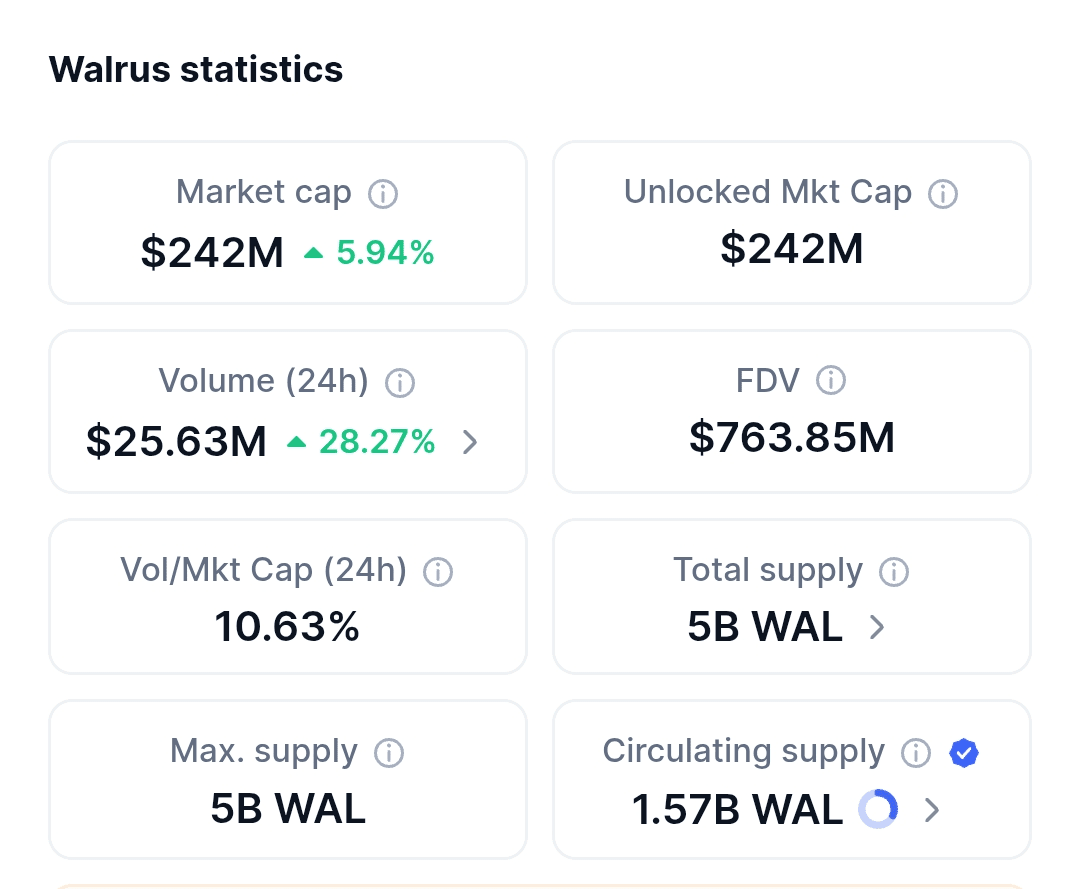
Now, let us talk about the token, WAL. Its role is directly tied to making this blob storage system function. It is not a speculative afterthought. According to the protocol mechanics, nodes in the network stake WAL tokens to participate and provide storage service. Clients pay fees in WAL to store and retrieve their data. This establishes a self sustaining economic cycle where the value of the storage service generates essential demand for the token. Participants who stake their tokens are motivated to provide consistent service, as penalties can be applied to their staked assets for inadequate performance, a standard security measure that coordinates node operations with the overall stability of the network. Based on my evaluation of the current metrics on CoinMarketCap, the fully diluted valuation is around $763.85 million, while the token is sitting considerably below its all time high price. The market is clearly still evaluating the adoption curve for decentralized blob storage as a sector. A notable feature is the minimal yearly inflation rate; the tokenomics seem structured to prevent swift value erosion for early adopters, emphasizing a utility-driven approach over new supply generation.
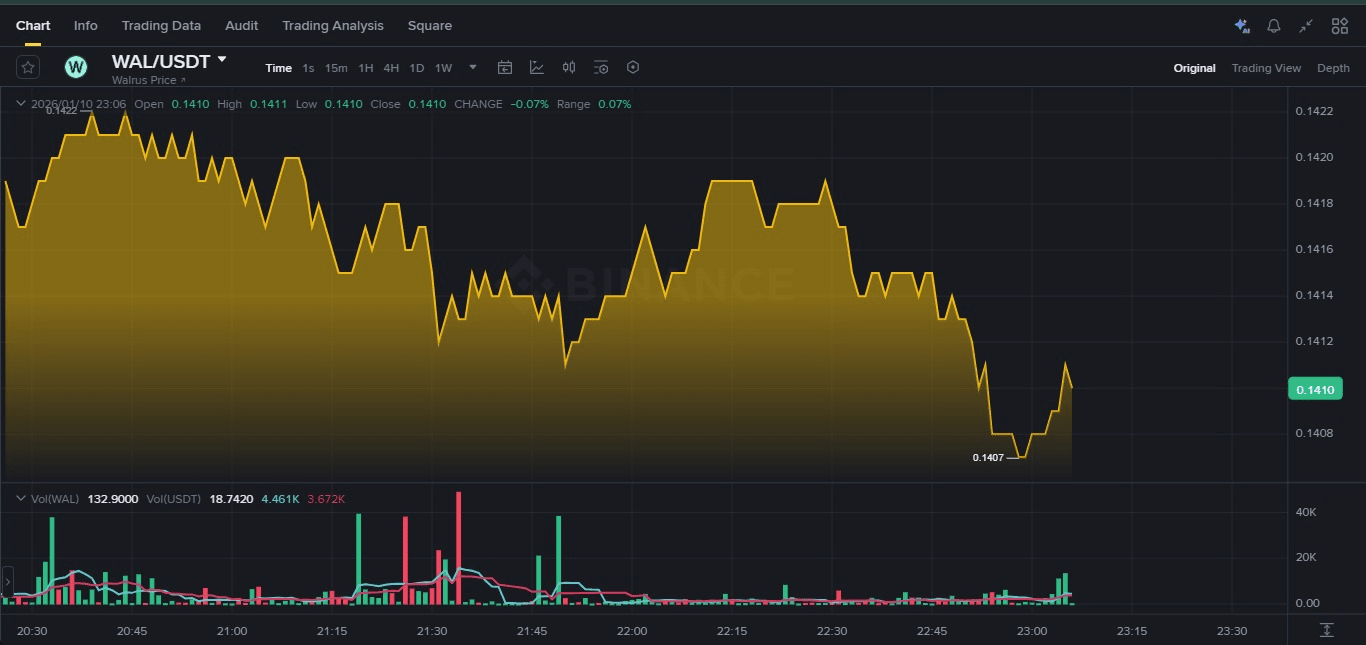
Analysis of the WAL/USDT chart on Binance Spot indicates a developing asset that is consolidating within its price boundaries. The price experienced heightened volatility surrounding the mainnet launch in April, as anticipated, before consolidating into a relatively confined range. Trading activity has been sporadic, missing steady drive in either direction. Based on my chart assessment, key levels feature a recent support zone around $0.1390, which has faced testing and held multiple times. On larger timeframes, the price remains beneath all major moving averages, a typical sight for a fresh protocol before widespread uptake. The RSI does not signal severe overbought or oversold states, instead hovering in a middle range. This pattern indicates the market is experiencing a phase of anticipation, waiting for concrete usage metrics from the Walrus ecosystem to emerge.
This triggers a broader assessment. The cryptocurrency infrastructure ecosystem in 2024 appears noticeably distinct from the period of increased speculation witnessed in 2021. Initiatives are now evaluated based on their substantive technical foundations and practical utility, rather than mere storytelling. For Walrus Protocol, the question is not whether blob storage is clever, it is. The real question is whether developers and enterprises will choose a decentralized solution over entrenched, cheap cloud giants. Their bet seems to be on a future where censorship resistance, verifiable data integrity, and alignment with decentralized application stacks hold tangible value. It is a bet on a slower, more fundamental build.
After spending time with the whitepaper and recent announcements, what becomes clear is that Walrus is not trying to do everything. It is specializing in a specific, infrastructural niche, persistent, scalable blob storage. In a world where decentralized applications are growing more complex, needing to store everything from user generated content to machine learning models, such a primitive could become as essential as a reliable RPC endpoint. Their achievement relies on implementation, the robustness of the node network, the quality of developer tools, and preserving that vital cost edge. This is underlying, fundamental effort, the sort that frequently escapes attention until it abruptly turns essential.
by Hassan Cryptoo
@Walrus 🦭/acc | #walrus | $WAL