
In the ever-evolving landscape of Web3, the transition of Humanity Protocol a decentralized identity (DeID) network from the Inter Planetary File System (IPFS) to Walrus marks a pivotal shift in how the industry handles sensitive, large-scale human data.
The migration involves moving over 300GB of data, representing millions of user credentials, onto Walrus, a decentralized storage protocol natively integrated with the Sui ecosystem. This move is not merely a technical upgrade; it is a strategic alignment that positions Walrus as the "backbone" of verifiable human identity in an age increasingly dominated by AI.
The Scale of the Migration
Humanity Protocol currently manages over 10 million user credentials, verified primarily through unique palm-print scans. By migrating to Walrus, the protocol aims to scale this figure to over 100 million unique credentials by the end of 2025.
Storing 300GB of identity data on a traditional blockchain is economically and technically unfeasible. Most blockchains are designed for "logic" (smart contracts) rather than "heavy lifting" (large file storage). Historically, projects used IPFS for this purpose, but IPFS often lacks the guaranteed data availability and seamless smart contract integration required for real-time identity verification. Walrus solves this by offering a specialized blob storage layer that functions as an extension of the Sui blockchain.
What is Walrus?
Developed by Mysten Labs (the creators of Sui), Walrus is a decentralized storage protocol designed to handle massive, unstructured data—videos, images, and, in this case, identity graphs.
While Sui handles the transaction logic, Walrus handles the "storage of things." It uses a technique called erasure coding, which breaks data into small fragments (slivers) and distributes them across a global network of nodes. This ensures that even if a large portion of the network goes offline, the original data can be reconstructed perfectly.
The Role of Walrus in the Sui Ecosystem
Within the Sui ecosystem, Walrus acts as the Data Availability (DA) layer. Here is how it fundamentally changes the game for a project like Humanity Protocol:
* Cost Efficiency: Traditional storage often requires full replication (copying the same file many times), which is expensive. Walrus’s erasure coding reduces storage overhead significantly while maintaining high redundancy, making it 10x to 100x cheaper than other decentralized alternatives.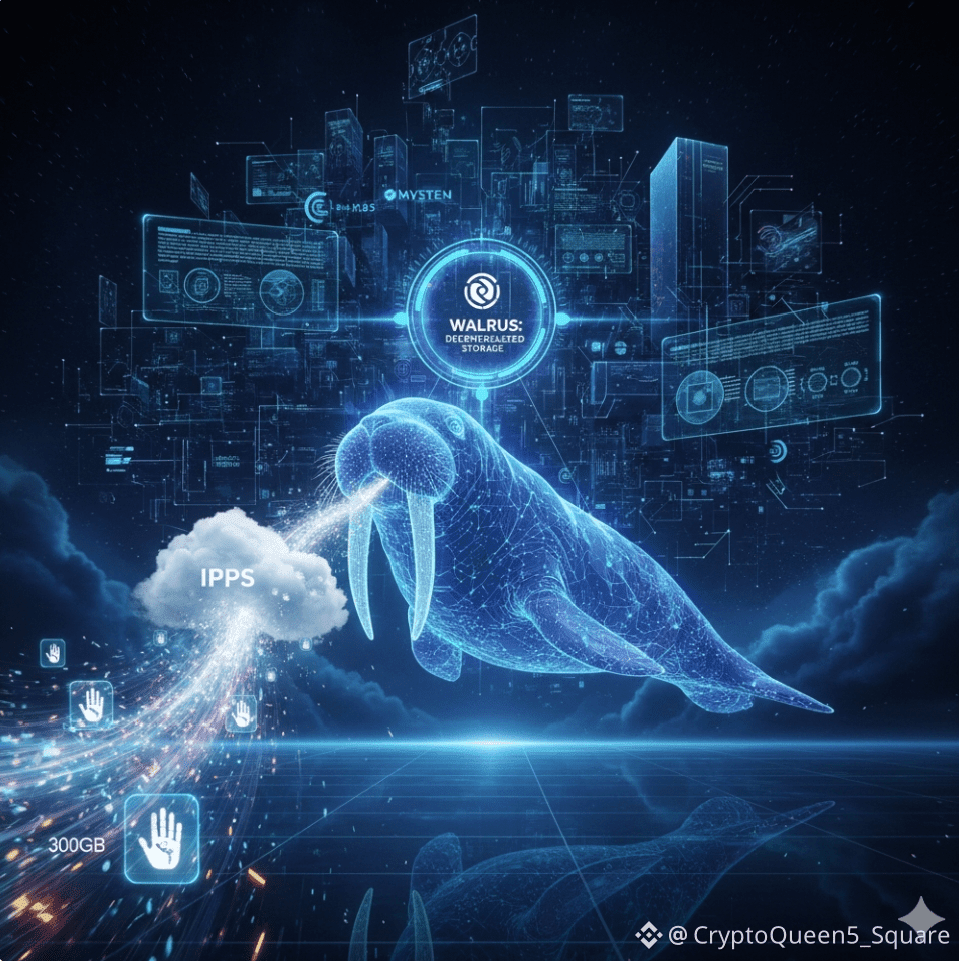
* Programmable Storage: Because Walrus is tightly integrated with Sui, storage is "object-centric." This means a user’s Human ID (stored on Walrus) can be directly interacted with by a smart contract on Sui. Developers can write code that says, "Allow this transaction only if the user has a verified credential on Walrus."
* High Throughput for Issuance: Identity protocols need to issue and verify credentials in seconds. Walrus provides the high-bandwidth environment necessary to scale from millions to hundreds of millions of users without the latency typical of older decentralized storage networks.
Fighting AI Fraud and Deepfakes
The core mission of Humanity Protocol is to establish a "Proof of Personhood" to combat AI-generated deepfakes and Sybil attacks (where one person creates thousands of fake accounts).
By moving to Walrus, Humanity Protocol creates a Verifiable Identity Graph. When a user scans their palm, the resulting biometric proof is stored on Walrus. Because Walrus is decentralized, no single entity (not even Humanity Protocol itself) can delete or alter that record. This provides a "Root of Trust" for the entire Sui ecosystem.
Why this matters: In the 2026 digital economy, being able to prove you are a human privately and securely is the ultimate currency. Walrus provides the "vault" where that proof lives, while Sui provides the "rails" it moves on.
Impact on Users and Developers
For the average user, this migration happens "under the hood," but the benefits are tangible. It enables Cross-Chain Verification, meaning your Human ID stored on Walrus can eventually be used to prove your identity on other blockchains or even Web2 platforms, all without you ever losing control of your data.
For developers, the Humanity-Walrus integration provides a "plug-and-play" trust layer. A developer building a social media app on Sui can now integrate a "Human-Only" filter by simply querying the Humanity Protocol data residing on Walrus. This eliminates the need for invasive KYC (Know Your Customer) processes while ensuring the platform is bot-free.
Conclusion: The Future of On-Chain Identity
The migration of 300GB of data is just the beginning. As Humanity Protocol scales toward its 100-million-user goal, the partnership validates Walrus as a premier infrastructure for Enterprise-grade Web3.
Walrus isn't just a place to "park" data; it is an active participant in the Sui ecosystem that makes data liquid, programmable, and permanent. By anchoring the world’s most ambitious identity project, Walrus has moved from an experimental storage tool to an essential utility for the future of the human-centric internet.