


In the great ledger of human progress, the digitization of memory marks a pivotal epoch. Yet, for decades, this collective memory—our data—has resided in rented vaults, subject to the whims of centralized custodians. The promise of Web3 is not merely decentralization of finance, but decentralization of context and history. Standing at this convergence is Walrus, a protocol engineered not as a passive repository, but as an active, programmable substrate for the internet's enduring memory, built natively on Sui. This is a treatise on its architecture, its economic truth, and its unfolding role as the foundational cortex for a smarter, more sovereign web.
The Philosophical Split: Separating the "What" from the "Who"
The genius of Walrus lies in a fundamental architectural dichotomy, a deliberate separation of concerns that elevates both security and capability. It cleaves the data plane—the raw substance of information—from the control plane—the immutable logic of ownership and access.
· Sui as the Sovereign Ledger (Control Plane): Here, Sui operates as the judicial branch of the Walrus ecosystem. Every datum stored is represented by a sovereign digital object on Sui—a cryptographic title deed. This object encodes the immutable provenance: the owner's identity, the data's unique fingerprint, its storage terms, and access covenants. All economic and logical operations—payment streams, reward distributions, slashing conditions—are executed by Sui's smart contracts, providing final, auditable settlement.
· Walrus as the Performant Archive (Data Plane): This is the executive branch, a globally distributed network of specialized storage nodes. Their sole mandate: to custody fragmented "slivers" of data with high fidelity and availability. This specialization allows for optimization raw storage performance, untethered from the consensus overhead of the blockchain itself.
The binding agent between these two planes is not mere code, but a cryptographic marvel: Red Stuff Erasure Coding. This two-dimensional encoding scheme shatters data into redundant, information-dense fragments. Its resilience is almost alchemical: the original data can be perfectly reconstituted even if up to two-thirds of the global storage network vanishes or turns adversarial. It achieves this while maintaining a storage overhead so efficient it redefines the economics of decentralized persistence.
The WAL Token: The Circulatory System of a Living Archive
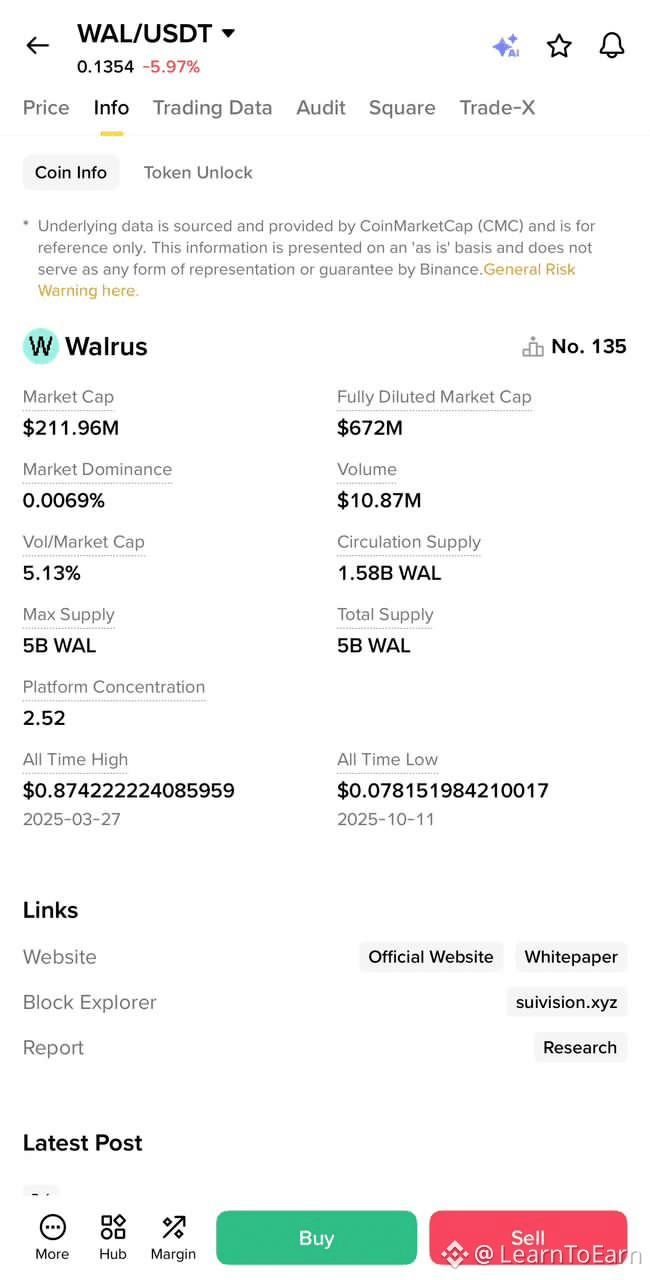
A network of this ambition cannot be powered by goodwill alone. It requires a finely tuned cryptoeconomic circulatory system—the WAL token. With a fixed corpus of 5 billion tokens, its distribution was architected as a constitutional document, vesting power sustainably in the hands of its builders and users.
Allocation Category % of Supply Strategic Mandate
Community Reserve & Grants (43%) 2.15B The perpetual endowment fund, governed for ecosystem R&D, developer grants, and global inoculation.
Core Contributors (30%) 1.5B Vesting over years, ensuring the long-term alignment of the protocol's original architects.
Walrus User Airdrop (10%) 500M A direct enfranchisement of the community, seeding ownership among early adopters.
Subsidies (10%) 500M The network ignition catalyst, lowering initial barriers to foster organic network effects.
Investors (7%) 350M Patient capital, locked to allow the organic economy to mature before liquidity events.
WAL is not a mere payment token; it is a tri-functional instrument:
1. The Medium of Transaction: Users pay in WAL to purchase verifiable data immortality.
2. The Bond of Security: Staking WAL represents a skin-in-the-game commitment, where tokenholders underwrite the network's integrity and earn a share of its storage revenue.
3. The Franchise of Governance: WAL is a voting share, granting stakeholders the right to steer the protocol's evolution.
Crucially, this economy is designed with a deflationary bias. A portion of every storage fee (a projected 0.5%) is perpetually burned. Future penalties for network misbehavior will also be incinerated. As adoption grows, this controlled combustion counteracts inflationary pressures, creating a virtuous cycle where utility drives scarcity.
Proof of Availability: The Continuous Covenant
Beyond storage, Walrus guarantees continuous, verifiable custody through its Incentivized Proof of Availability (PoA) system. This is not a sporadic audit but an economically enforced, real-time covenant.
The Process: A Ritual of Verification
1. Fragmentation & Distribution: User data is encoded into slivers via Red Stuff and dispatched to a committee of staked nodes.
2. Cryptographic Attestation: Each node cryptographically signs an acknowledgment of its custodial duty, creating a digital vow.
3. On-Chain Notarization: Once a threshold of vows is collected, an immutable Proof of Availability certificate is etched onto the Sui ledger.
4. Economic Activation: This certificate is the trigger—it initiates the flow of rewards to honest nodes and stakers, directly tethering economic gain to proven, reliable performance.
This transforms data storage from a blind act of faith into a publicly verifiable, economically incentivized contract.
The Proof Is in the Patrimony: Real-World Patrimony on Walrus
Theoretical elegance means little without tangible adoption. Walrus has already become the chosen patrimony for groundbreaking applications:
· AI & Autonomous Intelligence: Talus leverages Walrus as the persistent memory layer for its AI agents, allowing them to access, update, and reason over vast datasets in real-time, powering complex DeFi and gaming strategies.
· Sovereign Identity & Privacy Tech: CUDIS builds a user-owned health data vault on Walrus, while DLP Labs enables EV drivers to own and monetize their vehicle telemetry. Walrus's "Seal" encryption feature makes privacy a default, not an add-on.
· Cultural Artifacts & NFTs: The Pudgy Penguins ecosystem migrated its media infrastructure to Walrus's Tusky platform, ensuring its digital cultural artifacts are preserved on decentralized, permanent infrastructure.
· Transparent Prediction Markets: Myriad runs its entire prediction market engine on Walrus, with all event data and market states immutably stored, processing millions in volume atop a foundation of verifiable truth.
The Horizon: 2026 and the March Toward a Seamless Data Fabric
Having established its foundational layer in 2025, Walrus's trajectory for 2026 is one of deep integration and abstraction.
· The Invisible Infrastructure: The aim is to render Walrus invisible to developers. Through SDKs and APIs that mirror Web2 cloud simplicity, building on a decentralized data layer will become the path of least resistance.
· Privacy as Primitives: Expanding beyond "Seal," Walrus will bake advanced privacy primitives—like zero-knowledge proof integrations for verifiable computation on encrypted data—directly into its fabric. This is essential for regulated industries and private AI.
· Symbiosis with Sui: The integration with Sui will deepen into a singular stack. Imagine smart contracts that can natively query, trigger, and update their own persistent data stores on Walrus as seamlessly as reading from memory—blurring the line between blockchain state and decentralized storage.
Epilogue: The Bedrock of Context
Walrus is more than a protocol; it is a philosophical stance on data sovereignty. It posits that for Web3 to mature from a financial experiment into a full-stack alternative internet, it requires a native, resilient, and intelligent memory layer. By combining cryptographic guarantees with sound token engineering and proven adoption, Walrus is not merely participating in the Web3 narrative. It is laying down the geological strata upon which that narrative will be permanently recorded. In the sovereign digital age, context is king. Walrus provides the kingdom.@Walrus 🦭/acc $WAL #Walrus


