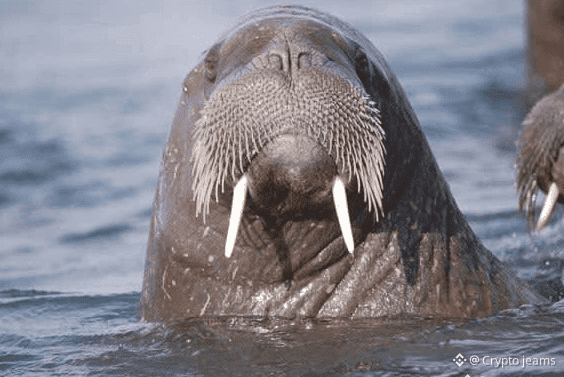
You know that feeling when you walk into a party and immediately realize you're overdressed, underdressed, or just. dressed wrong? That's basically what a walrus looks like all the time, except the walrus has zero concern about it.
Picture this You're hauled out on an ice floe in the Arctic. The temperature is somewhere between "why" and absolutely not. You're shaped like a very large potato wearing a borrowed suit. You've got two massive teeth jutting out of your face at awkward angles. Your mustache looks like you glued a push broom to your upper lip. And you're surrounded by thousands of other potato shaped individuals who look exactly like you.
Do you care? Not even a little bit.
That's the walrus energy we all need.
The Beauty of Not Caring What You Look Like
Let's talk about walrus bodies for a minute, because they're fascinating in the way that a Picasso painting is fascinating nothing is quite where you'd expect it to be, but somehow the whole thing works.
Adult male walruses can tip the scales at 4,000 pounds. That's two literal tons of blubbery confidence. Females are slightly smaller at around 2,700 pounds, which is still roughly the weight of a compact car. They're shaped like overstuffed sausages that have been left in the sun too long. Their skin hangs in folds and wrinkles that suggest they're either melting or were assembled from spare parts.
And those tusks. Good lord, those tusks.
They grow continuously throughout a walrus's life, sometimes reaching over three feet long. Imagine having two giant teeth permanently sticking out of your mouth not in a cute vampire way, but in a I can't close my mouth properly and I'm fine with it way. You'd think this would be inconvenient. You'd be wrong. Walruses use these tusks for practically everything. hauling out of the water (hence tooth walking), making breathing holes in ice, fighting, showing off, and probably scratching itches in hard to reach places.
Then there's the color situation. Walruses can go from grayish brown to straight up pink depending on water temperature and blood flow. They're like enormous mood rings, except the mood is always temperature dependent vasodilation.
The Mustache That Actually Earns Its Keep
If you've ever met someone with a truly impressive mustache, you know there's usually some pride involved in its maintenance. The walrus has 400 to 700 whiskers forming what is arguably the animal kingdom's most functional facial hair, and it uses every single one.
These aren't decorative whiskers. These are highly sensitive, specialized tools called vibrissae, and they can detect vibrations, textures, and movements in pitch black water. A walrus feeding on the ocean floor in complete darkness is essentially reading the environment through its face.
Here's what that looks like in practice. A walrus dives down sometimes to depths where the pressure would make your ears explode. It's dark. It's cold. The seafloor is covered in mud, rocks, and hopefully clams. The walrus sweeps those magnificent whiskers across the bottom like someone searching for their phone that fell between the couch cushions, except the couch is the Arctic Ocean and the phone is dinner.
When it finds something promising, it blasts a jet of water from its mouth to excavate the clam, thenvand this is the really impressive part it creates a suction powerful enough to pull the soft body right out of the shell. The shell stays behind. The walrus gets exactly what it wants. It's like surgical precision performed by an animal that looks like it's never had a graceful moment in its life.
A successful feeding walrus can consume somewhere between 3,000 and 6,000 clams in a single session. That's not eating. That's industrial processing.
The Complicated Social Life of Very Large Neighbors
Walruses are gregarious, which is a polite way of saying they have absolutely no concept of personal space.
They haul out in groups that can number in the thousands, all crammed together on ice floes or beaches like concert goers at a very cold, very smelly festival. They lie on top of each other. They lean against each other. They grumble and shove and occasionally stab each other with tusks when someone crosses a line. But mostly, they just exist together in a massive, blubbery pile.
It sounds chaotic, and honestly, it probably is. But there's a method to it. Huddling together conserves heat. Being in a group provides protection there's safety in numbers when you're worried about polar bears or orcas. And for young walruses, growing up in these massive groups is basically an extended education in how to be a walrus.
The social hierarchy is real, though. Bigger tusks generally mean higher status, particularly among males. Bulls will display their tusks to each other, posture, vocalize, and sometimes engage in full on combat that involves rearing up and striking with those ivory weapons. Most of the time it's just threatening displays the walrus equivalent of you want to take this outside?but occasionally things get serious.
Mothers, meanwhile, are dealing with their own challenges. Raising a walrus calf is a multi year commitment. Calves nurse for 18 months to two years, but they stay with mom for up to three years total, learning everything they need to know. And mothers are fiercely, almost violently protective. A mother walrus defending her calf is not something you want to be on the wrong side of. Even polar bears think twice.
The bond between mother and calf is one of the most touching things in nature. Mothers constantly vocalize to their babies a mix of grunts, whistles, and bellows that probably translate to some combination of stay close, be careful, and yes, sweetie, you're doing great.
Built Different (Literally)
Everything about walrus anatomy suggests that evolution was in a particularly creative mood.
That thick, wrinkled skin? It's covering a blubber layer that can be six inches thick a built in wetsuit and emergency food reserve that allows walruses to survive in water temperatures that would kill most mammals almost instantly. The blubber also makes them positively buoyant, which creates an interesting problem. How do you dive when you're essentially a giant, unwilling flotation device?
Walruses solve this by exhaling most of their air before diving, reducing buoyancy. Then they use powerful flippers to propel themselves downward. Their hind flippers, which can rotate forward, act like rudders and provide thrust. It's surprisingly graceful for an animal that looks like it should sink like a stone or bob like a cork with no in between.
And then there are the pharyngeal air sacsbasically internal flotation bladders in their throat that they can inflate to keep their head above water while they sleep. Imagine a pod of walruses sleeping vertically in the Arctic Ocean, bobbing gently like very large, mustachioed buoys. It's one of nature's more absurd solutions to the problem of how do I not drown while sleeping in the ocean?
The Sound of Walrus
If you've never heard a walrus, you're missing out on one of nature's stranger sonic experiences.
Walruses are vocal. Very vocal. They produce a range of sounds including bell like tones, knocks, clicks, barks, growls, and whistles. During breeding season, males become underwater performers, producing elaborate songs that can last for hours. These aren't beautiful whale songs. They're mechanical, otherworldly, almost alien like someone's playing a very strange instrument in a swimming pool.
Why do they do this? The usual reasons: attracting mates, warning off rivals, establishing territory. But the sheer effort involved suggests there's also an element of. showing off? Pride? The walrus equivalent of look what I can do?
Females and calves have their own vocalizations, which they use to stay in contact even in crowded, noisy haul outs. A mother can pick out her calf's voice among thousands. A calf knows its mother's call immediately. In the chaos of a massive walrus gathering, these vocal signatures are lifelines.
When Your Home Is Disappearing
Here's where we need to talk about the elephant in the melting room.
Walruses evolved in sync with Arctic ice. Their entire life strategy depends on it. They rest on ice between foraging dives. They use ice as a platform to access productive feeding areas. They give birth on ice. Their annual movements track the advance and retreat of the ice edge.
But Arctic ice is disappearing at a rate unprecedented in walrus evolutionary history. Summer sea ice extent has been declining by about 13% per decade. That's not an abstract statistic when you're a walrus whose survival depends on that ice.
The consequences are visible and heartbreaking. Walruses are being forced to haul out on land in massive numbers sometimes 30,000 or 40,000 animals on a single beach. These enormous congregations lead to deadly stampedes when the herd gets spooked. Calves are crushed. Animals are forced to travel much farther between resting areas and feeding grounds, expending energy they can't always afford to lose.
In 2019, footage emerged of walruses in Russia attempting to scale cliffs behavior that's completely unnatural for them simply because the beaches were so overcrowded. Some fell to their deaths. These weren't stupid animals making poor decisions. These were intelligent creatures trapped in an impossible situation, trying to survive in a world that's changing faster than they can adapt.
Why This Matters (Besides the Obvious)
Walruses are what scientists call an indicator species their health reflects the health of their entire ecosystem. When walruses struggle, it's a sign that something is seriously wrong in the Arctic.
But beyond their ecological role, walruses represent something important. They're proof that you don't have to be conventionally attractive, graceful, or built for speed to be successful. They're slow on land, awkward looking, and equipped with features that seem almost comically impractical. And yet they've thrived in one of Earth's harshest environments for millions of years.
They've figured out how to be social without losing their independence. They've learned when to fight and when to just coexist. They've mastered the art of being perfectly suited to their niche without trying to be anything else.
Until recently, that was enough.
The Walrus Philosophy
If there's a lesson in all this, maybe it's that being weird isn't a weakness it's often a strength. The walrus's strange features aren't design flaws; they're innovations. The same tusks that make them look ridiculous also make them uniquely capable. The same bulk that makes them awkward on land makes them powerful in water.
Walruses don't apologize for taking up space. They don't worry about looking ungainly. They just. exist, loudly and unapologetically, in all their wrinkled, mustachioed glory.
We could probably learn something from that.
We could also learn from the fact that even the toughest, most adapted creatures have limits. Walruses have survived for millions of years, but they can't survive the loss of their habitat. No amount of evolutionary perfection can overcome the simple fact that ice, once melted, makes for terrible resting platforms.
So maybe we owe it to them to these strange, wonderful, beautifully awkward survivors to make sure they still have somewhere to haul out when they need to rest.
Because a world without walruses would be a world with a little less character, a little less strangeness, and a lot less proof that being different is exactly what makes you perfect for where you belong.#walrus @Walrus 🦭/acc $WAL