
When I look at how blockchains have improved over the years, I notice something strange. Everyone gets excited about faster transactions, cheaper fees, or new consensus models, but hardly anyone talks about where the actual data goes. Most apps still send everything important to normal servers. I have seen projects that claim to be fully decentralized but collapse when their cloud provider has an outage. That feels like a major contradiction. It is almost like the technology keeps growing on one side while dragging an old problem behind it.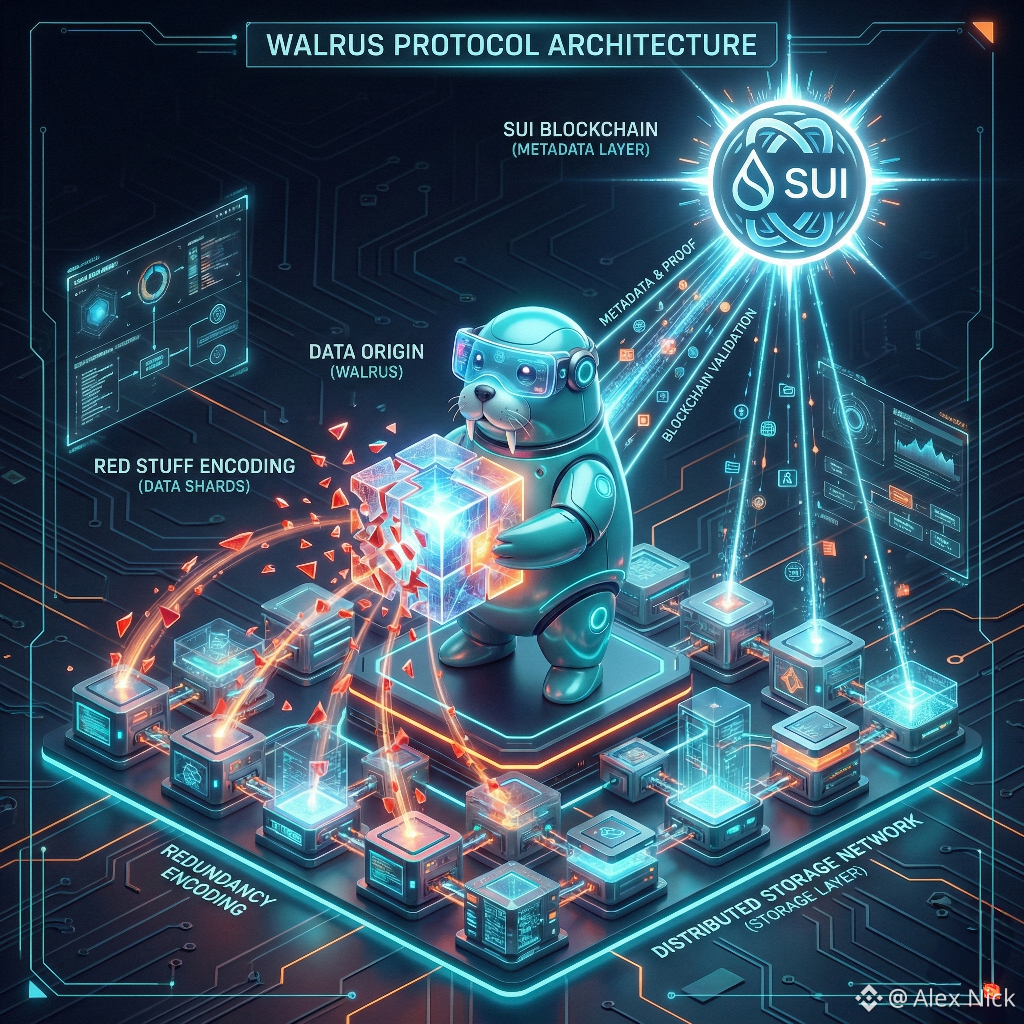
Walrus steps in here by trying to rebuild the storage layer in a way that actually fits the goals of Web3. When I first read about it, the idea that kept coming up for me was digital control. If someone else holds your data, then you are not in control, no matter what the blockchain promises. Walrus treats data as something that should be protected by mathematics and incentives instead of trust. I like this mindset because it removes the need to believe in a company or a server provider.
The team built Walrus on $SUI , and at first I did not fully understand why. After spending more time looking into it, the structure finally made sense to me. Sui organizes data as separate objects that can be processed independently. That means Walrus can link stored data to these objects without slowing everything down. There is no need for the entire network to sync on every action. This creates room for bigger storage tasks without turning the blockchain into a giant archive.
The storage process itself is interesting. Walrus takes a file, breaks it apart, encrypts the pieces, and sends them to different nodes. No one gets a full copy. No one can rebuild it alone. Even if some pieces go missing, the system can still recreate the original file. When I think about reliability, this is a huge improvement. It avoids the waste of storing complete copies everywhere while still keeping the data safe.
Privacy is built into the system from the start. Nodes only hold fragments they cannot understand. They cannot guess who owns the data or what it contains. This keeps users safe from internal leaks. At the same time, it creates a new challenge because the system cannot index or categorize the data. That part is left to applications. I actually think this is a reasonable tradeoff. You cannot protect privacy and still expect the network to automatically know everything about your files.
The WAL token ties the incentives together. Storage costs, rewards, penalties, and participation are all connected to it. I see it as the economic language of the system. Instead of having a central operator managing storage, the protocol uses payments and rules to coordinate everything. But I also understand that this only works if there is steady demand for storage. If demand does not grow, the token economy becomes unstable. So adoption plays a big role here.
One thing I appreciate is that Walrus is not pretending to solve every issue right away. It is more like a framework that can grow into something much larger. Web3 is expanding into digital identity, confidential financial transactions, and content systems. All of these areas need strong storage that cannot be censored or tampered with. Without that layer, the entire structure becomes weaker. Walrus offers a way to build that layer in a decentralized and mathematically sound way.
There are challenges though. Running a node for Walrus seems more demanding than running a basic blockchain node. You need more technical knowledge and better infrastructure. This might limit how many people join the network early on. Over time, the team will need to create tools that simplify the process. Otherwise, the system might be too concentrated among a few operators.
Another tradeoff is speed. A centralized server can give you instant access because everything is in one place. Rebuilding data from fragments takes more steps and adds delay. Walrus clearly chooses security, privacy, and resilience over immediate performance. This makes it better for long term storage and sensitive information rather than real time use cases.
What stands out most to me is that Walrus pushes the conversation in a new direction. Instead of treating storage as a secondary service, it treats it as a crucial part of decentralization. If Web3 is going to be more than a buzzword, it needs this type of infrastructure. Without it, developers are forced to rely on traditional systems that weaken the trust model.
To sum everything up, I see Walrus as a serious attempt to fix a missing piece of Web3. It builds a foundation for storing data securely, privately, and in a way that matches the values of decentralized systems. There are still hurdles related to adoption, complexity, and performance, but the project brings attention to a problem that many people ignore. If Walrus continues to grow and developers start building around it, it could become one of the essential parts of future decentralized infrastructure.

