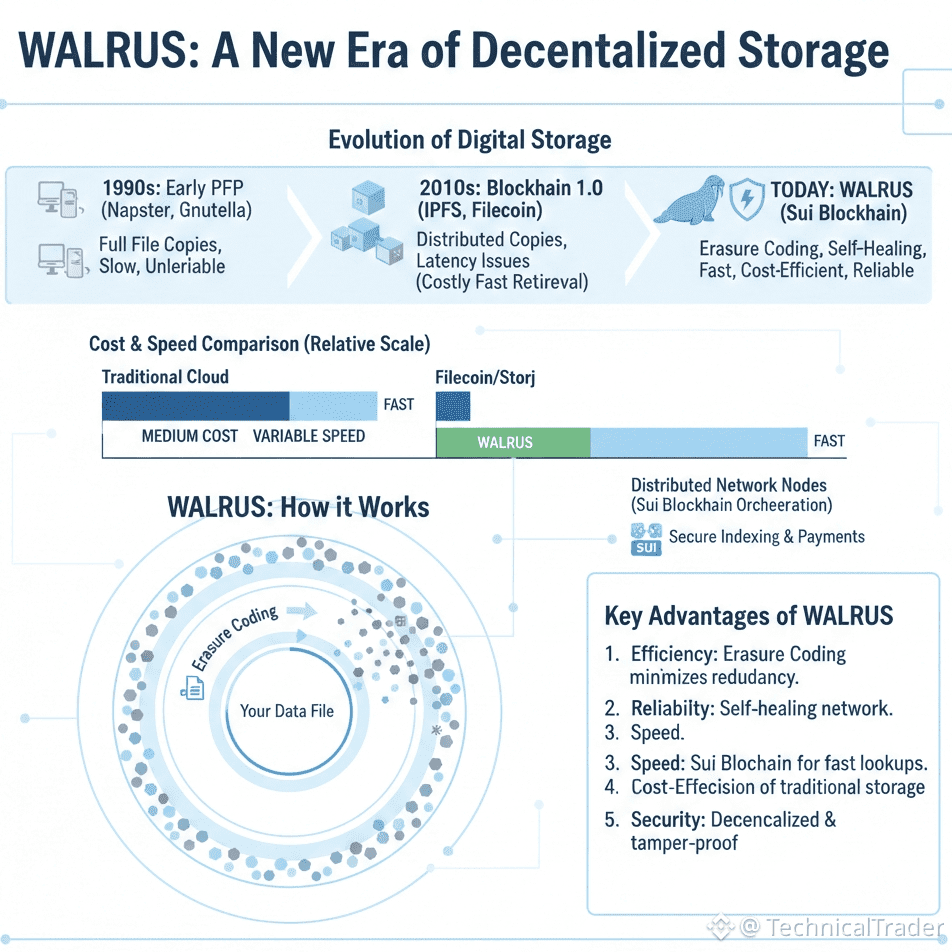
Have you ever wondered what happens to your digital files if the big companies hosting them suddenly go away? For a long time we have been searching for a way to store our information so that no single person or group can delete it. This journey started back in the nineties with the early peer to peer movement. Back then people wanted to make sure documents could stay online forever without being suppressed. We had old systems like Napster and Gnutella which were great for their time but they were often slow and not very reliable.
We can see that those early systems were just the beginning. They tried to keep files safe by making full copies on every computer in the network. As you can imagine that takes up a huge amount of space and makes everything move slowly. Later on researchers created better ways to find files across the web using smart math. But even those systems had flaws and were easy for hackers to trick. This is why we are now looking at Walrus because it takes all those old lessons and builds something much more modern and secure for us to use.
Learning from the Past to Build Walrus
If we look at the blockchain world today we have things like IPFS and Filecoin. These tools are definitely a step up because they let us store files across many different computers. However they still have some hurdles that make them tough for regular people to use. For example if you use Filecoin you might have to wait a really long time to get your data back unless you pay extra money for a fast copy. It feels a bit like paying for a storage unit but having to wait days for the manager to find your key.
This is where Walrus really starts to shine for you and me. Unlike those older systems Walrus doesn't make you jump through hoops to get your data. It uses the Sui blockchain to keep a perfect list of all the nodes in the network. This means the system always knows exactly where your data is and who is looking after it. We don't have to worry about the "churn" of nodes constantly disappearing because Walrus uses professional grade infrastructure. It is built to be fast and reliable which is exactly what we need when we are saving important work.
The Secret Math That Makes Walrus So Efficient
You might be asking how Walrus stays so cheap while keeping data safe. The secret is something called erasure coding. Instead of making five or ten full copies of your file which is very expensive Walrus breaks your data into many small shards. It is like a puzzle where you only need a few pieces to see the whole picture. Because of this Walrus only needs a tiny bit of extra space to ensure your data survives even if many computers in the network fail at the same time.
We can compare this to other projects like Storj. While Storj also uses similar math it has a hard time fixing itself if pieces go missing. Usually the user has to do the hard work of putting the file back together and re-uploading it. Walrus is much smarter because it has a built in way to heal itself automatically. If some storage nodes go offline the network just repairs the missing parts on its own. It gives us peace of mind knowing that our files are being looked after by a system that actually knows how to maintain itself.
Why the Connection to Sui Matters for Walrus
One thing I find really cool about Walrus is that it doesn't try to do everything by itself. Most storage networks try to build their own blockchain from scratch which is a massive task. Instead Walrus uses the Sui blockchain to handle the heavy lifting of security and payments. This allows Walrus to focus 100 percent on being the best storage tool possible. It is a great example of two different technologies working together to make our lives easier.
By using Sui the Walrus network stays very organized. We know that the people running the storage nodes are getting paid fairly and have a reason to keep the system running perfectly. It also means that writing new data to the network is fast and smooth. Even if a third of the network is having a bad day Walrus keeps working without a hitch. This level of reliability is something we haven't really seen in the decentralized world until now. It makes the whole experience feel much more professional and ready for everyday use.
Looking Toward a Cheaper and Faster Future with Walrus
As we move forward we are seeing more and more data being created every day. Storing a simple video on a traditional blockchain is way too expensive for most of us because every single person on that chain has to keep a copy. Walrus changes the game by offering a way to store huge amounts of data for a fraction of the cost. It is designed to scale with the internet so as we create more photos and videos Walrus can grow right along with us.
We are finally getting to a point where decentralized storage isn't just a dream for tech experts. With Walrus we have a system that is inexpensive fast and incredibly hard to break. It provides a way for us to keep our digital history safe for as long as we want without relying on a single big company. Whether you are a developer building the next big app or just someone who cares about data privacy Walrus is a huge step forward for all of us. It is an exciting time to see how this technology will change the way we live online.
what you think about this? don't forget to comment 💭
Follow for more content 🙂