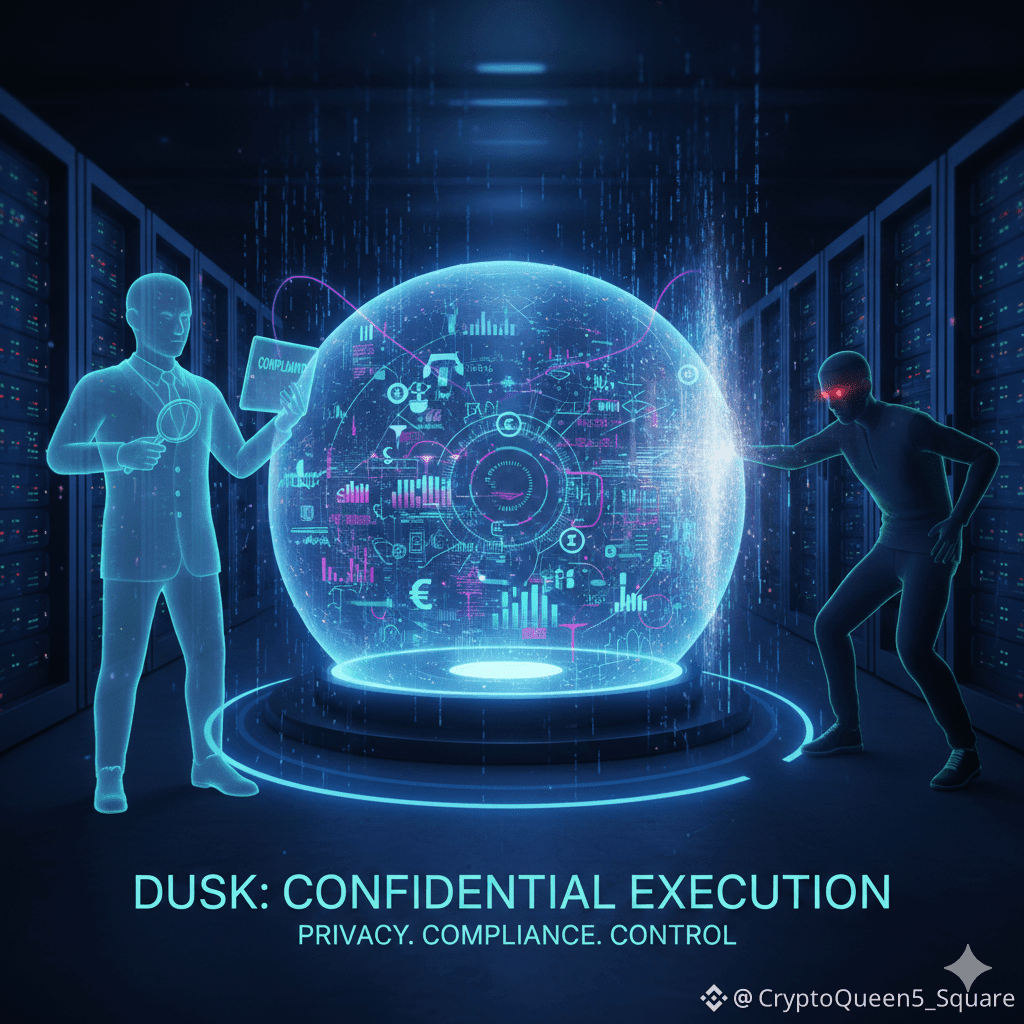
The promise of blockchain technology transparency, immutability, and decentralization has long been at odds with the fundamental requirements of institutional finance: privacy, compliance, and risk management. For a global investment bank or a major asset manager, a public ledger is often a liability rather than an asset. If every trade, every liquidity position, and every client movement is visible to the world, the institution loses its competitive edge and violates strict data protection laws. This is where Dusk and its Confidential Execution framework become essential.
Here is financial institutions need this specific brand of privacy to operate safely in the digital age.
1. Protecting Alpha and Market Strategy
In the world of high-stakes finance, information is the most valuable currency. If a large institution begins accumulating a specific asset, and that transaction is broadcasted on a transparent ledger (like Ethereum or Bitcoin), market predators use that data to front-run the trade.
Dusk’s Confidential Execution uses Zero-Knowledge Proofs (ZKP) to allow transactions to be verified without revealing the underlying data. This means an institution can execute a massive buy order or rebalance a portfolio without alerting the entire market to its strategy. By keeping the "what" and the "how much" hidden while proving the "that it happened," Dusk protects the alpha that institutions work so hard to generate.
2. Navigating the "Privacy-Compliance" Paradox
Financial institutions are caught between two opposing forces:
* GDPR/Data Privacy Laws: Which mandate that personal and financial data must be protected.
* AML/KYC Requirements: Which mandate that regulators must be able to see who is doing what to prevent money laundering.
On a standard public blockchain, you can’t have both. You either have total transparency (violating GDPR) or total anonymity (violating AML).
Dusk solves this through programmable privacy. Confidential Execution allows for "selective disclosure." The data remains encrypted to the public, but the institution can grant viewing keys to auditors or regulators. This creates a "safe" environment where privacy is the default, but compliance is guaranteed through math rather than manual reporting.
3. Eliminating Counterparty Risk
Safety in finance is often synonymous with settlement finality. In traditional systems, settling a trade can take days (T+2), during which time one party might fail.
Dusk enables Atomic Settlement. Because the execution is confidential and handled by the Citadel protocol (Dusk’s KYC/AML solution), assets can be swapped instantly and privately. There is no "limbo" period where a trade can fail due to external market volatility. The safety comes from the fact that the transaction only executes if all compliance checks hidden within the zero-knowledge proof are met simultaneously.
4. Preventing "MEV" and Exploitative Arbitrage
On transparent networks, "Maximal Extractable Value" (MEV) bots act as "invisible taxes," reordering transactions to profit at the expense of the user. For an institution moving millions of dollars, MEV is not just an annoyance it’s a breach of fiduciary duty.
Because Dusk’s execution is confidential, bots cannot see the contents of the mempool. They cannot see your price or your volume before the block is finalized. This creates a "dark pool" environment on-chain, ensuring that institutions get the best possible execution price without being exploited by predatory algorithms.
5. Secure Tokenization of Real-World Assets (RWA)
The next frontier of finance is the tokenization of private equity, real estate, and carbon credits. These assets involve sensitive contracts and non-public valuations.
If a bank tokenizes a private debt fund, they cannot have the terms of those loans sitting on a public explorer. Dusk’s Confidential Smart Contracts allow these assets to live on a blockchain while keeping the sensitive contract logic—like interest rates, collateral ratios, and participant identities—encrypted. This allows for the liquidity of the blockchain with the security of a private vault.
6. Institutional-Grade Sovereignty
Ultimately, safety for a financial institution means control. They need to know that their data won't be leaked, their trades won't be front-run, and their regulatory standing won't be compromised.
Dusk’s Piecrust (its unique ZK-virtual machine) is designed specifically for this. It allows for the execution of complex financial logic at scale, ensuring that the "Confidential" part of the execution doesn't come at the cost of performance. It provides a sovereign environment where the institution is the master of its data, but the blockchain provides the trustless infrastructure.
Summary: The New Standard
Financial institutions cannot "move fast and break things." They require systems that are private by design and compliant by necessity. Dusk’s Confidential Execution provides the only viable middle ground. It transforms the blockchain from a "public glass box" into a "secure digital vault," allowing the world’s largest capital allocators to finally bring their trillions of dollars in assets on-chain without fear of exposure or exploitation.