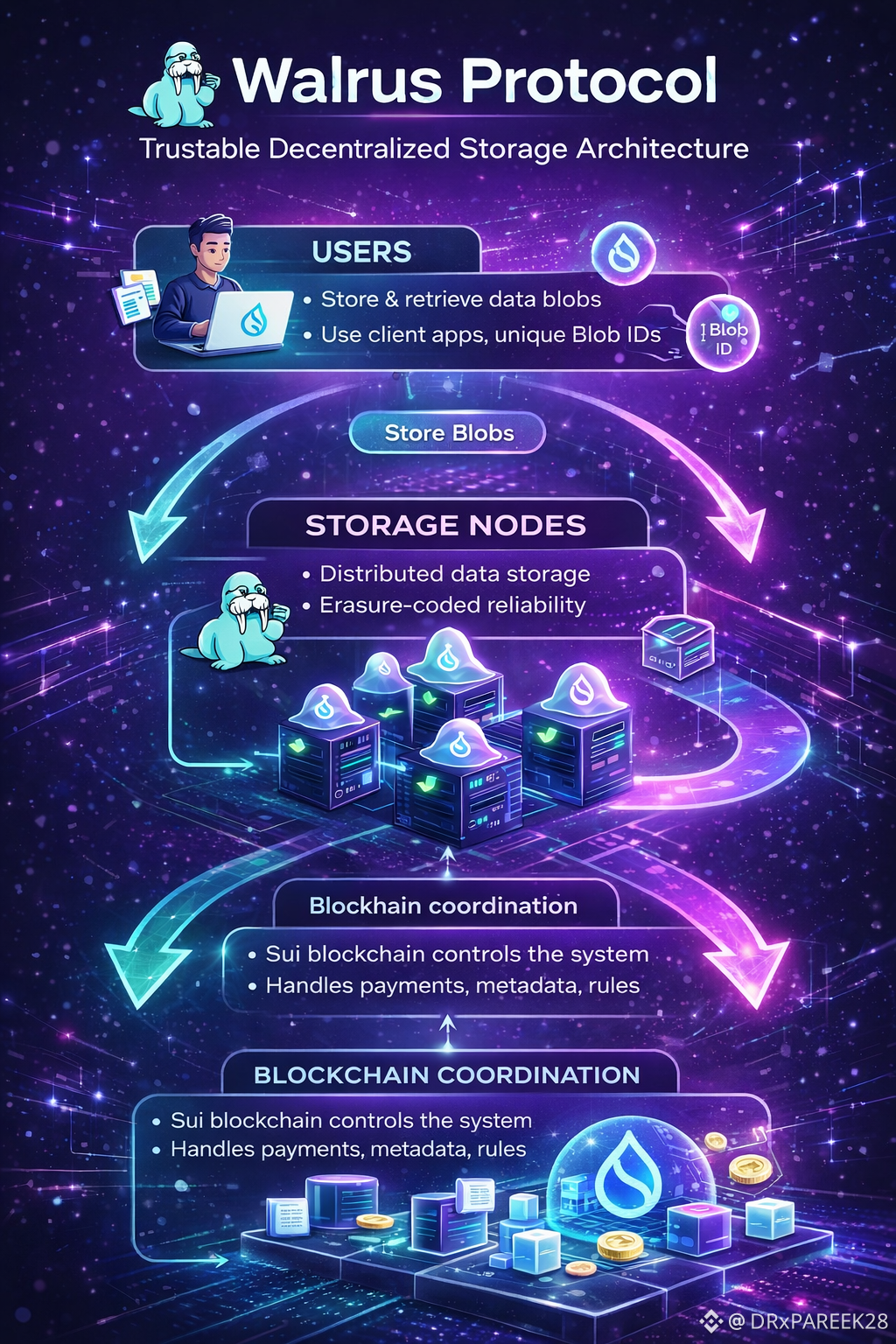
In the Web3 world, everyone talks about decentralization—but when it comes to data storage, most systems still behave like the old internet. Files are uploaded, stored somewhere invisible, and users simply “hope” that everything stays available and unchanged. That works for normal files, but when the future internet is becoming more dependent on AI, onchain apps, digital assets, and permanent data, “hope” is not enough.
This is where Walrus Protocol becomes extremely important.
Walrus is not just a storage platform. It’s a complete architecture designed to store and retrieve data blobs in a scalable, decentralized, and verifiable way. It focuses on building a storage system that is not only fast and cost-efficient—but also structured enough to support real-world applications reliably.
From the architecture shown in the content you provided, Walrus is built around a clean and logical design with three key actors working together: Users, Storage Nodes, and Blockchain Coordination. These three components make Walrus different from typical decentralized storage systems because responsibilities are clearly divided and the system remains manageable and secure.
1) Users: The People and Apps Driving the Network
The first key actor in Walrus architecture is Users.
Users are basically the clients—meaning people, apps, or developer systems—that store and retrieve data. But here’s an interesting thing Walrus does differently: it doesn’t treat your uploads like random files stored “somewhere.” Walrus treats every upload as a data blob.
A blob can be:
a file (image, video, PDF)
NFT metadata or media
application data
dataset chunks
AI model files
backups and archives
When users interact with Walrus, they do it through clients (software tools). These clients upload blobs and retrieve blobs whenever needed. Now, Walrus adds a major improvement here:
✅ Every stored blob is identified by its Blob ID.
Think of a Blob ID like the identity card of your data. It’s a unique reference that proves which exact data is stored. This gives two big benefits:
You can always request that exact blob later using the Blob ID.
The system avoids confusion and duplication because each blob has its own identity.
This Blob ID concept is very powerful for developers, because now the workflow becomes clean:
Upload blob → receive Blob ID → store Blob ID in app → retrieve anytime
So instead of relying on centralized URLs or cloud accounts, applications can rely on verifiable data identifiers.
That alone makes Walrus feel like “real infrastructure,” not just storage.
2) Storage Nodes: Where the Real Storage Happens
The second key actor is Storage Nodes.
Storage nodes are distributed machines/operators that actually hold the data. But Walrus does not store data in a basic way like copying full files everywhere. That would be expensive and inefficient.
Instead, Walrus uses a smarter and more professional method:
✅ Erasure-coded data storage
Erasure coding is basically a technique where a file is broken into multiple pieces and encoded with redundancy in such a way that even if some pieces are missing, the original file can still be reconstructed.
Imagine it like this:
If normal storage is like keeping 5 full copies of a file (wasteful),
erasure coding is like breaking the file into parts + backup math so it can be rebuilt even if some parts disappear.
This creates huge advantages:
Higher reliability: Even if some storage nodes go offline, your data can still be recovered.
Better efficiency: It doesn’t waste storage space like full replication.
Stronger decentralization: Data is spread across nodes, not stored in one place.
In real life, nodes will fail. Internet will drop. Machines will restart. But Walrus architecture assumes this reality and designs around it.
That is exactly what professional infrastructure should do: not pretend the world is perfect, but survive even when it isn’t.
3) Blockchain Coordination: The Brain That Controls Everything
Now comes the third actor—and honestly, this is what makes Walrus architecture feel next-level:
✅ Blockchain Coordination using Sui blockchain
Storage nodes store data, but without coordination a decentralized storage network can become chaotic. Who controls metadata? Who tracks payments? Who decides how storage is assigned? Who ensures rules are followed?
Walrus solves this by using blockchain coordination.
In the architecture you shared, the coordination layer is done by Sui blockchain, which handles:
Payments (storage contracts and economic layer)
Metadata management (information about blobs)
System orchestration (keeping the network coordinated)
So here’s the most important point:
Walrus stores data off-chain, but controls the system on-chain.
That’s a perfect design.
Because storing huge files directly on blockchain is expensive and slow. But storing everything off-chain without control creates trust problems.
Walrus balances both:
Nodes store the heavy data
Blockchain enforces the rules
That’s how you build a decentralized storage system that can actually scale.
How These 3 Actors Work Together
When you put it all together, Walrus feels like a clean pipeline:
Users upload a blob using a client
The system assigns a Blob ID
Storage nodes store the blob using erasure coding
The blockchain coordinates payments + metadata + orchestration
Users retrieve the blob later using the Blob ID
So the system doesn’t depend on one server or one company.
It depends on:
distributed storage nodes for persistence
onchain coordination for order and trust
client-based interaction for developer freedom
Why This Architecture Matters
This is not just technical beauty—it’s a big deal for the future internet.
Because the next generation of apps will require:
permanent storage
secure access
verifiable files
censorship resistance
reliability at scale
Think about areas like:
AI datasets that must remain unchanged
decentralized social media content
NFT assets that shouldn’t disappear
game assets that must stay available forever
Web3 apps that need predictable data storage
Walrus architecture supports these future use cases because it is not based on assumptions like “nodes never fail” or “trust a central platform.”
Instead, it builds with realistic assumptions:
nodes can fail
systems need coordination
users need verifiable IDs
data should be distributed and recoverable
Final Thoughts
Walrus Protocol is building more than decentralized storage—it’s building a storage infrastructure blueprint for Web3.
The architecture is powerful because it’s simple but strong:
Users interact through clients
Data is stored as blobs with Blob IDs
Storage nodes hold erasure-coded data
Blockchain coordination on Sui manages payments, metadata, and orchestration
That’s the kind of system that can support serious applications—not just experiments.
In the coming years, as data becomes more valuable than ever, storage networks won’t be judged by hype—they’ll be judged by architecture. And Walrus is clearly designed with long-term reliability in mind.