

Most people think the main problem of digital systems is how to store things, but over time a quieter problem appears: how things get forgotten. Servers are replaced, teams move on, formats change, and the original reasons for keeping certain data often disappear. In decentralized systems this problem is even sharper, because there is no single owner whose job it is to keep everything alive forever. Walrus can be understood as a response to this slow erosion of memory. Instead of assuming that someone will always be there to maintain files, it builds a system where data survival is a property of the network itself. By splitting data into pieces and distributing responsibility, it treats information as something that should survive ordinary change rather than something that depends on constant care.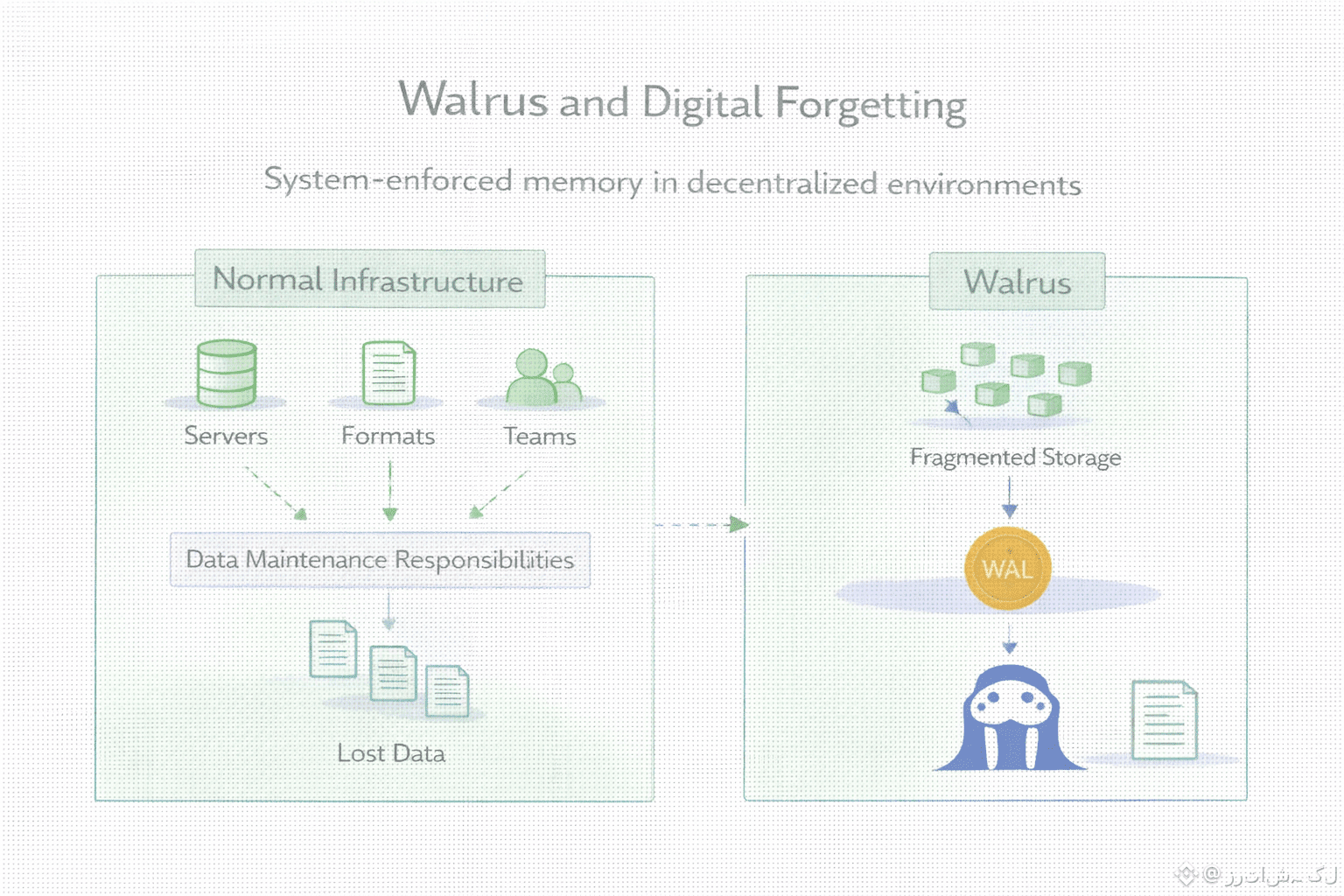
This changes how we think about storage. Normally, storage is a promise made by a company or a team: “we will keep this for you.” Walrus replaces that promise with a structural rule: as long as enough of the system exists, the data can be recovered. This is a subtle but important shift. It does not rely on motivation, reputation, or long-term organizational stability. It relies on design. Over long periods of time, design usually outlives institutions. Teams dissolve, business models change, and priorities move on, but protocols tend to persist if they are useful. In that sense, Walrus is less like a warehouse and more like a library whose books are copied and spread across many places so that no single fire can erase them.
This way of thinking matters because more and more applications are becoming historical by nature. Games, social platforms, digital identities, and onchain records are not just about the present moment. They are about continuity. If those systems quietly lose pieces of their past, they lose part of their meaning. Walrus does not solve this by making bold promises, but by accepting that loss, change, and failure are normal. Its design assumes the world will not stay tidy. That is what makes it a long-term tool rather than a short-term convenience.

