
When I first looked into WAL staking rewards, I realized that Walrus is not trying to attract attention with short term hype. Instead, it is building a system focused on long term sustainability, fair incentives, and real usage. Walrus approaches staking differently because onchain storage is fundamentally different from typical transaction based blockchain platforms. This difference shapes how rewards are designed and why patience plays such an important role.
Walrus is built for decentralized storage, not just executing transactions. That single distinction changes everything about how costs, rewards, and growth work inside the ecosystem.
Why Onchain Storage Changes the Economics
Onchain storage has a very different cost structure compared to traditional smart contract platforms. In high throughput blockchains, validators mostly deal with fixed costs. In storage infrastructure, variable costs grow as more data is stored. If the network goes from storing one unit of data to two, it often needs much more physical capacity because data must be distributed across many machines to remain secure and resilient.
This is why Walrus is designed around a model where approximately five times more raw data is stored than what users actually upload. This replication ratio sits at the frontier of efficiency for decentralized storage and ensures data safety without unnecessary waste.
Storage Is a Service Over Time
One of the most important ideas behind Walrus staking rewards is that storage is an intertemporal service. When users pay for storage, they often pay upfront. However, the service itself is delivered over time. Data must remain secure and accessible across many epochs, not just at the moment of payment.
Because of this, Walrus charges fees at the beginning, but distributes them gradually. Fees are linear based on the amount of data stored and the duration of storage. This structure ensures that data remains protected throughout its lifetime, unlike transaction platforms where execution happens instantly.
How Pricing and Rewards Are Balanced
Walrus follows a clear and transparent pricing model governed by four core rules. Users pay a reduced price because of subsidies, while nodes and stakers receive incentives that support long term operation.
What matters most to me here is balance. Users get benefit from lower costs and storage nodes earn much to cover their expenses, and stakers receive rewards tied to actual network usage. This alignment is intentional and avoids creating artificial or unsustainable incentives.
The Role of Subsidies in Early Growth
Walrus includes a 10 percent token allocation dedicated to adoption and early growth. Part of these tokens are used as subsidies. This allows users to access decentralized storage at a fraction of the market price, while still ensuring storage operators earn much revenue to remain viable.
Remember this These subsidies are not permanent. They are designed to help the ecosystem grow during its early phase. As adoption increases, storage operators work to reduce their fixed costs per unit of data. Over time, improvements in storage hardware and operational efficiency naturally lower prices.
The goal is clear: long term sustainability even after subsidies are phased out.
Why Staking Rewards Start Low
One of the most misunderstood aspects of WAL staking is that rewards start at a very low rate. At first glance, this might seem unattractive. But when I looked deeper, the reasoning became clear.
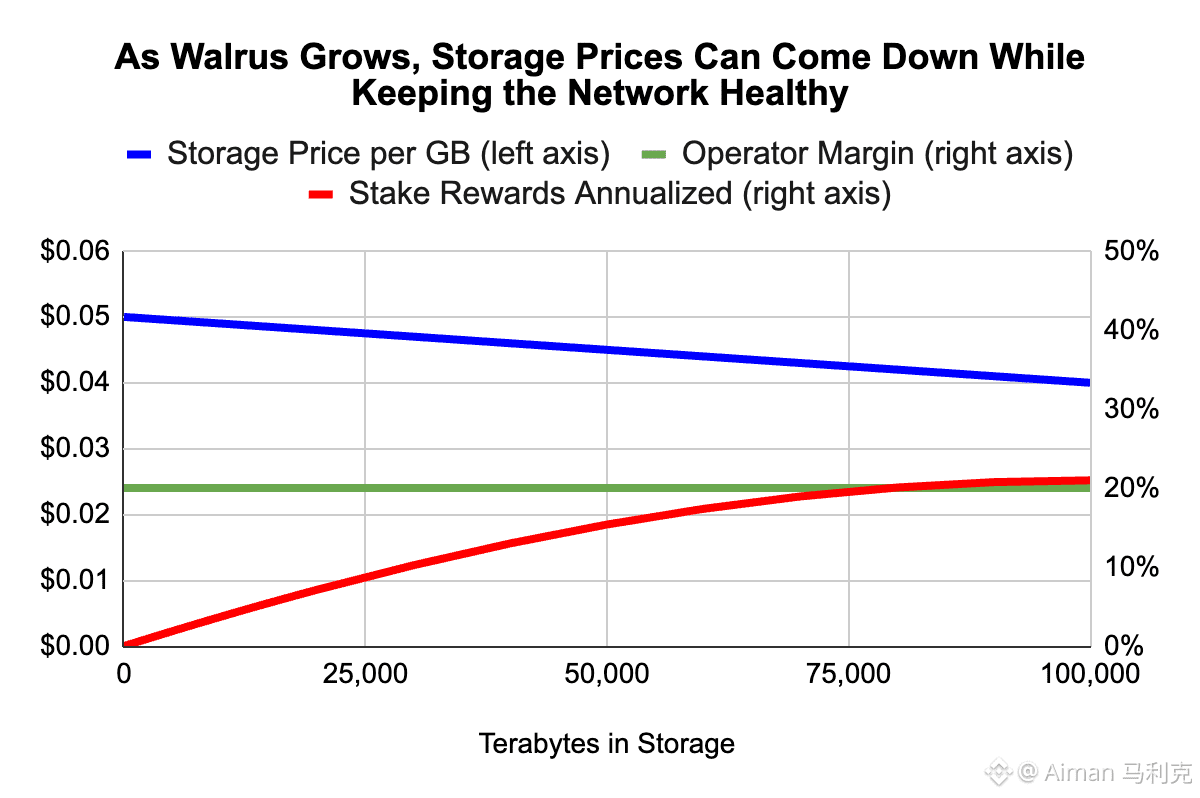
Walrus is prioritizing network health over short term incentives. Low initial rewards prevent excessive speculation and ensure that early participants are aligned with long term success. As the network grows and more data is stored, rewards naturally increase.
This means participants are consciously trading short term gains for a stronger ecosystem.
How Rewards Scale With Network Growth
There is a fundamental difference between storage operators and stakers. Storage operators face real costs that increase as more data is stored. Capacity must scale with usage. Stakers, on the other hand, do not face these operational costs.
As Walrus adoption grows, storage operators receive more revenue to offset their higher expenses. Stakers benefit even more, because their rewards increase without a corresponding rise in costs. Over time, this creates increasingly attractive staking returns as the network matures.
This is where patience is rewarded.
Capital Efficiency Improves Over Time
Another key insight is how user costs decrease as Walrus scales. As the network becomes more efficient, some of the gains naturally flow back to users in the form of lower storage prices.
This does not harm operators. Instead, market mechanics adjust commissions so operators can maintain healthy margins. Commission rates rise as prices fall, keeping operations sustainable while still allowing stakers to benefit from network growth.
This dynamic creates a fair balance between users, operators, and stakers.
A System Designed for Everyone to Win
What stands out most to me is how carefully the system is designed to avoid conflict between participants. Users gain access to affordable decentralized storage. Operators maintain viable businesses. Stakers earn increasing rewards over time.
No single group benefits at the expense of another. Instead, growth strengthens the entire ecosystem.
Walrus staking rewards are not built to impress on day one. They are built to last. Early participants accept lower returns in exchange for contributing to a system that becomes stronger with real adoption.
As you see storage demand increases, rewards scale naturally. Costs decline. Efficiency improves. The entire ecosystem benefits from this growth flywheel.
From my perspective WAL staking rewards represent a mature approach to decentralized finance. They are grounded in real usage, real costs, and real value creation. Rather than chasing short lived incentives, Walrus focuses on building a sustainable storage economy that rewards patience and participation.
For those who understand long term systems, WAL staking is not about what you earn today. It is about what you help build for tomorrow.

