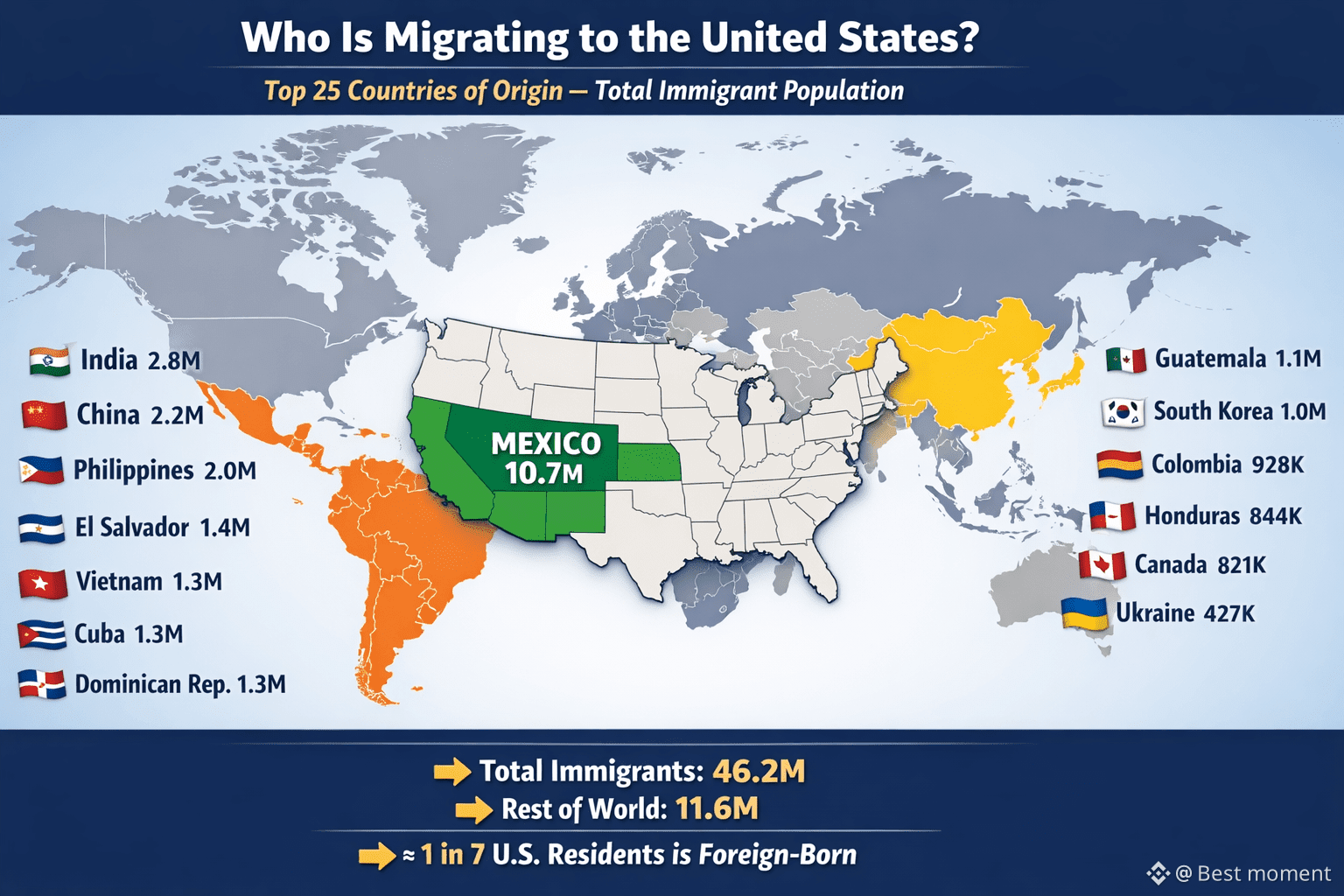
📊 Top 25 Countries of Origin for Immigrants in the United States (by Total Population)
🇲🇽 Mexico – ~10.7M
🇮🇳 India – ~2.8M
🇨🇳 China – ~2.2M
🇵🇭 Philippines – ~2.0M
🇸🇻 El Salvador – ~1.4M
🇻🇳 Vietnam – ~1.3M
🇨🇺 Cuba – ~1.3M
🇩🇴 Dominican Republic – ~1.3M
🇬🇹 Guatemala – ~1.1M
🇰🇷 South Korea – ~1.0M
🇨🇴 Colombia – ~928K
🇭🇳 Honduras – ~844K
🇨🇦 Canada – ~821K
🇯🇲 Jamaica – ~805K
🇭🇹 Haiti – ~731K
🇬🇧 United Kingdom – ~677K
🇻🇪 Venezuela – ~668K
🇧🇷 Brazil – ~619K
🇩🇪 Germany – ~537K
🇷🇺 Russia – ~518K
🇵🇪 Peru – ~472K
🇳🇬 Nigeria – ~448K
🇺🇦 Ukraine – ~427K
🇮🇷 Iran – ~407K
🇵🇰 Pakistan – ~399K
➡️ Rest of world: ~11.6M
➡️ Total U.S. immigrant population (foreign-born): ~46.1M+ (≈13.8% of U.S. residents) �
Pew Research Center +1
📌 Key Insights & Clarity
🇲🇽 Mexico dominates by a wide margin.
Mexico is by far the largest source of U.S. immigrants, with more than 10 million residents born there — roughly one in five of all immigrants in the U.S. �
Pew Research Center
🌍 Latin America and Asia lead the flow.
Latin American nations (Mexico, El Salvador, Guatemala, Dominican Republic, etc.) collectively account for a large share, while major Asian sources like India, China, the Philippines, and Vietnam reflect strong economic, educational, and family-linked migration. �
Pew Research Center
🌐 Growing diversity beyond traditional flows.
In recent decades, migration has diversified significantly: Eastern European (Ukraine, Russia), African (Nigeria), Middle Eastern (Iran), and South American (Venezuela, Colombia) origin groups now appear prominently in the top 25 — a shift from earlier historical patterns dominated by European migration. �
Pew Research Center
📊 Long-term trends matter.
These patterns reflect decades of policy, economic ties, and network effects: family reunification, employment opportunities, refugee flows, and educational migration shape who comes and stays in the U.S. �
migrationpolicy.org
🧠 Bottom Line:
The U.S. immigrant population is large and diverse. Mexico remains the largest origin country by far, but Asia and Latin America together make up the bulk of today’s foreign-born residents. Smaller but still significant communities from Africa, Europe, and the Middle East underscore how global migration to the U.S. has evolved. �