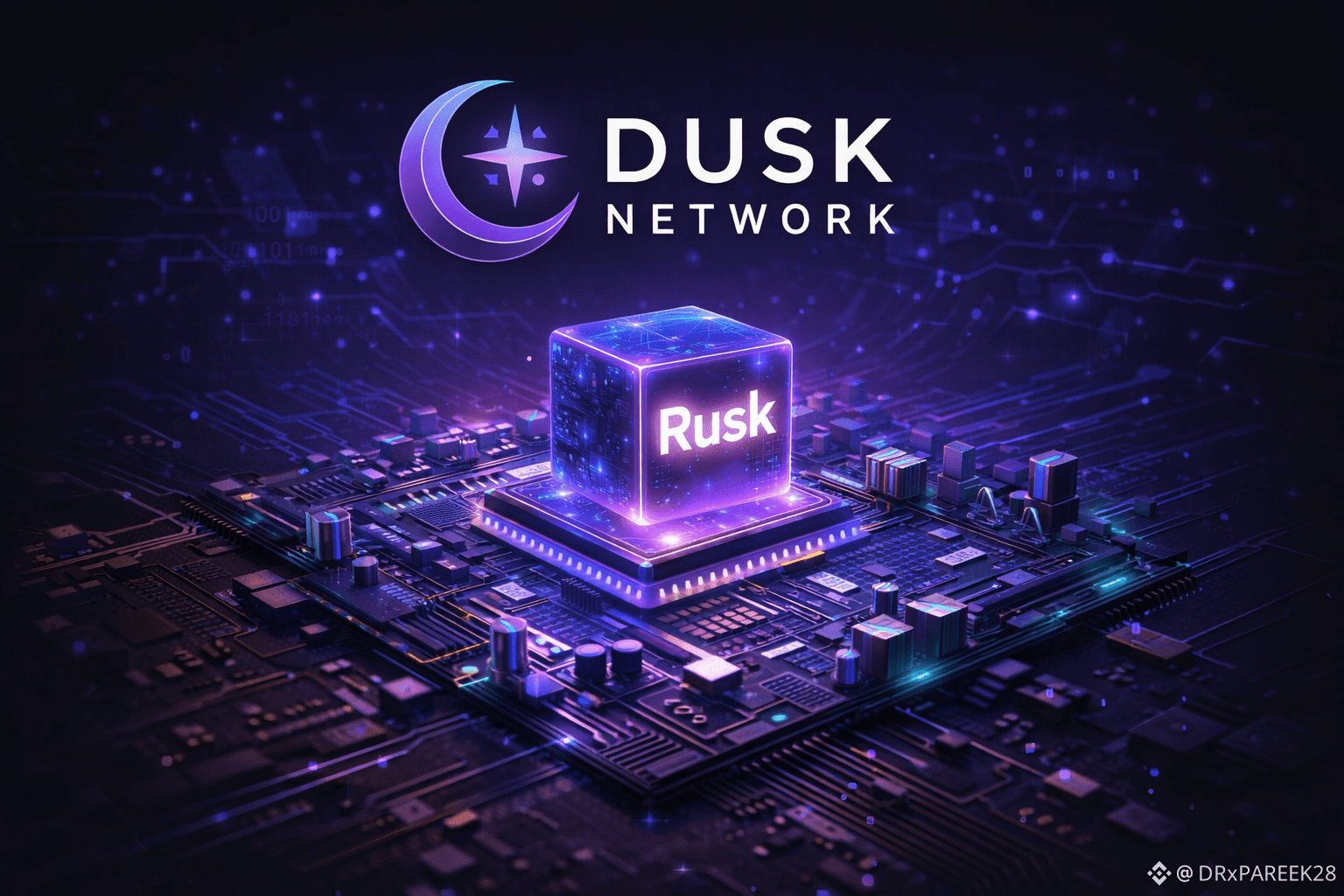
At the core of the Dusk ecosystem lies a component that rarely receives mainstream attention, yet quietly determines how the entire network functions: Rusk. Often compared to the motherboard of a computer, Rusk is not a single feature or tool, but the technological heart that binds the Dusk protocol into a coherent, secure, and operational blockchain system. To understand how Dusk Network truly works beneath the surface, one must understand the role Rusk plays.
Rusk is the reference implementation of the Dusk protocol written in Rust, a language chosen deliberately for its performance guarantees, memory safety, and suitability for low-level, security-critical systems. Rather than being an abstract layer, Rusk is the environment where the protocol’s rules are enforced in real time. It defines how the chain behaves, how state is maintained, and how all critical components communicate with one another. Without Rusk, Dusk would be a specification on paper rather than a living, executing network.
One of Rusk’s most important responsibilities is hosting the genesis contracts that define the blockchain’s foundational logic. These contracts, including those responsible for value transfers and staking, are not optional modules but integral parts of the system. By embedding them directly within Rusk, Dusk ensures that its most sensitive economic and security mechanisms are executed in a controlled and deterministic environment. This removes ambiguity and prevents the kinds of inconsistencies that can arise when foundational logic is treated as just another deployable smart contract.
Beyond genesis logic, Rusk integrates the cryptographic and execution frameworks that give Dusk its privacy-preserving capabilities. Components such as PLONK-based zero-knowledge proving systems, Kadcast for efficient block propagation, and the Dusk Virtual Machine are all orchestrated through Rusk. Rather than existing as disconnected subsystems, they are coordinated under a single implementation, ensuring that privacy, execution correctness, and network performance reinforce each other instead of competing for resources.
Rusk also serves as the home of the consensus mechanism and node software. It is responsible for maintaining the chain state, managing the database, and handling peer-to-peer networking. Every node running on Dusk relies on Rusk to remain synchronized with the network, validate blocks, and enforce protocol rules. This makes Rusk not just a development framework, but the operational backbone of decentralization itself. If consensus is the social contract of a blockchain, Rusk is the code that enforces it without bias or discretion.
For developers, Rusk provides structured host functions through Dusk Core, acting as a bridge between low-level protocol logic and higher-level smart contract development. This abstraction allows developers to focus on application logic while relying on Rusk to handle cryptography, state transitions, and execution guarantees. Importantly, this design choice reduces the surface area for critical errors, since the most complex operations are centralized in a well-audited, protocol-level implementation.
Rusk also exposes external APIs through the Rusk Universal Event System, enabling interaction with wallets, tools, and external services. These APIs are not an afterthought but a deliberate part of the architecture, designed to make the protocol observable and usable without compromising its privacy guarantees. Events can be consumed, analyzed, and acted upon without revealing sensitive internal data, preserving Dusk’s core design philosophy.
In essence, Rusk is where theory becomes reality. It transforms cryptographic promises, economic models, and protocol specifications into a functioning system that runs continuously and predictably. While users may interact with Dusk through wallets or applications, and developers may focus on smart contracts, it is Rusk that ensures every action conforms to the rules defined at genesis. Its quiet reliability is precisely what makes it powerful.
By anchoring the entire protocol in a single, cohesive implementation, Dusk avoids fragmentation and inconsistency—two problems that have plagued many blockchain ecosystems. Rusk does not seek attention, but it earns trust through correctness, stability, and discipline. In the long run, this invisible engine may be one of the strongest reasons Dusk can scale from an experimental blockchain into an infrastructure suitable for real-world, privacy-sensitive finance.