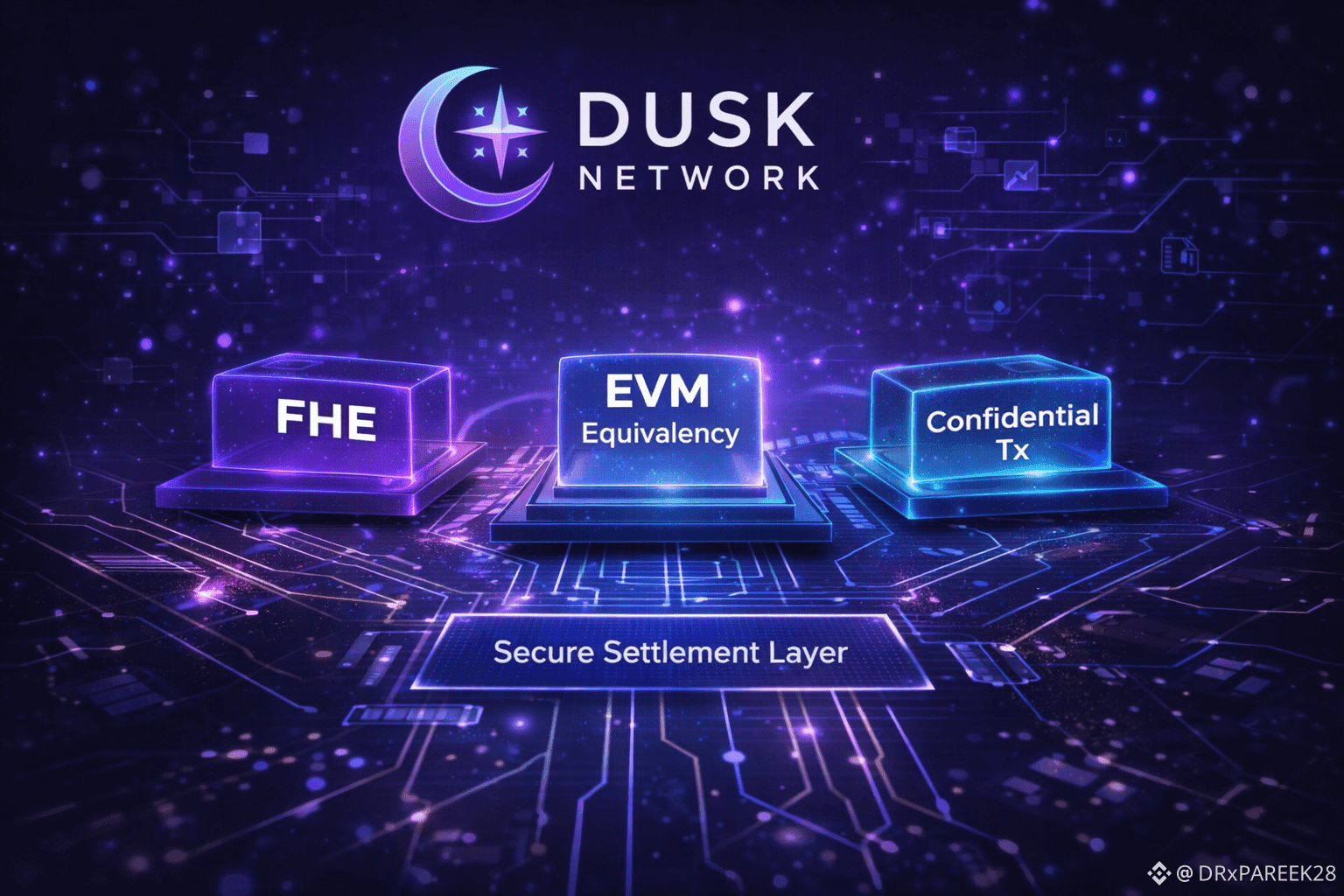
The design of modern blockchains is no longer just about consensus and transactions; it is about how computation itself is executed. One of the most advanced aspects of Dusk Network—its approach to execution environments. Rather than forcing all applications into a single virtual machine or computational model, Dusk introduces a flexible architecture that supports multiple specialized execution environments, each optimized for different real-world needs.
At the foundation of this design lies DuskDS, the settlement and data availability layer that guarantees security, finality, and compliance. Execution environments do not replace this layer; instead, they sit on top of it. This separation between execution and settlement is a deliberate architectural choice. It allows Dusk to experiment, optimize, and scale computation without compromising the core guarantees of the network. In simpler terms, no matter how complex or specialized the computation becomes, it always settles back into the same secure and compliant base layer.
One of the most important implications of this model is performance. By decoupling execution from settlement, Dusk avoids the bottlenecks that affect monolithic blockchains. Heavy computation can be handled in environments tailored for specific tasks, while DuskDS focuses on what it does best: ordering transactions, maintaining state consistency, and enforcing protocol rules. This approach enables high-throughput computation without sacrificing determinism or security.
Privacy plays a central role in these execution environments. Dusk is designed to support advanced techniques such as fully homomorphic encryption and zero-knowledge computation, enabling confidential transactions and smart contract execution. Instead of treating privacy as an optional feature, Dusk makes it a first-class concern at the execution level. Developers can choose environments that allow sensitive data to remain encrypted throughout computation, while still producing results that the network can verify. This is a significant departure from traditional smart contract platforms, where privacy often requires awkward workarounds or external systems.
Equally important is regulatory alignment. Many blockchain platforms struggle to balance decentralization with compliance, often leaning too far in one direction. Dusk’s execution environment model addresses this tension directly. Because execution inherits the settlement guarantees of DuskDS, applications can prove correctness, enforce rules, and selectively disclose information when required. This makes the network particularly suitable for regulated use cases such as tokenized securities, private financial contracts, and institutional DeFi, where both confidentiality and auditability are essential.
Composability is another key strength of this architecture. Even though execution environments may differ in how computation is performed, they all ultimately settle on the same base layer. This ensures that applications remain interoperable rather than siloed. Assets, contracts, and state transitions can interact across environments without fragmenting the ecosystem. In practice, this means developers are free to innovate at the execution level without breaking the broader system.
From a long-term perspective, Dusk’s execution environments represent a future-proof strategy. As cryptography evolves and new computation models emerge, Dusk does not need to redesign its entire protocol. New environments can be introduced on top of DuskDS, inheriting its security and compliance guarantees while extending its capabilities. This modularity allows the network to adapt over time without sacrificing stability.
In essence, the execution environment model reflects Dusk’s deeper philosophy. Instead of forcing one solution to fit all use cases, Dusk provides a structured framework where privacy, performance, and regulation are not competing goals but complementary ones. By separating execution from settlement and allowing specialization without fragmentation, Dusk positions itself as a blockchain designed not just for experimentation, but for real-world adoption at scale.