
Most people still talk about Walrus as if it’s just another decentralized storage layer. That framing is not only lazy — it completely misses why Walrus exists and where its real leverage lies. Walrus is not competing to be cheaper storage or “IPFS but better.” It’s attacking a deeper problem: how blockchains coordinate persistent data under churn without collapsing trust assumptions.
That distinction matters, especially now.
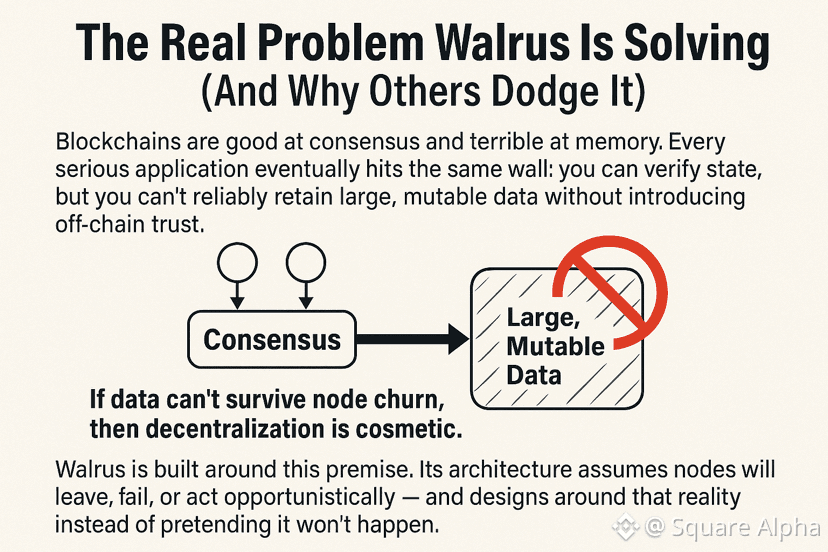
The Real Problem Walrus Is Solving (And Why Others Dodge It)
Blockchains are good at consensus and terrible at memory. Every serious application eventually hits the same wall: you can verify state, but you can’t reliably retain large, mutable data without introducing off-chain trust.
Most systems paper over this by outsourcing availability and hoping incentives hold. Walrus doesn’t. It treats data availability as a first-class coordination problem, not an afterthought.
The key insight is brutal in its simplicity:
If data can’t survive node churn, then decentralization is cosmetic.
Walrus is built around this premise. Its architecture assumes nodes will leave, fail, or act opportunistically — and designs around that reality instead of pretending it won’t happen.
Mechanism: Why Walrus Behaves Differently Under Stress
What separates Walrus from the pack isn’t a single feature — it’s behavioral resilience.
Walrus continuously reorganizes data placement as nodes enter and exit. That means availability isn’t static; it’s adaptive. Under normal conditions, this looks boring. Under stress — network volatility, validator rotation, incentive shocks — it’s the difference between data persistence and silent failure.
Most traders don’t price this in because it doesn’t show up in a demo. It only shows up when things go wrong.
And things always go wrong at scale.
This is where Walrus quietly flips the script:
Instead of asking, “How cheap can storage be?” it asks, “How predictable can availability remain when assumptions break?”
That’s a much harder question — and far more valuable.
What People Misunderstand About Walrus + Sui
Walrus being native to the Sui ecosystem is often framed as a limitation. That’s backward thinking.
Sui’s object-centric model and high-throughput execution aren’t just performance upgrades — they’re coordination upgrades. Walrus benefits directly from this by anchoring data logic closer to execution logic. The result is tighter coupling between what is stored and how it is used.
This matters for real applications:
On-chain games with large mutable assets
Social protocols with user-generated content
AI pipelines that require verifiable data persistence
These are not “store once, read forever” use cases. They are dynamic, messy, and adversarial. Walrus is designed for that world, not the clean-room version most whitepapers assume.
Second-Order Effects Most People Ignore
Here’s where it gets interesting.
By making data availability predictable under churn, Walrus lowers the risk premium for builders. That changes behavior.
Developers stop over-engineering redundancy. Protocols stop relying on centralized fallbacks “just in case.” Suddenly, entirely new classes of applications become economically viable.
This isn’t a feature-level advantage — it’s a behavioral unlock.
Over time, this compounds:
More serious applications deploy
Usage becomes sticky, not speculative
Data stored becomes harder to migrate elsewhere
That last point is critical. Walrus doesn’t just host data — it anchors ecosystems.
Market Reality: Why This Is Mispriced
Let’s be blunt: the market loves narratives that move fast and ignores infrastructure that moves correctly.
Walrus doesn’t generate hype candles. It generates reliability. That’s why it’s misunderstood — and why it’s dangerous to fade.
As regulation tightens and institutional players demand guarantees around data integrity and availability, hand-wavy storage solutions won’t cut it. Systems that can prove behavior under adverse conditions will win by default.
Walrus is positioned squarely in that lane.
The Deciding Factor Going Forward
Walrus will not succeed or fail based on marketing, partnerships, or short-term token action.
It will be decided by one thing:
Do serious applications trust it with irreplaceable data?
The signal to watch isn’t TVL or social buzz. It’s:
Long-lived applications choosing Walrus by default
Data that stays put through market cycles
Builders designing around Walrus instead of abstracting it away
When that happens quietly — and it will — the narrative will lag the reality.
By the time most people realize Walrus isn’t “just storage,” the coordination edge will already be priced in.
Smart observers don’t wait for headlines.
They watch where data chooses to live.

