Here’s the unspoken truth about Walrus: it isn’t just a storage network; it’s a behavioral lever. Most observers focus on capacity or uptime metrics, but the real game is how Walrus shapes developer decisions. When teams know their data will survive node churn without constant babysitting, their engineering and economic assumptions shift — often in ways that incumbents cannot anticipate.
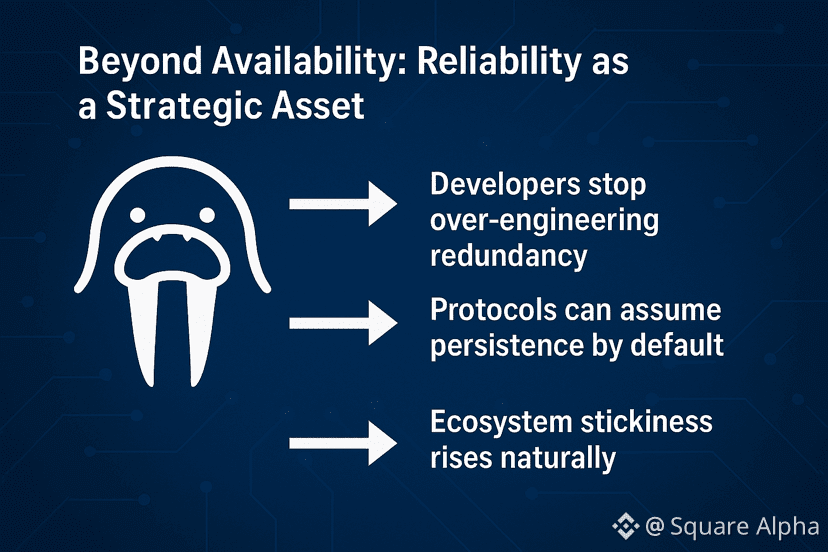
Beyond Availability: Reliability as a Strategic Asset
Walrus’s design flips the conventional risk calculus. Traditional decentralized storage treats node churn as a cost to be mitigated; Walrus treats it as an operational constant. This distinction changes everything:
Developers stop over-engineering redundancy: Less capital wasted on backup systems, fewer centralized shortcuts.
Protocols can assume persistence by default: Business logic and smart contracts become more deterministic, reducing failure modes.
Ecosystem stickiness rises naturally: Once builders integrate deeply, moving away is expensive both technically and socially.
This is subtle but profound. Reliability isn’t just a metric; it’s an economic moat.
Misread Market Perception
The market still underestimates Walrus because reliability is boring. Hype cycles reward flashy yield, not quiet operational excellence. Traders mistake low volatility and lack of headlines for lack of progress. They fail to recognize that long-term systemic resilience compounds value quietly, often invisible to superficial metrics like daily volume or token velocity.
Second-order effects amplify this:
As protocols rely on Walrus for dynamic content or mutable state, alternative storage solutions lose relevance.
Walrus’s network effects aren’t measured in nodes alone, but in developer confidence — an asset far harder to replicate.
The underestimation is not temporary; it’s a structural blind spot that rewards disciplined observers.
Implications for Adoption and Scaling
Integration with Sui isn’t a minor detail — it’s the launchpad for higher-order functionality. Walrus isn’t just storing data; it’s orchestrating how Sui applications reason about persistence.
Consider the stress test scenarios most onlookers ignore:
Rapid user growth in games or social dApps – Data churn spikes unpredictably. Walrus adapts dynamically.
Cross-chain bridges and off-chain computation – Consistency guarantees reduce friction in composability.
Regulated or institutional applications – Proof of persistent storage becomes a compliance enabler.
Under these conditions, alternative solutions either break or force centralized fallbacks. Walrus thrives.
The Real Edge
The market talks about decentralization and storage economics. Walrus’s edge is coordination under stress. In practice, this is equivalent to saying:
“Your application logic can assume truth, even when the network is chaotic.”
This is not a minor technical detail — it’s a foundational advantage that shapes which applications survive and which fail. It’s the difference between building a transient experiment and a sticky platform.
What to Watch Next
Success or failure will hinge on adoption by serious, risk-averse builders, not speculative hype. Smart observers should track:
Long-duration deployments that survive multiple network churn cycles
New protocols designing around Walrus as the primary persistence layer
Ecosystem messaging around reliability and guaranteed data availability
If these signals emerge, Walrus isn’t just “another storage project” — it becomes a keystone infrastructure, quietly controlling where developers allocate attention and capital.
The narrative will catch up eventually. By then, the edge will already be irreversible.