


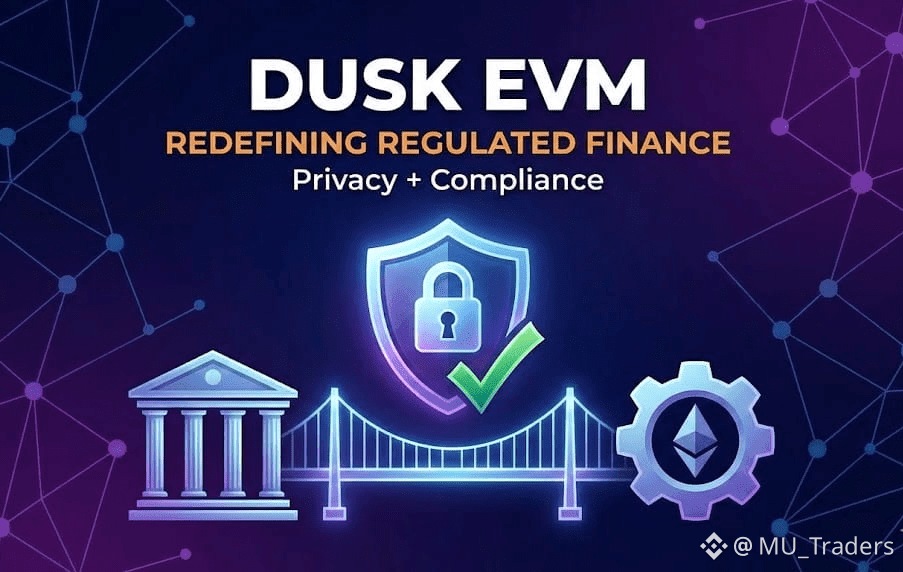
You’ve probably seen many Layer‑1 and Layer‑2 chains chase adoption by touting scalability or low fees, but Dusk Network is quietly doing something few other protocols are attempting: embedding privacy and real‑world compliance into an Ethereum‑compatible execution environment in a way that actually aligns with regulated markets. That combination isn’t just technical complexity. It’s a potential foundation for regulated financial services built on blockchain instead of beside it. (Dusk Forum)
why the EVM layer matters more than most realize
At the heart of this shift is DuskEVM, the EVM‑compatible execution layer now running a public testnet and progressing toward mainnet. It allows developers to use standard Ethereum tooling like Solidity, MetaMask, and familiar deployment pipelines while settling transactions on Dusk’s settlement layer. This matters because it drastically reduces friction for builders and institutions that otherwise have to rebuild or adapt tooling to custom ecosystems. (Dusk Forum)
Most chains with privacy goals isolate themselves with bespoke stacks that developers avoid because of tooling and ecosystem limitations. Dusk’s approach keeps familiar developer experiences while preserving deeper regulatory and privacy capabilities. (Dusk Network)
privacy that regulators can work with
That’s where Hedger comes in. Hedger is a confidential transaction engine built into DuskEVM that uses cryptography like homomorphic encryption and zero‑knowledge proofs to keep transaction details private while still enabling regulated auditability. In regular crypto environments, privacy often means hiding data from everyone or exposing too much for compliance. Hedger’s design sits between those extremes: sensitive data stays shielded, but authorized entities can verify correctness when needed. (Dusk Forum)
This is not just about hiding balances. It opens up structures like private order books and confidential transfers of regulated assets while still allowing institutions to meet compliance requirements. That makes DuskEVM more than another “EVM chain.” It makes it an environment where traditional finance can explore on‑chain tokens without sacrificing confidentiality or legal oversight. (Dusk Forum)
real implications for regulated markets
Dusk is also integrating with external infrastructures aimed at regulated real‑world assets (RWAs). Its partnership with Chainlink and NPEX aims to bring regulated securities on chain under compliant frameworks. That’s not marketing talk. It’s a route to list, trade, and settle actual financial instruments using privacy and compliance together, something most decentralized platforms cannot support because they lack the regulatory context or infrastructure. (Dusk Network)
In practical terms, this means issuers and custodians could tokenize and manage securities within a familiar crypto framework, but with the audit trails and controlled disclosures regulators expect. It bridges two worlds that have often clashed: the transparency and permissionless nature of crypto, and the controlled, privacy‑protected world of regulated finance.
why this shift could matter beyond niche applications
If developers and institutions can build compliant financial applications without reinventing the stack, adoption becomes a question of utility and integration, not foundational architecture. That’s a subtle but meaningful shift. It lowers barriers to entry for regulated players, while providing the privacy guarantees demanded by both users and oversight frameworks.
In an industry where most innovation is still trying to balance privacy versus compliance, Dusk’s layered approach could make regulated adoption not just possible, but practical.
crypto and cryptocurrency
