


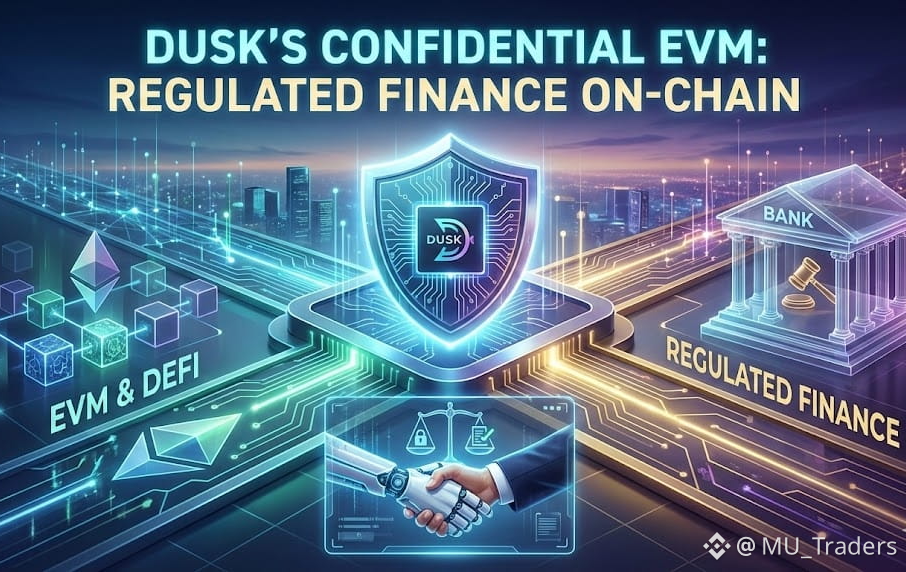
You’ve probably noticed most blockchain projects chase lower fees, higher TVL, or flashy yield farms. But there’s something quietly unfolding in Dusk Network’s ecosystem that doesn’t grab headlines yet could be foundational for real‑world finance on blockchain. Dusk is marrying privacy and compliance in an EVM‑compatible environment in a way that could make institutional, regulated financial activity practical on chain rather than theoretical. (Dusk Forum)
a familiar developer experience with deeper compliance
A big milestone in 2025 was the release of the DuskEVM public testnet, bringing a fully Ethereum Virtual Machine‑compatible layer to the Dusk stack. This is important because it lets developers use well‑known tooling like Solidity and MetaMask while settling transactions on a privacy‑native base layer. It removes a huge barrier: teams don’t have to learn or build for a bespoke smart contract environment just to access Dusk’s privacy and compliance features. (Dusk Forum)
Most privacy‑focused protocols isolate their technology in custom stacks that make real‑world adoption harder. Dusk’s choice to run EVM first allows existing DeFi developers and regulated platforms to integrate quickly without retooling. (Dusk Network)
privacy that regulators can work with
What sets Dusk apart isn’t privacy for privacy’s sake. The network’s Hedger module adds confidential transactions directly into the EVM layer using cryptography like homomorphic encryption and zero‑knowledge proofs. That means transaction details can be hidden from the public but still produce proofs that authorized auditors or compliance systems can verify. It’s confidentiality that doesn’t break regulatory oversight. (Dusk Forum)
This kind of auditability with confidentiality is rare. Many privacy solutions in crypto either hide everything so no one can verify compliance, or they sacrifice privacy entirely to meet regulatory demands. Dusk’s approach aims to balance those needs. (Dusk Network)
bridging regulated markets and blockchain automation
Beyond technology, Dusk has been positioning for regulated market participation. Collaborations with regulated platforms like NPEX and support for Chainlink interoperability frameworks are designed to bring European‑regulated securities and data on chain securely. That’s not just a fancy announcement. It provides a pathway for real financial instruments to live on a blockchain network with both compliance and confidentiality guarantees. (hozk.io)
If institutions can issue, trade, and settle tokenized RWAs — like securities or funds — using familiar Ethereum tooling and without exposing trade secrets or sensitive data, they don’t need to treat blockchain as a separate test environment. It becomes an operating infrastructure. (Dusk Trade)
what this means in practice
For builders, this lowers on‑ramp friction: you don’t need a bespoke stack or expensive custom integrations to meet regulatory and privacy standards. For regulated institutions, it means on‑chain systems can finally engage with both confidentiality and compliance without compromise.
In a space where most innovation is either purely experimental or focused on decentralized retail finance, Dusk’s blend of privacy and compliance within the EVM ecosystem could shape how regulated finance adopts blockchain for real financial workloads, not just token experiments.
crypto and cryptocurrency
