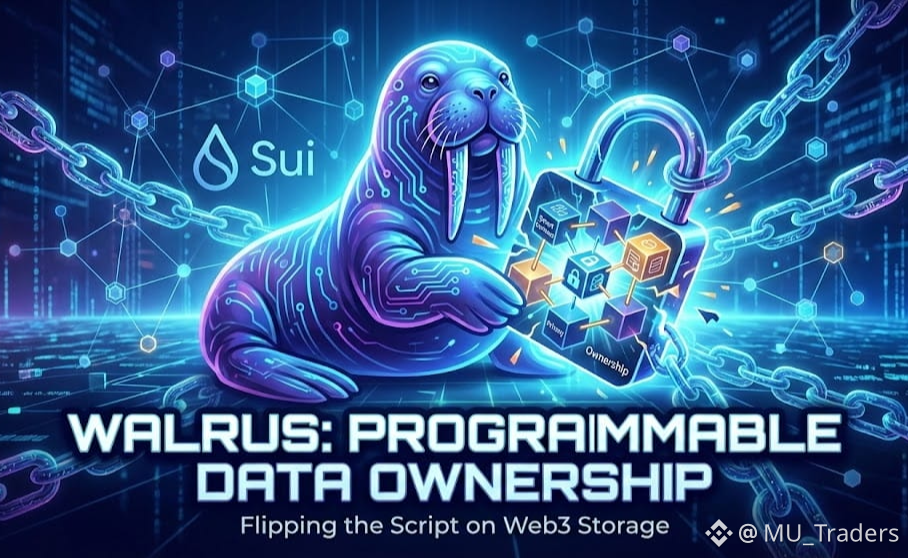
you might have skimmed past decentralized storage projects in crypto as “infrastructure stuff,” but Walrus isn’t just another file fridge for blockchain blobs. It reframes how data can be owned, controlled, and used in decentralized applications by integrating storage directly into the blockchain’s programmable layer. This subtle shift has deep implications that many builders and users haven’t fully digested yet. (CoinDesk)
The Data Ownership Problem Most Projects Avoid
Most decentralized storage systems focus on redundancy or permanence. But owning data isn’t simply about having copies distributed around the world. It’s about who can control access, who can update or delete content, and how that data interacts with other on‑chain logic. Walrus lets developers link stored blobs to smart contracts through the Sui blockchain, meaning data doesn’t just sit in storage — it can be conditioned by contracts, permissions, and token logic. That’s a different model from treating storage as a remote hard drive. (Binance Academy)
Imagine a document that only certain wallet holders can decrypt, or a media file that self‑expires when conditions change. Those aren’t just storage features, they are governance and ownership rules baked into the data itself. With the addition of access control layers like Seal, developers can now enforce privacy and gated access without moving off‑chain or relying on external identity systems. That lets you think of data as programmable property, not just a static file. (Walrus)
Why Sui’s Architecture Matters
Walrus’s deep integration with Sui isn’t accidental. Sui’s Move‑based smart contract environment enables storage objects to exist as first‑class citizens on the blockchain. When data has a presence on chain — represented by objects with metadata, availability proofs, and references — it becomes much easier to compose with other on‑chain assets, tokens, and logic. That opens possibilities like rights‑managed media NFTs, decentralized game asset stores, or dynamic datasets for AI that update based on usage. (Superex)
The design also uses efficient erasure coding, which breaks large files into shards that can be reconstructed even when some nodes go offline. This model balances cost and availability without requiring every piece of data to be fully replicated across the entire network. That efficiency makes storage more affordable and usable for real applications rather than just archival backups. (Superex)
The Bigger Picture for Web3 Product Builders
What Walrus reveals is a broader shift in how decentralized systems handle digital ownership. Instead of treating data as something stored off‑chain with a link on chain, Walrus treats data and control as intertwined on the blockchain fabric itself. Programmable storage means applications can enforce rules, permissions, and logic at the data layer rather than as an afterthought in an application layer.
This implication extends beyond traditional storage use cases. It affects identity, permissioned content, archival of legal documents, decentralized social platforms, and any system where who controls data matters as much as what the data is. As Web3 products evolve, this foundational rethink could become a competitive differentiator for builders who need privacy, programmability, and genuine user ownership woven into their stacks. (Walrus)
In essence, Walrus isn’t just about storing bits and bytes. It’s about flipping the script on data ownership in a way that could ripple through the future of decentralized applications.
@Walrus 🦭/acc $WAL #Walrus