

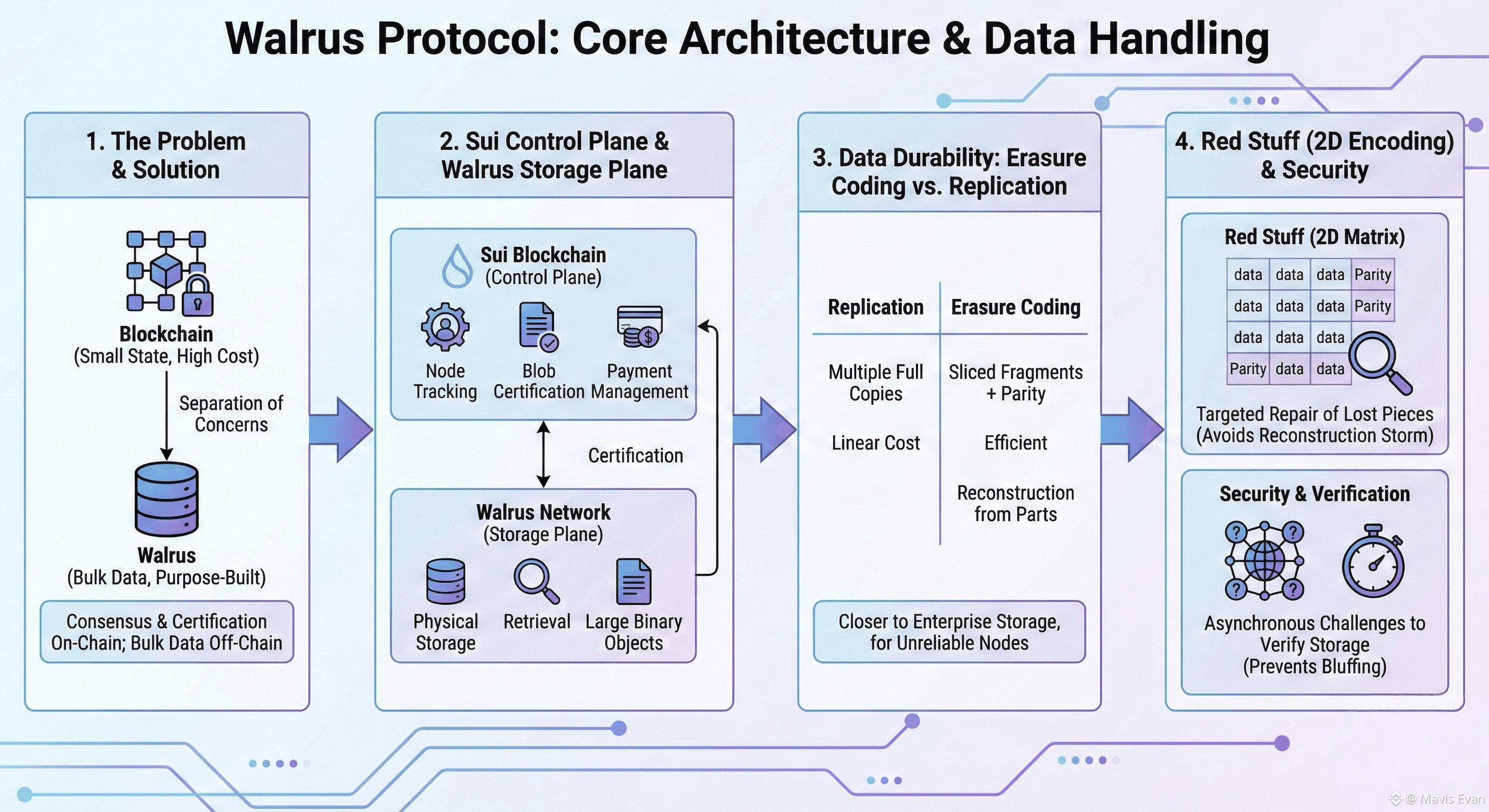
Blockchains are efficient at agreeing on small pieces of state, but they are structurally poor at handling large files. Every additional byte placed directly on a chain multiplies storage costs across all validating nodes and permanently increases the system’s historical burden. Walrus exists to separate these concerns by keeping consensus and certification on-chain while pushing bulk data into a purpose-built decentralized storage layer. The problem it targets is not simply cost, but the mismatch between how blockchains evolve and how modern applications consume data.
At a conceptual level, Walrus treats storage as a service coordinated by the Sui blockchain rather than as something the chain itself must carry. Sui functions as the control plane that tracks node participation, certifies stored blobs, and manages payments, while the Walrus network handles the physical storage and retrieval of large binary objects. This division mirrors how data centers separate orchestration from the actual disks and network fabric, but in a decentralized context where participants are economically motivated rather than contractually bound.
The choice to build around erasure coding instead of full replication is fundamental to Walrus’s cost model. Replication is reliable but linear in expense. Every extra copy multiplies the amount of hardware and bandwidth required. Walrus uses erasure coding so that a file is sliced into fragments plus parity, allowing reconstruction even if some parts are missing. This is closer to how enterprise storage arrays achieve durability, but Walrus must operate in an environment with unreliable and self-interested nodes rather than controlled hardware clusters.
What differentiates Walrus from generic erasure-coded systems is its two-dimensional encoding scheme known as Red Stuff. In traditional one-dimensional coding, losing a small piece of data can trigger large repair operations because the network must reassemble the entire object to regenerate the missing fragment. Red Stuff arranges data in a matrix so repairs can target only the lost pieces. This design choice directly addresses the “reconstruction storm” problem that plagues decentralized storage networks when nodes churn. By keeping repair bandwidth proportional to actual loss, the system remains economically viable even under unstable membership.
This encoding approach is tied to a more subtle security problem: how to verify that nodes are truly storing their assigned fragments. In a decentralized setting, operators can try to bluff by responding selectively or exploiting network delays. Walrus designs its storage challenge system for asynchronous networks where timing assumptions cannot be trusted. That choice reflects experience with real peer-to-peer systems, where availability is not binary and adversarial behavior is often expressed through subtle performance degradation rather than outright failure.
Membership management is another area where the protocol reveals its priorities. Walrus organizes storage providers into committees that change across epochs, and it includes a structured reconfiguration process to preserve blob availability as the committee shifts. This is not an administrative convenience. It is a recognition that long-lived decentralized systems cannot rely on static operator sets. Hardware fails, incentives fluctuate, and participants leave. Treating committee transition as a first-class protocol event is how the system attempts to remain resilient without drifting toward centralization.
The WAL token sits at the intersection of security and service provision. It is used in a delegated proof-of-stake mechanism to select committee members, and it is also the unit of account for paying for storage. This coupling matters. In Walrus, storage capacity is not a background utility. It is the economic product of the network. By forcing both security and service to flow through the same token, the protocol makes mispricing visible quickly. If storage demand rises faster than operator rewards, reliability degrades. If staking incentives become detached from actual service quality, the network accrues hidden fragility.
Walrus requires users to pay upfront for storage over defined time windows. This aligns incentives in a way that simple pay-per-use models cannot. Storage is a long-lived commitment. Operators need predictability to justify keeping hardware online, and the network needs assurance that blobs are funded for the duration they are expected to remain available. This model shifts application design. Developers must think about data lifecycle explicitly rather than assuming indefinite persistence, which in turn pushes better engineering discipline around archival, caching, and cleanup.
The protocol’s interaction model reflects a pragmatic view of developer behavior. Walrus supports CLI tools, SDKs, and integration with standard HTTP delivery patterns, including caching and CDN compatibility. This is an admission that decentralized storage cannot demand that every application accept unpredictable latency. By allowing familiar delivery infrastructure to sit on top, Walrus tries to make decentralization a backend property rather than a user-facing constraint.
A real-world scenario illustrates how these pieces fit together. Consider a content-heavy application that wants to publish large media files without relying on a single cloud provider. The application stores each file as a blob in Walrus, paying upfront for a defined retention period. The Sui blockchain records certification of the blob and manages the distribution of rewards to storage nodes. End users retrieve content through standard HTTP endpoints backed by caches, while the underlying storage is distributed across the Walrus committee. If a node goes offline, Red Stuff ensures that only the missing fragments are repaired, and the epoch transition mechanism rebalances responsibility without disrupting availability.
As of mid-2025, the project reports more than a hundred storage node operators and millions of blobs uploaded, totaling hundreds of terabytes. These figures are less important as growth signals than as evidence that the system is exercising real operational paths. Storage networks often fail quietly when theoretical designs meet actual hardware, bandwidth constraints, and human behavior. Sustained data volume suggests the protocol is being tested in ways that simulation cannot replicate.
The governance and penalty mechanisms reveal how the team views long-term stability. Planned slashing and partial token burning are tied to concrete behaviors such as short-term stake shifts that force costly data migration or backing underperforming nodes. These are not ideological deflation tools. They are attempts to internalize network externalities. When a delegator moves stake rapidly, the entire system pays the cost. Penalizing that behavior is a way to make those costs visible rather than letting them accumulate as invisible technical debt.
There is, however, an unavoidable tension at the regulatory boundary. Walrus acknowledges that it cannot guarantee compliance with all data protection and content regulations because of its decentralized nature. This is not a peripheral issue. Storage networks inherit responsibility for whatever users upload, and decentralization complicates enforcement. The more resilient the system is to censorship, the more complex its relationship with jurisdiction-specific laws becomes. This tension will shape which enterprises are willing to adopt the protocol and under what conditions.
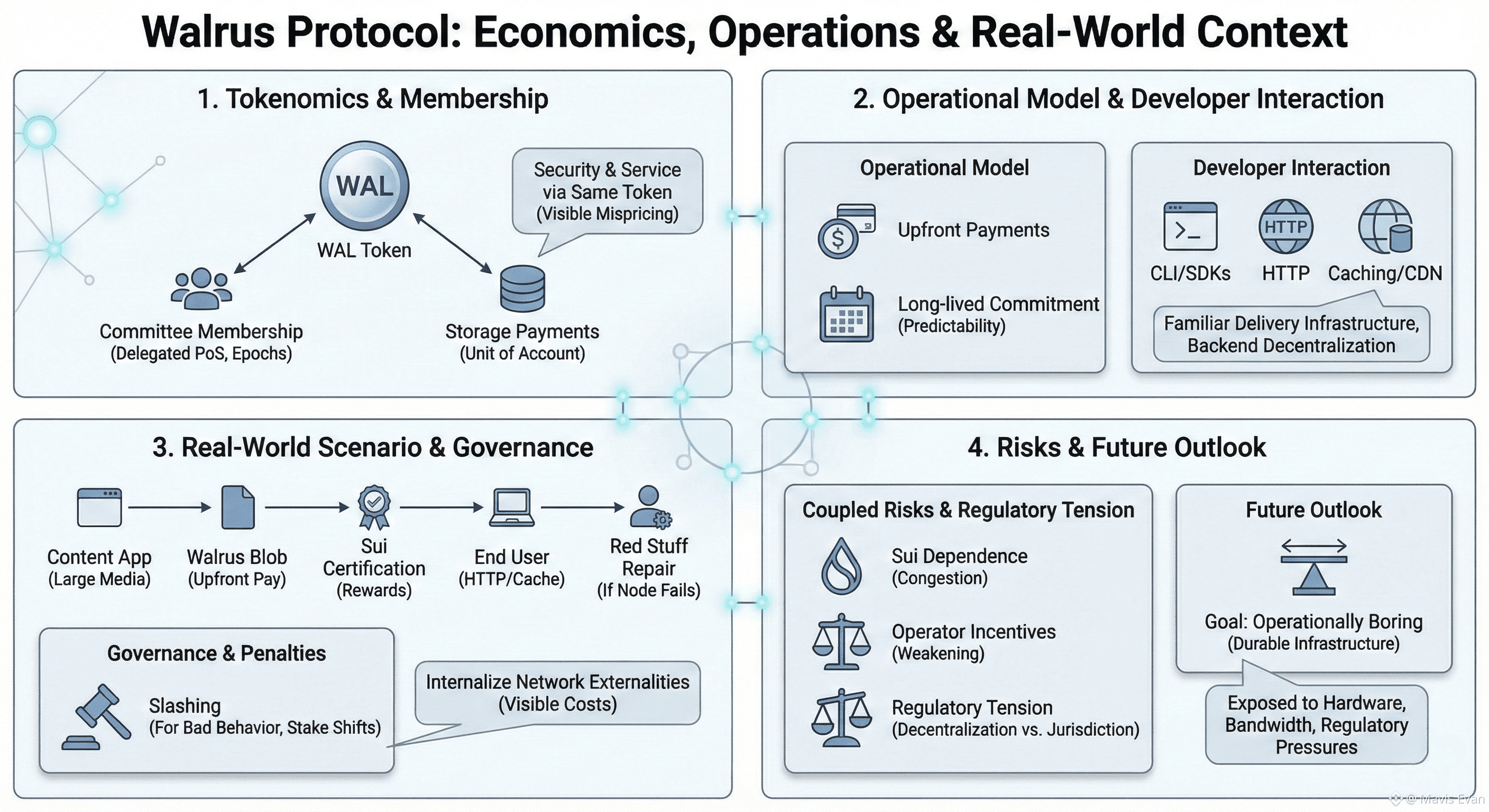
The protocol’s layered design also creates coupled risks. Because Sui acts as the control plane, congestion or economic shifts at the chain level can affect storage coordination even if the storage layer itself is healthy. Conversely, if operator incentives weaken, Sui may continue to record payments while users experience degraded retrieval. The architecture localizes complexity, but it does not eliminate systemic interdependence.
Walrus ultimately stands or falls on whether it can make decentralized storage operationally boring. That means predictable retrieval, transparent costs, and a stable operator base that views running a node as a business rather than a speculative activity. Its strengths lie in acknowledging real storage economics and embedding those realities into protocol design. Its risks stem from the same honesty. The system exposes itself to the messy dynamics of hardware markets, bandwidth pricing, and regulatory uncertainty. If those pressures remain aligned with its incentive structure, Walrus can become durable infrastructure. If they drift, the protocol will not fail loudly. It will slowly lose reliability, one underfunded fragment at a time.

