

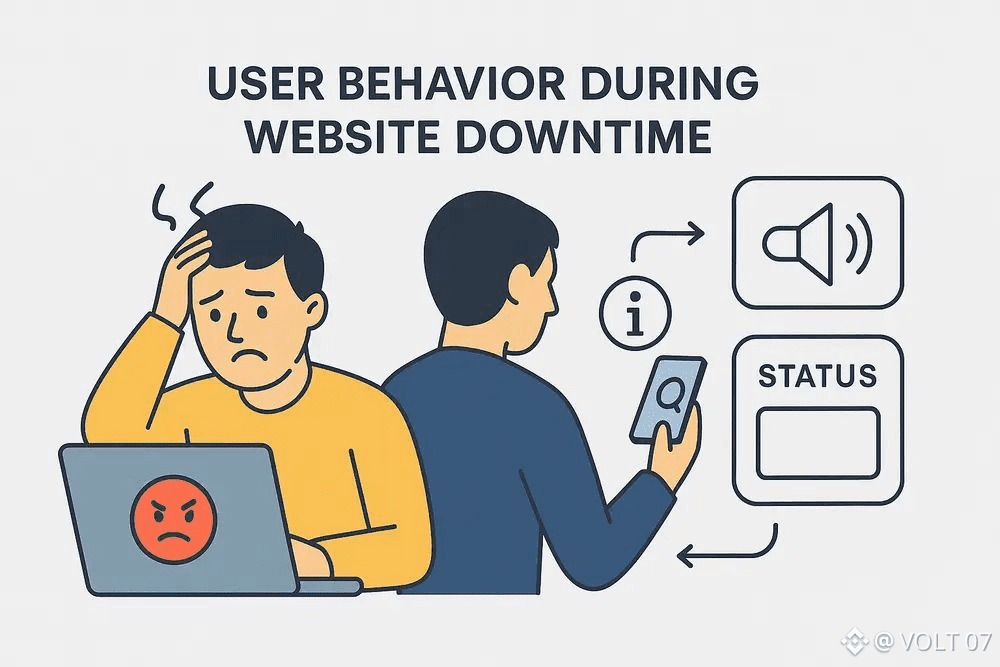
 Reliability tells you how a system behaves when everything is fine. Panic tells you who it protects when it isn’t.
Uptime, replica counts, and availability charts are comforting. They look scientific. They suggest control. But they only describe behavior under cooperation. When stress arrives markets swing, disputes erupt, recovery becomes urgent reliability metrics go quiet.
Panic does not.
That realization changed how I evaluate storage, and it’s the right lens for understanding Walrus (WAL).
Panic is a behavioral metric, not an emotional one.
Panic isn’t fear. It’s reaction time under uncertainty:
How quickly do participants change behavior when incentives thin?
How fast does responsibility diffuse?
How early do costs get pushed onto users?
How soon do explanations replace fixes?
These reactions are measurable and far more predictive than average reliability.
Reliable systems can still produce catastrophic panic.
Many protocols boast years of solid uptime and still collapse when stress hits because:
degradation was silent until it mattered,
recovery depended on coordination at the worst moment,
accountability was implied, not enforced,
users were the last to discover risk.
From the dashboard’s perspective, the system was reliable. From the user’s perspective, it failed all at once.
Panic reveals where incentives actually bind.
When things go wrong, look at who moves first:
validators exit quietly,
operators defer repairs,
applications add emergency workarounds,
users rush to extract or exit.
That sequence reveals the real incentive gradient. Whoever can delay action without consequence holds power. Whoever must react urgently bears risk.
Walrus is designed to flatten that gradient before panic arrives.
Why panic starts with ambiguity, not outages.
True panic doesn’t begin when data disappears. It begins when:
availability is inconsistent,
costs spike unpredictably,
timelines are unclear,
no one can say who’s responsible.
Ambiguity accelerates panic faster than downtime. Systems that optimize for reliability but ignore ambiguity are building calm on borrowed time.
Walrus treats ambiguity as a first-class failure mode.
Measuring panic means asking different questions.
Instead of:
What’s the uptime?
How many replicas exist?
Ask:
How early would users know something is wrong?
Who feels pressure first when degradation starts?
Is neglect uncomfortable immediately or only catastrophic later?
Can recovery begin without emergency coordination?
These questions map directly to panic dynamics and to whether trust survives stress.
Walrus designs to slow panic before it starts.
Not by promising perfection, but by engineering behavior:
making degradation visible early,
penalizing neglect upstream,
keeping recovery economically rational under stress,
preventing responsibility from diffusing into “the network.”
The goal isn’t zero failure. It’s bounded reaction so stress triggers correction, not chaos.
As Web3 matures, panic becomes the real risk.
When storage underwrites:
financial records and proofs,
governance legitimacy,
application state,
AI datasets and provenance,
the cost of panic dwarfs the cost of downtime. Markets don’t forgive uncertainty. Institutions don’t tolerate ambiguity. Users don’t wait for explanations.
Systems that can’t manage panic will be abandoned even if their reliability metrics look fine.
Walrus aligns with this reality by treating human reaction as part of the protocol surface.
I stopped trusting calm dashboards.
Because calm dashboards don’t show:
who will move first,
who will wait it out,
who will pay late,
who will explain after the fact.
Panic shows all of that instantly.
The storage systems worth trusting are the ones that can explain, in advance, how panic is prevented, absorbed, or redirected before users are forced to act under pressure.
Walrus earns relevance by designing for the moment calm ends.
Reliability measures success. Panic measures survival.
In long-lived infrastructure, survival is the higher bar.
The protocols that endure are not the ones that look reliable on good days, but the ones that behave predictably when uncertainty spikes when decisions must be made quickly, and mistakes are irreversible.
Walrus is built with that moment in mind.

