I often think about how much trust we give to the internet without realizing it. Every file we upload, every idea we save, every memory we store is handed over to systems we do not control. We hope they will be there tomorrow. We hope the rules will not change. We hope access will not be taken away. Walrus exists because too many people have learned the hard way that hope is not enough.
Walrus is a decentralized protocol built to protect data in a more honest way. It focuses on secure and privacy aware blockchain based interactions while also solving a very real problem, how to store large and valuable data without depending on a single authority. Built on the Sui blockchain, Walrus is designed to handle big files like application resources, videos, datasets, AI model weights, and digital archives. These are not small pieces of information. These are the building blocks of modern digital life.
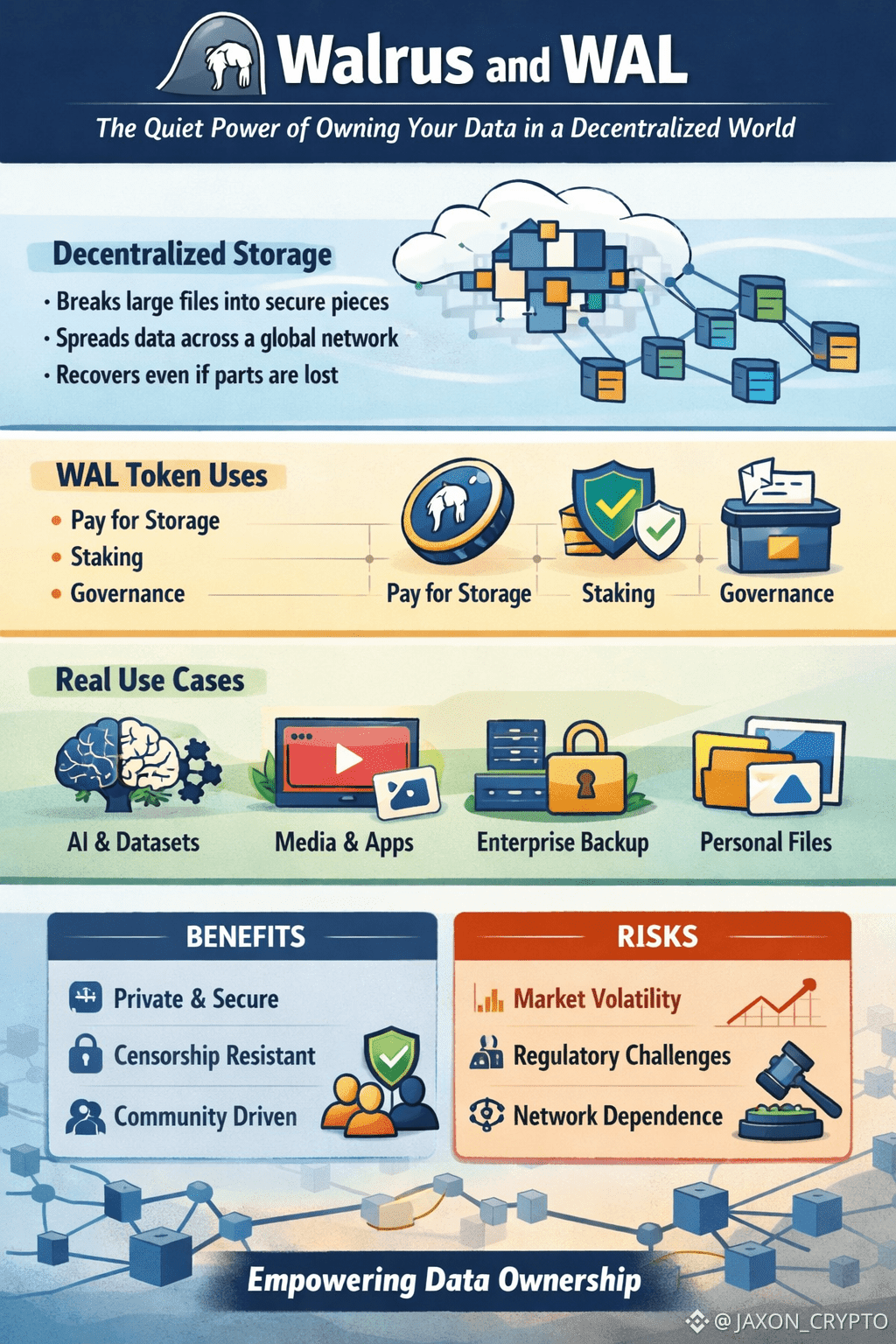
Instead of storing full files on one server, Walrus breaks data into pieces and spreads them across a decentralized network. Even if some parts of the network fail, the original data can still be recovered. This design accepts reality. Systems fail. Servers go offline. Companies change direction. Walrus does not fight this reality. It prepares for it. That alone makes the protocol feel more human and more reliable.
What truly sets Walrus apart is how storage is connected to decentralized applications. Data is not just stored and forgotten. It becomes part of smart contracts and on chain logic. Developers can build applications knowing their data layer is verifiable and censorship resistant. Users can interact with confidence, knowing no single entity controls access behind the scenes. This creates a deeper level of trust that goes beyond technology.
The WAL token plays a central role in keeping this ecosystem alive. WAL is used to pay for storage, but it is also used for staking and governance. People who operate storage nodes earn WAL by honestly storing and serving data. People who stake WAL help secure the network and participate in decisions about its future. This creates a shared economy where responsibility and rewards are linked. WAL is not just a token. It is participation.
Tokenomics are designed with long term sustainability in mind. WAL incentives encourage network growth, honest behavior, and reliable storage. Distribution supports developers, node operators, and ecosystem expansion. The goal is not short term excitement, but a system that can survive and grow over time. For access and liquidity, WAL being available on Binance helps users enter the ecosystem through a familiar and trusted gateway, making participation easier for a wider audience.
The use cases for Walrus are deeply practical. AI developers can store training data and models with confidence. Builders can host application files without fear of sudden shutdowns. Enterprises can back up critical data in a way that resists censorship. Creators can protect their work from disappearing overnight. Even individuals can store personal files knowing their access is not controlled by a single company.
Of course, Walrus is not without risk. Decentralized storage is complex. It relies on active participation and strong incentives. Token markets can be emotional and unpredictable. Data regulations continue to evolve. Walrus must balance openness with responsibility, and that balance takes time and care.
At its heart, Walrus feels like a quiet promise. A promise that data can belong to the people who create it. A promise that systems can be built with empathy, resilience, and honesty. In a world where trust is fragile, Walrus and WAL stand as a reminder that better digital foundations are possible if we choose to build them.