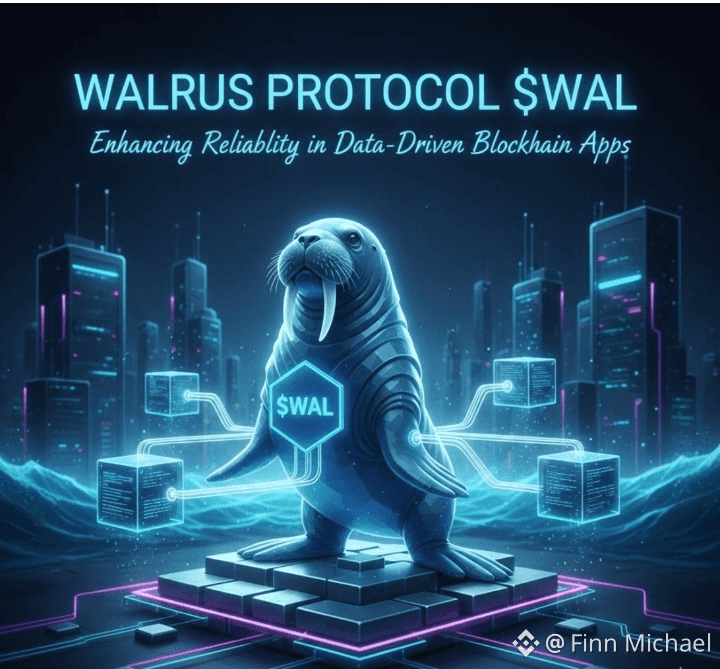
In every era of technological progress, there is an invisible cost that people only recognize when it is almost gone. In the digital age, that cost has been ownership. Ownership of data. Ownership of identity. Ownership of choice. Over time, convenience quietly replaced control, and centralized platforms became the silent gatekeepers of our finances, our memories, and our voices. Walrus emerged not as a loud rebellion, but as a deliberate correction to that imbalance.
Walrus (WAL) is the native cryptocurrency that powers the Walrus protocol, a decentralized system designed to return dignity to digital interactions. Built on the Sui blockchain, Walrus brings together decentralized finance, private transactions, governance, staking, and decentralized data storage into a single, unified infrastructure. It is not designed to impress with spectacle, but to endure with purpose. At its heart lies a simple belief: technology should serve people, not dominate them.
The Walrus protocol focuses on enabling secure and privacy-preserving interactions across blockchain-based applications. In most modern systems, users are exposed by default. Every transaction leaves a trail. Every file lives under the control of someone else’s servers. Walrus takes a different approach. It allows users to interact with decentralized applications and financial tools without revealing more than what is necessary. Privacy is not treated as secrecy or evasion, but as a basic human right embedded directly into the system’s architecture.
One of the most defining aspects of Walrus is its decentralized storage model. Today’s digital world relies heavily on centralized cloud providers, creating single points of failure that affect millions at once. Accounts are suspended, data is erased, access is restricted, often without warning or explanation. Walrus addresses this fragility through a powerful combination of erasure coding and blob storage.
Erasure coding breaks files into encoded fragments and distributes them across many independent nodes in the network. Instead of relying on full copies stored in one place, Walrus ensures that data can be reconstructed even if multiple nodes fail or disappear. This approach significantly lowers storage costs while dramatically increasing resilience. Blob storage allows the protocol to support large, unstructured data such as application files, media content, archives, and enterprise datasets. Together, these technologies make Walrus suitable not only for crypto-native users, but also for real-world applications that demand reliability, scale, and censorship resistance.
The decision to build on the Sui blockchain is central to Walrus’s capabilities. Sui is a modern layer one network designed for high performance and scalability, using an object-based architecture that enables parallel transaction execution. This allows Walrus to handle large volumes of data and interactions efficiently, without the congestion and high costs that limit older blockchains. As demand grows, the system is designed to scale naturally, without compromising security or accessibility.
The WAL token plays a vital role in sustaining this ecosystem. It is used to pay for storage and protocol services, ensuring that resources are allocated fairly and transparently. WAL also supports staking, allowing participants to contribute to network security while earning rewards. Beyond its economic role, WAL enables decentralized governance. Token holders can participate in decisions that shape the future of the protocol, from technical upgrades to long-term strategic direction. Governance is not symbolic here. It directly influences infrastructure that people depend on.
What sets Walrus apart is the way it unites decentralized finance with decentralized infrastructure. Many DeFi platforms still rely on centralized storage or external services, creating hidden vulnerabilities. Walrus removes those dependencies. By integrating storage and privacy directly into the protocol, it enables applications that are decentralized from end to end. Financial tools, data-driven platforms, and enterprise solutions can operate without surrendering control to centralized intermediaries.
Beneath the code and cryptography lies something deeply human. Walrus is for developers who want to build without fear of takedown. For creators who want their work to exist beyond platform approval. For organizations that need infrastructure they can trust. And for individuals who simply want to know that their digital presence cannot be erased at someone else’s discretion. Walrus does not treat users as data points or revenue streams. It treats them as participants with agency.
In a world where dominance is often disguised as efficiency and surveillance is framed as security, Walrus makes a quieter choice. It chooses dignity. It chooses resilience over control, distribution over consolidation, and participation over dependence. It does not promise a perfect system, but it offers something far more valuable: the ability to stand on infrastructure that does not own you.
By breaking data into fragments and distributing it across a decentralized network, Walrus restores something that has been steadily fading from the digital experience. Trust without submission. Access without permission. Ownership without compromise. As the internet continues to evolve, Walrus stands as a reminder that technology still has a choice to make. And this time, it chooses dignity over dominance.