
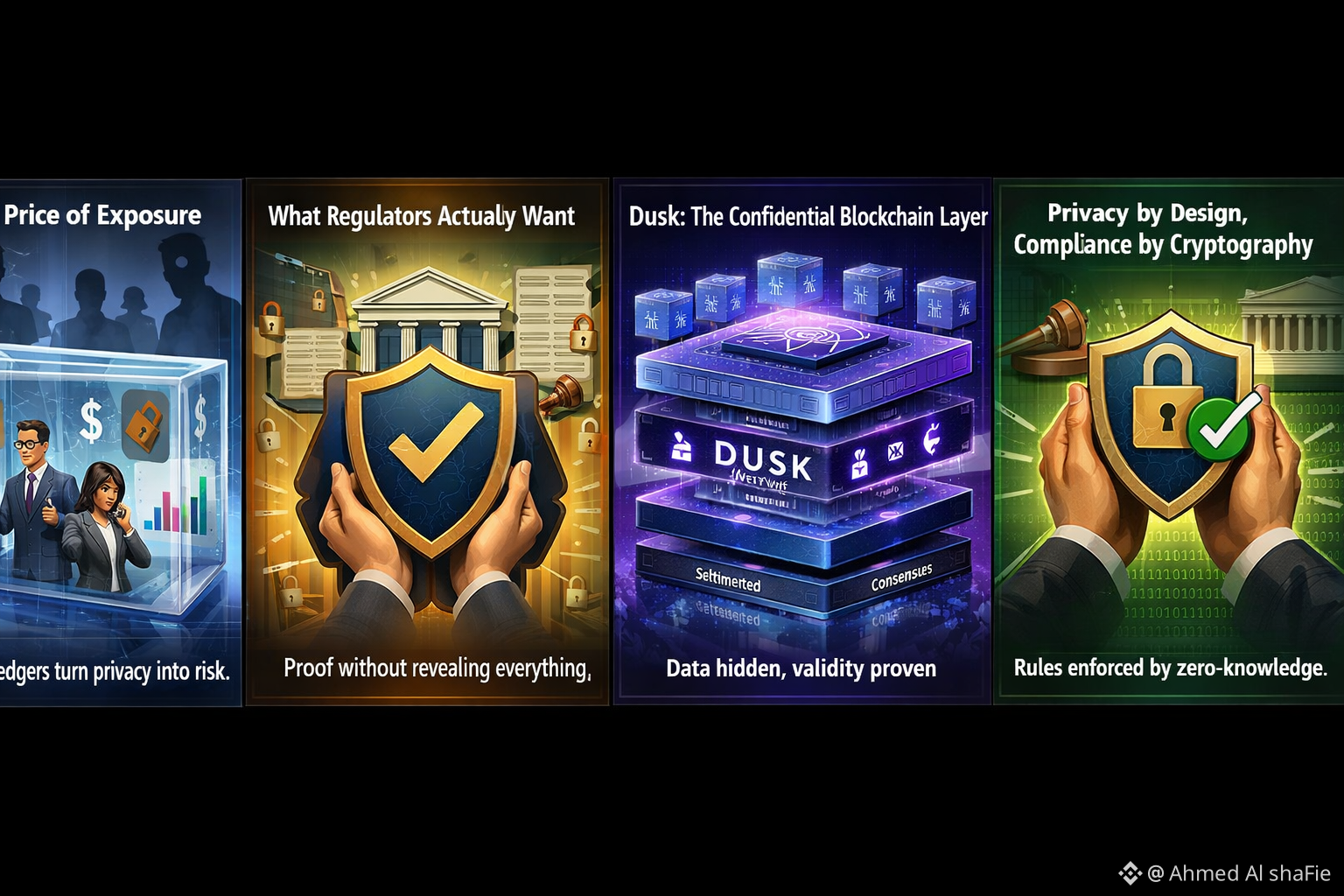
 Regulation Was Never About Exposure. It Was About Trust.
For years, blockchain culture has repeated a simple mantra: transparency creates trust. It was a necessary belief in the early days, helping an untested technology prove its integrity without intermediaries. Yet as blockchain systems edge closer to real economic infrastructure, that assumption begins to fracture.
In the real world—where pensions, securities, and national regulations exist—trust has never been built on exposure. It has been built on guarantees. On the ability to prove that rules were followed, obligations were met, and risks were contained, all without forcing participants to reveal everything about themselves.
Regulation, at its core, does not ask for visibility of data. It asks for provability of behavior. This subtle distinction is where many blockchain designs quietly lose their footing.
The Human Cost of Radical Transparency
When blockchains insist on total visibility, the cost is not abstract—it is deeply human. Public ledgers turn financial activity into permanent public records, accessible to anyone, forever. What began as a tool for accountability becomes a vector for exposure.
A fund cannot safely operate if its positions are visible in real time. A business cannot function if its internal cash flows are public. An individual cannot be financially free if every transaction becomes part of an immutable dossier.
Regulators understand this instinctively. Institutions feel it acutely. Users sense it even if they cannot articulate it. Systems that demand full transparency do not create trust; they create fear, risk, and legal impossibility.
This is why privacy is not a concession to regulation. It is the foundation that makes compliance viable in the first place.
What Regulation Actually Requires
Once emotional reactions are stripped away, regulatory demands are remarkably precise. They do not require open ledgers or public balances. Instead, they ask for assurances.
They require proof that funds are legitimate without exposing their origin. Proof of ownership without identity disclosure. Proof that constraints were enforced without revealing internal mechanics. Auditability without mass surveillance.
What matters is not what everyone can see, but what can be verified when it matters.
Public blockchains confuse these two ideas. They assume that verification requires observation. Regulation has always operated on the opposite principle: verification through controlled disclosure.
This mismatch is not philosophical. It is architectural.
Why the Modular Blockchain Stack Is Incomplete
Modern blockchain design embraces modularity. Execution, settlement, data availability, and consensus are separated to improve scalability and composability. Yet beneath this sophistication lies a fragile assumption: that data must be readable to be valid.
This assumption works for experimental finance and open DeFi primitives. It collapses under regulatory pressure.
What modular stacks lack is a data layer designed for confidentiality—one that treats privacy not as an add-on, but as a first-order constraint. A layer where state can exist without exposure, and where correctness can be enforced without inspection.
Until such a layer exists, modular blockchains remain structurally incapable of supporting regulated systems at scale.
Dusk’s Core Shift: From Visibility to Provability
Dusk begins where other architectures stop. It does not attempt to mask public data or selectively hide transactions. Instead, it reframes the role of data entirely.
Within Dusk, state is encrypted by default. Transactions operate on hidden values. Zero-knowledge proofs enforce correctness. Validators reach consensus without learning what they validate.
This is not secrecy for its own sake. It is a deliberate separation between knowledge and assurance.
Data no longer exists to be observed. It exists to be proven correct.
Cryptographic Enforcement Replaces Human Trust
Traditional compliance systems depend on institutions, audits, and legal recourse after violations occur. They scale poorly and fail silently. Dusk replaces this fragile structure with cryptographic finality.
Rules are not interpreted; they are compiled. Constraints are not guidelines; they are mathematical boundaries. Transactions either satisfy them or they do not.
No administrator can override enforcement. No participant can exploit ambiguity. Compliance becomes deterministic, automatic, and irrevocable.
For regulators, this is not opacity—it is the strongest form of assurance possible.
A New Standard for Blockchain Data
Compared to conventional data layers, Dusk does not optimize for readability or broadcast. Compared to existing privacy solutions, it does not sacrifice composability or compliance.
Instead, Dusk introduces a new baseline:
Privacy by default
Verification without disclosure
Compliance enforced at the protocol level
This is not a feature set. It is a structural upgrade to how blockchains handle truth.
Why Dusk Exists at All
At its deepest level, Dusk exists because blockchain technology has reached a moment of reckoning. To remain experimental is easy. To support real markets, real institutions, and real lives is far harder.
Systems that demand exposure as the price of participation will never become infrastructure. People need guarantees without surveillance, oversight without vulnerability, and enforcement without centralization.
Dusk does not make blockchains darker.
It makes them safe enough to matter.
And in a regulatory world that is only becoming more precise, privacy is no longer optional. It is the only path forward.
