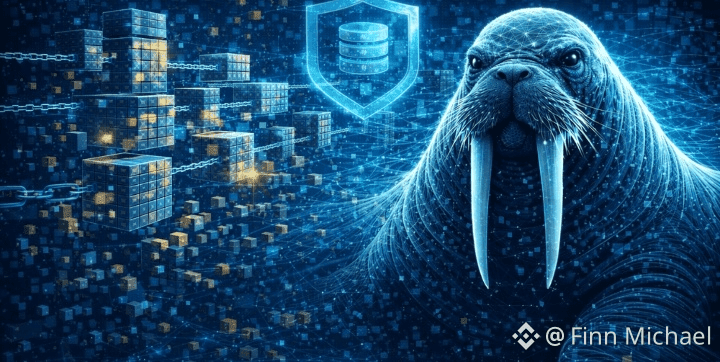
There is a quiet fear most people never talk about. It shows up late at night, when you scroll through old photos, unfinished ideas, saved documents, and realize that none of it truly lives with you. It lives on platforms. On servers. Under terms you didn’t write. One policy change, one locked account, one silent failure and pieces of your life can disappear without warning. Walrus was born from that fear, and from the deeper human need for something we have slowly lost online: certainty.
Walrus is not just a decentralized protocol or a technical breakthrough. It feels more like a promise. A promise that your data does not have to be fragile. A promise that ownership can exist without permission. Built on the Sui blockchain and powered by its native token WAL, Walrus is designed to store real data for real people in a way that doesn’t collapse when trust breaks.
For years, centralized cloud storage taught us convenience while quietly taking control. It made us comfortable, then dependent. Walrus challenges that relationship. Instead of handing your memories and work to a single company, Walrus spreads them across a living network of independent participants. Your files are broken into pieces, protected by mathematics, and shared across the world in a way that no single failure can erase them. Even if parts of the network disappear, your data survives. That resilience is not accidental. It is the soul of the system.
What makes this feel different is that Walrus does not treat data as an abstract concept. It treats it as something personal. Photos are not just files. They are moments. Documents are not just text. They are effort, time, ambition. Walrus understands that losing data is not a technical inconvenience. It is an emotional loss. So it was built to assume failure, to expect chaos, and to protect what matters anyway.
The WAL token gives this system its heartbeat. It aligns people who store data, people who protect it, and people who build on top of it into a shared economy of responsibility. Storage providers are not faceless corporations. They are participants who stake value, earn trust, and are rewarded for reliability. Users don’t rent space blindly. They enter clear agreements, knowing what they pay and what they receive. Governance is not hidden behind closed doors. It lives in the hands of those who care enough to hold the token and participate.
Privacy inside Walrus does not feel like isolation. It feels like choice. You decide who sees your data, how it is accessed, and how long it lives. The network does not demand exposure in exchange for decentralization. It respects boundaries. That makes Walrus suitable not only for individuals, but for creators, developers, enterprises, and even emerging technologies like artificial intelligence that depend on trusted data at scale.
There is something deeply human about the way Walrus fits into the future of the internet. It becomes the unseen foundation for decentralized applications, for NFTs whose media won’t vanish, for AI models that need clean, permanent datasets, for blockchains that need history without bloat. Walrus does not compete for attention. It supports everything quietly, reliably, in the background.
What truly sets Walrus apart is not speed, funding, or architecture. It is intent. It was built by people who understood that the internet is not just code. It is memory. Identity. Work. And trust, once broken, is hard to rebuild. Walrus does not ask you to trust blindly. It gives you systems that earn trust every day.
In a world where digital life often feels temporary and borrowed, Walrus offers something rare. Stability without control. Freedom without chaos. Ownership without fear. It reminds us that the future of the web does not have to feel cold or corporate. It can feel human again.
Walrus is not shouting for attention. It is quietly holding space for what matters, waiting for a world that is finally ready to stop losing itself online.