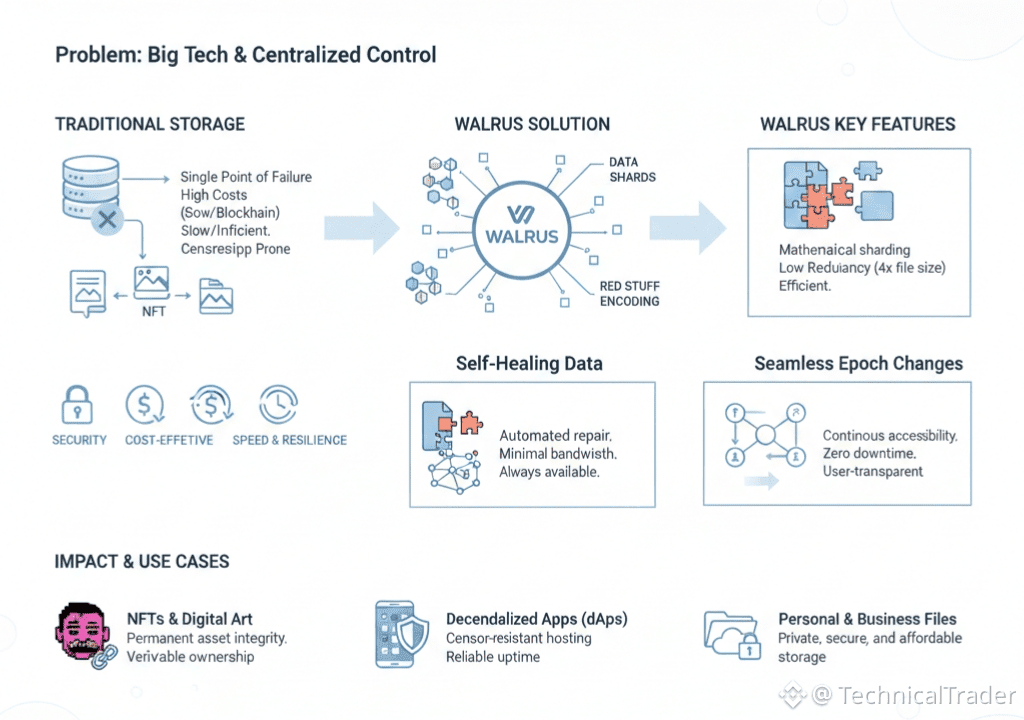
Think about all the digital stuff we own these days. Whether it is a cool NFT, a piece of digital art, or even just important documents, we usually trust that they will be there whenever we log in. But have you ever stopped to wonder where that data actually sits? Most of the time, it is on a server owned by one big company. If they go down or change their mind, your data could vanish.
This is exactly why decentralized storage is such a hot topic. We want our data to be safe, permanent, and not controlled by any single boss. However, doing this has always been hard because it is usually too expensive or too slow. That is why I want to introduce you to a new system called Walrus that is trying to change the game for all of us.
The Problem With How We Store Data Today
Right now, if you want to keep data safe on a blockchain, you have to pay a massive amount of money. This is because every single person on the network has to keep a full copy of your file. Imagine if you had to give a copy of your favorite movie to every person in your city just to make sure it never gets lost. It is just not practical for big files like videos or high-quality photos.
Walrus is stepping in to solve this. It looks at the trade-offs we usually have to make between cost and security. The team behind it realized that we need a way to store "blobs" which is just a fancy word for big chunks of data without it costing a fortune. I think it is amazing how they are finding a middle ground that actually works for regular users like us.
How Walrus Makes Storage Much Cheaper
You might be wondering how Walrus manages to be so much cheaper than other options. They use a very clever piece of tech called Red Stuff. Instead of making hundreds of identical copies of your file, it uses math to break the data into little pieces and spreads them out. It is a bit like a puzzle where you only need a few pieces to see the whole picture.
Because of this, Walrus only needs a small amount of extra space to keep your data safe. In fact, it only takes about four times the size of the file to guarantee it stays online. This is a huge deal because it means we can store way more data for way less money. We are finally getting to a point where decentralized storage can actually compete with the big tech giants.
Why Self Healing Data Is a Total Game Changer
One thing I find really cool about Walrus is how it handles accidents. In the digital world, computers go offline all the time. In older systems, if a few computers went down, fixing the data was a slow and painful process that used up a lot of internet bandwidth. Walrus is different because it has a "self-healing" feature.
If some data is lost because a node goes offline, the network can fix itself using only a tiny bit of information. It doesn't have to download the whole file all over again just to fix one small part. This makes the whole system much more resilient. I love the idea that the network is constantly looking out for itself and making sure our files stay intact without wasting resources.
Keeping Things Moving When Nodes Leave
We all know that people come and go in any community. The same thing happens with storage providers. Sometimes a group of computers stops providing storage and a new group takes over. In many systems, this transition can cause a lot of lag or even make your files temporarily disappear. Walrus has a special way of handling these "epoch changes" so everything stays smooth.
The system is designed to pass the torch from one group to the other without any interruptions. This means you can access your data 24/7, no matter what is happening behind the scenes with the hardware. It is all about making sure that we, as users, never even notice that a change happened. Reliability is key when you are trusting a network with your important digital life.
Why This Is Great News for Your NFTs and Art
If you are into NFTs, you should definitely pay attention to Walrus. Did you know that many NFTs actually store the image on a regular website? If that website disappears, your NFT might just point to a broken link. That is a scary thought for collectors. Walrus provides a way to store the actual image data in a way that is just as permanent as the blockchain itself.
By using Walrus, creators can make sure their art stays available forever. It adds a layer of "integrity" which basically means you can always prove that the file you are looking at is the original one. I think this is a massive step forward for digital ownership because it makes our digital assets feel much more real and secure.
Cleaning Up the Internet With Better Apps
Most of the "decentralized" apps we use today are actually half-centralized. The buttons and the look of the website are usually hosted on normal servers. Walrus wants to change this by allowing developers to host their entire app on its network. This would make apps much harder to censor and much more reliable during outages.
Imagine an internet where no single company can "turn off" an app just because they feel like it. That is the kind of freedom Walrus is helping to build. It gives developers a neutral place to put their code where it is safe from meddling. We are moving toward a more open web, and I think that is something we can all get excited about.
Final Thoughts on the Future of Storage
Walrus is about giving us more control. Whether you are a developer building the next big social media platform or just someone who wants to keep their photos safe, having a reliable and cheap way to store data is essential. It is the backbone of a better and more private digital world.
The technology might sound complex, but the goal is simple: a safer internet for everyone. By solving the problems of cost and speed, Walrus is making it possible for us to move away from big tech and toward a system that we actually own together. It is a big vision, and I am excited to see where it goes from here.
what you think about this? don't forget to comment 💭
Follow for more content 🙂