Architecture of Programmable Data Primitives.
Walrus also proposes programmable blobs as Sui-native objects, which store storage capacity, availability guarantees and code along with data in one composable unit allowing decentralized applications to respect data as executable code instead of fixed files. These blobs are directly observable in Sui, where users can add smart contract policies that relate to access patterns, automatic lifecycle management, and economic incentives and respond to validation of on-chain consensus mechanisms. The design allows data assets to react to network conditions, market signal and application demand without orchestration layers at their centres, and does not separate storage and calculation, as was previously done.
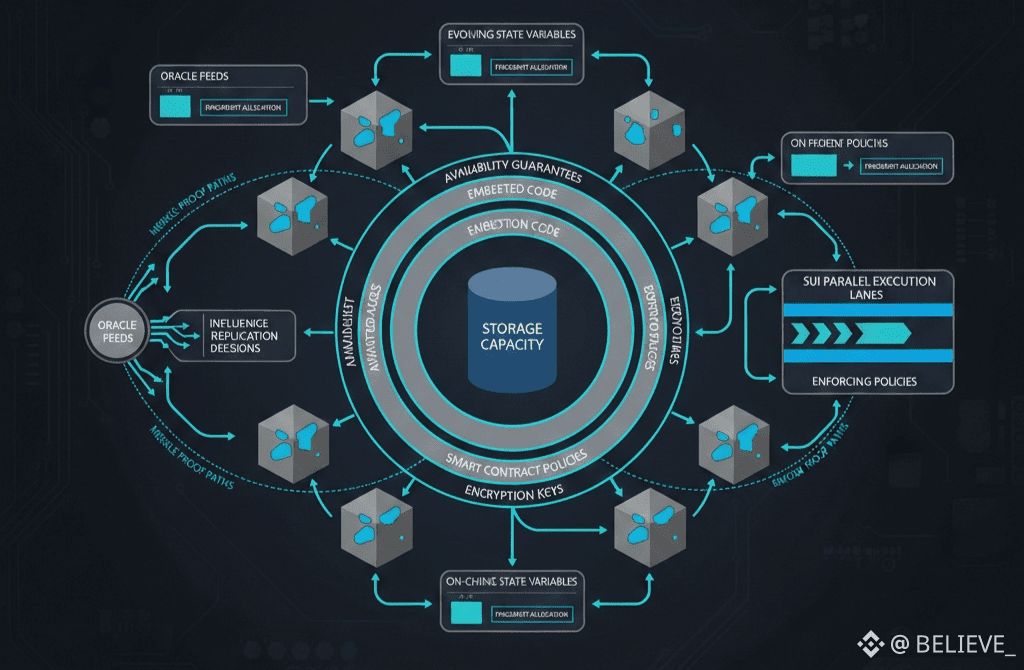
The essence of it is that the metadata registration of blob on Sui registers metadata Merkle proofs of initial encoding with dynamically evolving state variables that monitor fragment allocation among storage nodes. Relevant policies are enforced with the latest proofs with the use of smart contracts: time-bound access, usage-based charges, or demanding selective decryption through zero-knowledge credentials. With AI-controlled applications, this is expressed as self-optimizing datasets that are trained via oracle feeds: fragments are proactively replicated to low-latency nodes in response to compute demand spikes to maintain inference pipelines distributed throughout high-volatility global traffic patterns.
Walrus makes this programmable with capacity tokens which are fungible Sui objects that are guaranteed storage quotas that can be collateralized, bought and sold by dApps in DeFi protocols. Enterprises use such tokens to ensure minimum availability of mission critical datasets, and protocols such as prediction markets use off-the-book provenance of blobs to mathematically compute weights on oracle submissions. The isolated primitive is an integration that will gird growth in data silos in Web3, making Walrus a unifying tissue with storage as the generative blood in intelligence systems.
Red Stuff Encoding: Accuracy Durability to Work loads with High stakes.
The proprietary method of erasure coding of two-dimensional blobs used by Walrus, known as Red Stuff, breaks the blobs into granular slivers good enough to deliver Byzantine fault tolerance at a relatively low replication overhead, and can build data back up by any replication sufficient even when node failures are coordinated by adversaries. This algorithm uses Reed-Solomon row-based encoding of systematic redundancy, then uses fountain code column-based encoding to support asynchronous degradation, which is essential in environments where the node churn rate reaches more than 40 percent without affecting any of the retrieval speed. Such hybrid scheme leads to a reduction in storage amplification of 1.1-1.5x of raw data compared to single-dimensional systems which require complete replicas to achieve the same type of durability.
In the programmable context, Red Stuff is used together with Sui parallel execution to report sliver integrity by issuing randomized challenges on the blob lifecycle events. Scabies nodes that are trying to launch timing attacks are confrontated by the preliminary evidences that shine forth faked vacavities, which engage in automatic censure via delegated Proof-of-Stake economics. In the case of AI markets, this is corresponding to dataset resilience where training operas auto-repurpose medium-midway: corrupted slivers rerouted to the healthy nodes with full transparency and without requiring human intercession or costly retraining.
The performance of the encoding goes up to exabytes workloads where conventional replication would put the financial skyrocket. Walrus nodes handle migration of slivers on the change of epochs so that access can continue in low-latency (using relays distributed around the world). Quilt extensions consolidate small-file telemetry payloads in common in IoT telemetry, or agentic memory, into optimized packages, usually cutting overheads ten to twentyfold on high-velocity streams without reducing the grain of provability of downstream analytics.
Self-sufficient Agency in Data Markets.
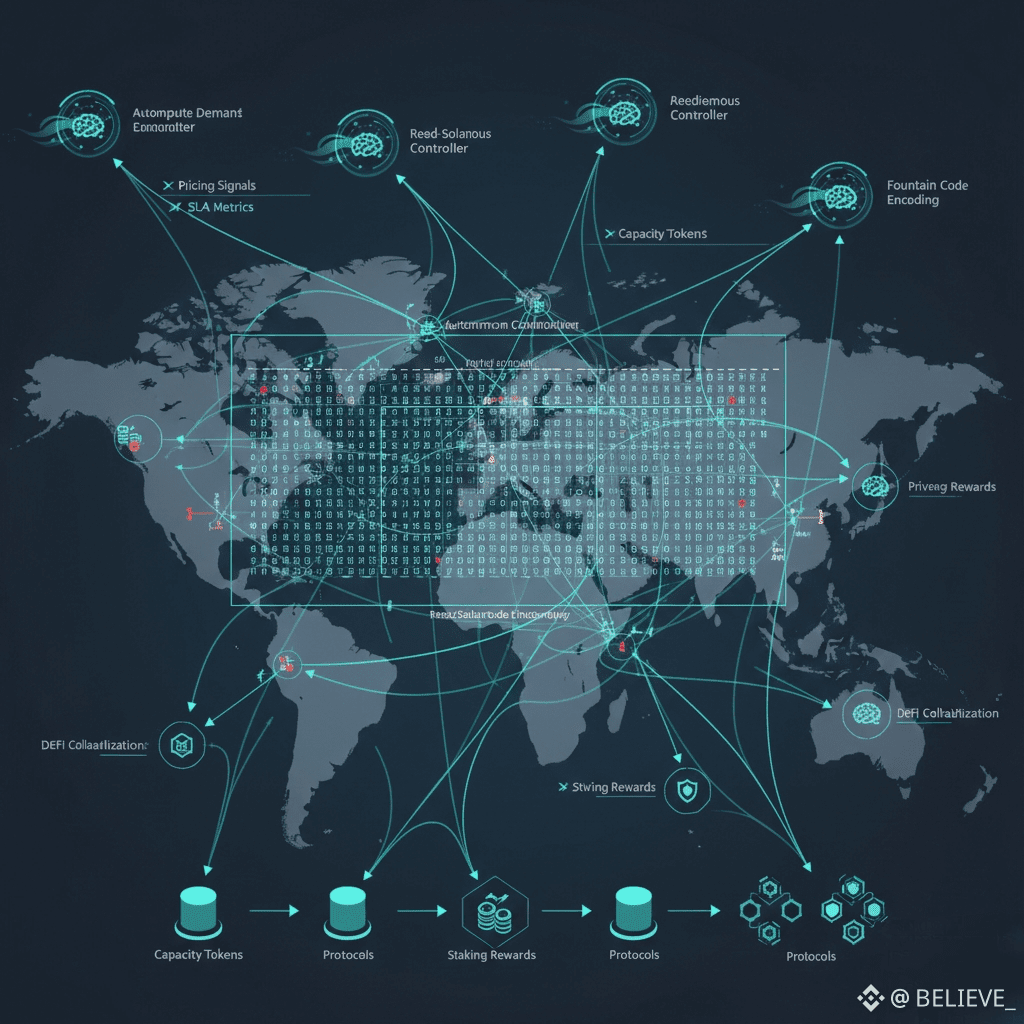
The programmable blobs enable autonomous data agency, where AI agents can bake contracts of storing data using embedded logic processing incoming pricing cues, privacy needs, and demands shown as performance SLA on-chain. A federated learning provisioner includes parameters such as minimum PoA levels and zk selective disclosure policy; and the blob is then spawned into child fragments distributed among vetted operators which adapt themselves depending on fulfillment metrics reported to Sui. Rewards are distributed according to proven uptime, which forms incentive tapers that build dependable infrastructure naturally.
This agency is extended to economic flywheels: blobs release APIs to micropayments conditioned upon query volume, letting DeFi protocols to collateralize datasets as assets yielding interest. Prediction markets use seamlessness evidence of blobs to modulate oracle integrity, whereas content protocols compromise premium assets by access curves of token mass. These primitives have cross-chain bridges, tokenizing them on Solana and Ethereum L2s, and the data flows in either direction are unified, with Solana transaction histories input to Sui-hosted AI analyzers, and the reverse. These primitives are reconstructed using no trust by Walrus mediation.
The privacy innovations entail per-blob encryption keys, which are operated with the help of succinct proofs, making it easier to engage in joint training where all participating reveal gradient updates without sharing raw inputs. The asynchronous verification model by Walrus scaled to this by verifying the availability but did not require a complete download that would put the bandwidth-limited agents to the test.
Integration of Economy and Governance.
In programmable-stack tokenomics have incentives that are consistent throughout: storage charges redeem operator rewards and deflationary buybacks, and governance ratifies blob policy standards such as maximum encoding parameters or cross-chain interoperability specifications. Delegators post a wager on high-performing nodes, the yield of compounds on throughput of blobs, which increase with the use of AI. With liquid staking derivatives, the participation is magnified and institutional capital is attracted which further defends the network against eclipse attacks.
Governance proposals are encoded into the templates of blobs, allowing them to be evolved community-driven, e.g. dynamic pricing oracles adjust pricing based on world demand of compute. Emergency pauses come in through multisig guardians on exploits, post-mortem fed on refined slashing. This is governed through closed loop to keep programmable blobs flexible to withstand economic exploits and increase velocity on features.
Ecosystem Implementation and Performance.
Walrus uses vertical value creation at scale: AI infrastructure protocols present verifiable corpora to model markets; game worlds present player-owned objects as buy and sell blobs; content networks present a tiered content structure unlocked by NFT proofs. SDK upgrades can be used to provide agentic integrations, and TypeScript relays can be used to optimize bandwidth of mobile dApps.
Scalability roadmaps focus on committees of 10000 nodes with sharded encoding and Pipe Network additions to also cut ETF latency to minutes. Predominantly, zero-knowledge PoA versions, known as promise private verification of regulated industries, and EV data pipes compensate fleets to submit high-fidelity telemetry blobs that input in risk models.
Walrus reinvents decentralized storage as an intelligent substrate implicit programmable blobs that manage data flows, impose economic primitives, and grow as insatiable demands by AI. Combining the composability of Sui with hardy encoding, the protocol comprises the nervous system of sovereign intelligence economies, in which data does not simply exist, it develops, trades, and powers in the nebulae of decentralization.