
I was using a so-called “decentralized” dApp. The smart contracts executed, tokens transferred, and wallet prompts appeared perfectly. Yet half the experience—images, user data, media—was still hosted on a single, traditional server. When that server lagged, the whole app felt broken.
That moment revealed a quiet, critical weakness in the crypto stack: we’ve decentralized money and execution, but we still outsource the data layer to what looks a lot like AWS.
Walrus is built precisely for that weak point. It's a decentralized storage network from Mysten Labs (creators of Sui), designed to store large data blobs in a durable, censorship-resistant, and practical way. The WAL token powers this ecosystem—not as a narrative-driven meme, but as the payment and incentive mechanism for securing and storing data.
For traders, WAL sits at a potent intersection: real infrastructure utility and tokenized incentives—both themes the market consistently reprices. For investors, it addresses a critical bottleneck: decentralized storage is no longer optional for Web3 apps that want to move beyond toy demos to reliable products.
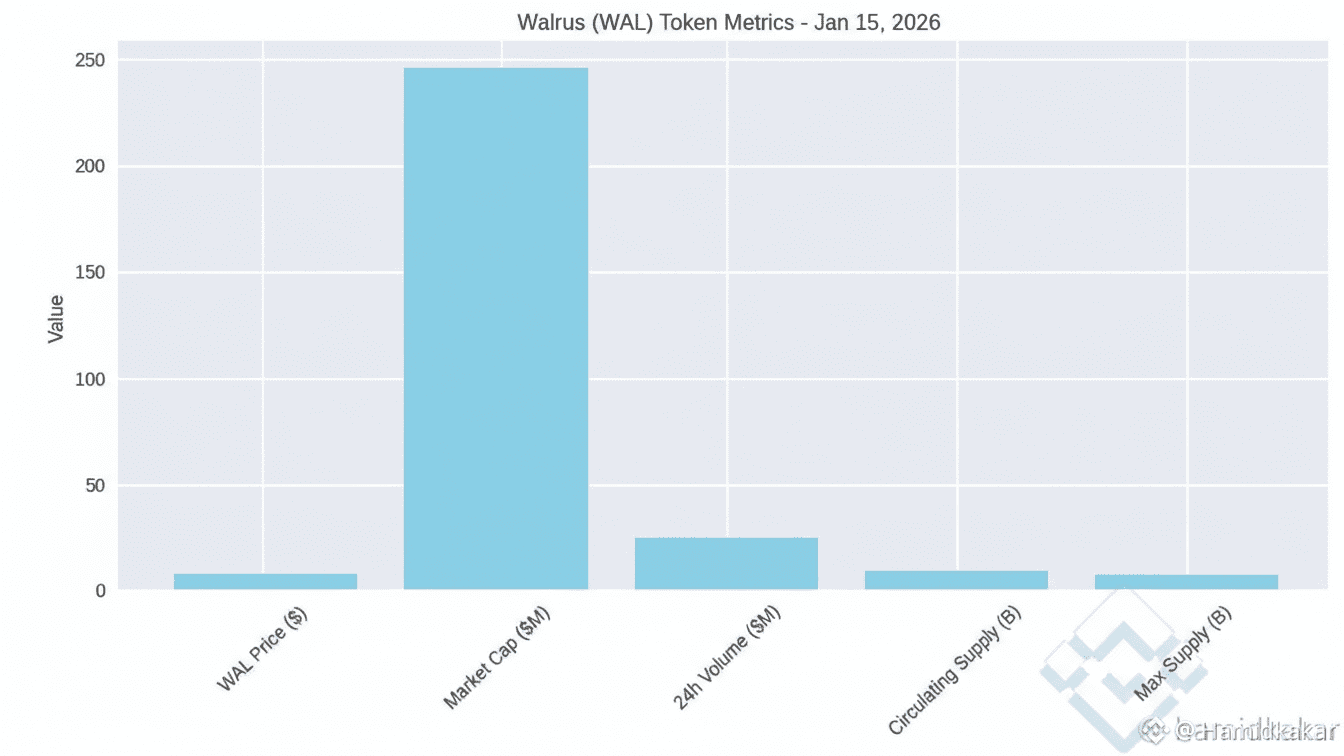
As of January 15, 2026, WAL trades around $0.156, with ~$26.0M in 24-hour volume and a market cap near $246M. The circulating supply is ~1.577B WAL, with a max supply of 5.0B. This positions WAL in a compelling middle ground: liquid enough to trade, yet early enough that its price reflects significant potential, not just current adoption.
So what makes Walrus different?
At its core, Walrus is engineered to make decentralized storage usable. It employs erasure coding—breaking files into fragments, encoding them with redundancy, and distributing them across the network. This ensures data remains recoverable even if multiple nodes fail, delivering durability without centralized control.
By running on $SUI , it leverages high throughput and low latency for metadata operations, while the heavy data itself is stored efficiently in a decentralized blob store. The result is a storage layer that’s resilient, cost-effective, and built for real applications.
In short: Walrus isn't chasing a narrative. It's solving a foundational problem—closing the decentralization loop for the apps we actually want to use.
But Walrus goes beyond standard erasure coding with its novel Red Stuff scheme. This is a two-dimensional erasure coding design engineered to maximize data durability and recovery speed, without the heavy inefficiency of full data replication.
In simpler terms: Walrus sidesteps the old trade-off where decentralized storage is either prohibitively expensive (by duplicating everything) or dangerously fragile (by not keeping enough copies).
This is critical because in Web3, storage equals product continuity.
If an NFT’s image vanishes, the NFT becomes a broken promise.
If a game’s save files are lost, the game dies.
If an AI agent can’t access its model weights, it’s not autonomous—it’s just pretending.
Building on Sui isn't a branding exercise. Sui’s high-throughput architecture complements Walrus’s focus on large data blobs and frequent reads. This positions Walrus not as a "crypto Dropbox," but as a foundational performance-plus-permanence layer for demanding applications.
Now, for the crucial economic perspective: What does the WAL token actually do?
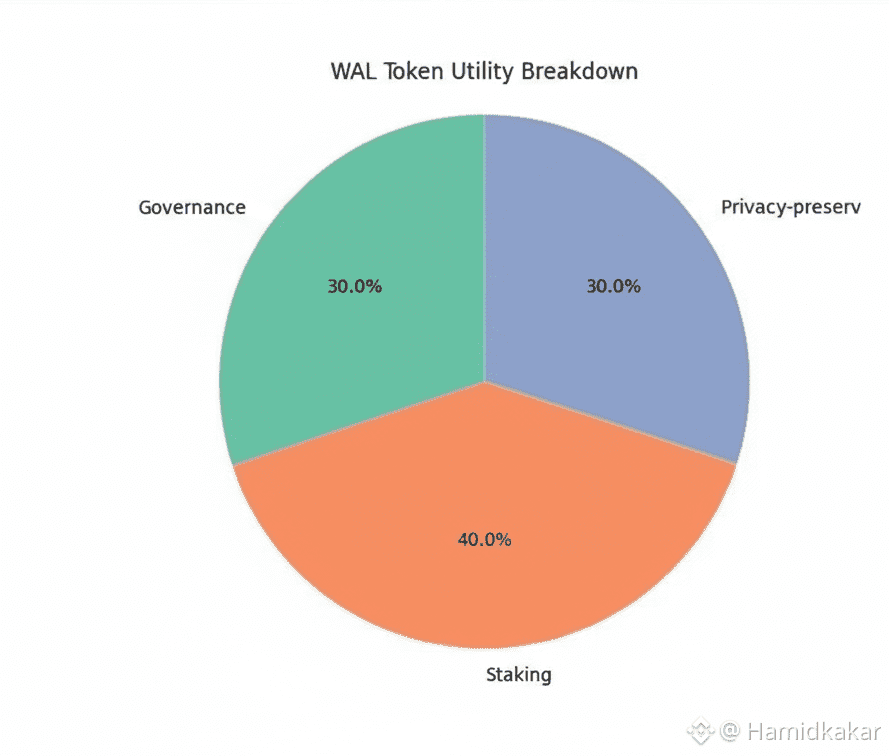
WAL is the protocol’s economic engine. It is:
The Payment Token: To store data for a defined period, users pay in WAL.
The Incentive Token: These payments are then distributed over time to the storage nodes and stakers who secure and serve the data.
Critically, the mechanism is designed to stabilize storage costs in fiat terms, insulating users from WAL’s price volatility. This solves a major pain point in crypto infrastructure, where network fees can become unusable during market hype cycles.
From a valuation lens, a clean model is to view WAL as the commodity token powering a global storage marketplace. Its fundamental demand driver is simple: the more real-world data stored on the Walrus network, the greater the economic activity denominated in and requiring WAL.
The fundamental value proposition for WAL is clear: as more data is stored, consistent demand for $WAL as payment grows. Concurrently, staking and node incentives are needed to keep the storage supply secure and reliable.
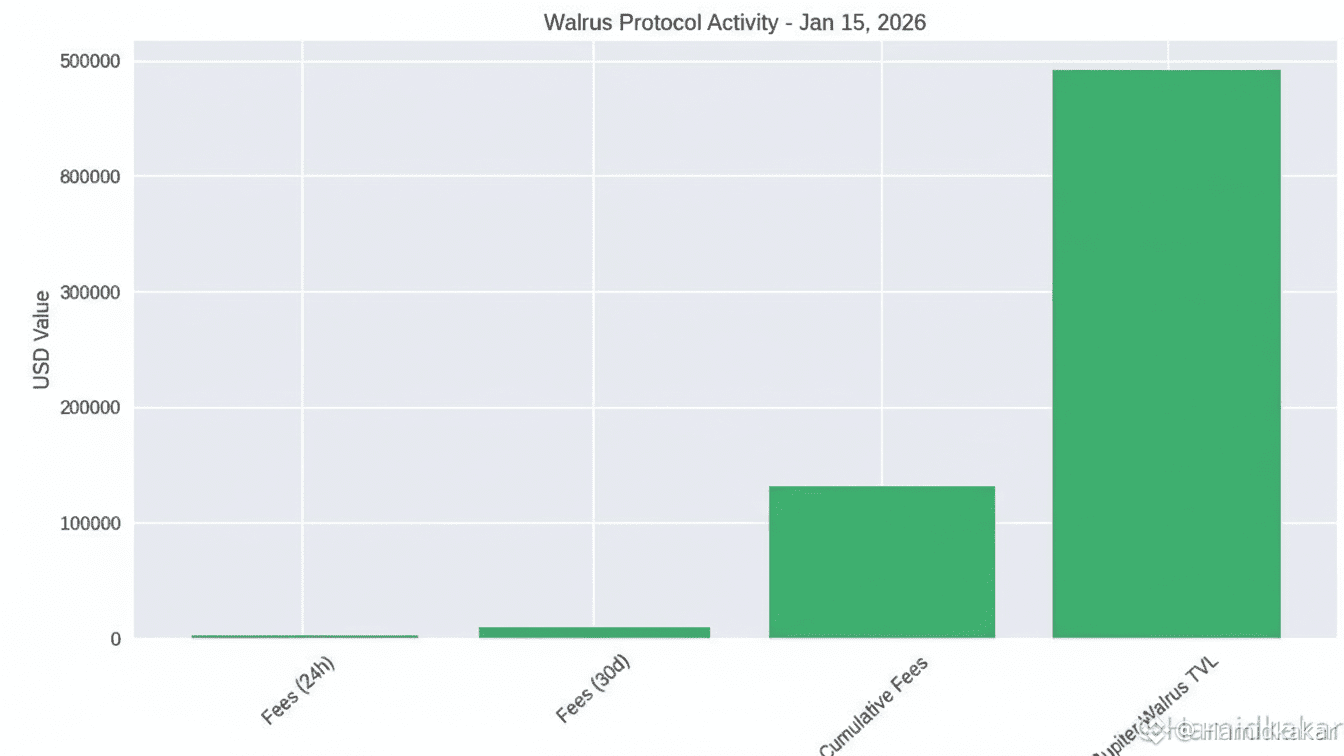
That said, it's important to be clear: as of January 2026, Walrus is in the "proving usage" stage. Adoption isn't measured by DeFi TVL. A more relevant, adjacent metric is the growth of liquid staking projects like Winter Walrus, which holds around $492K TVL. While not massive, this signals the early development of its financial ecosystem and underscores that Walrus should be viewed primarily as infrastructure adoption, not DeFi yield magnetism.
A more telling metric for an early-stage protocol is whether it generates real revenue. DefiLlama shows Walrus Protocol with roughly $374 in fees over the last 24 hours and about $2,555 over 30 days. Its cumulative fees stand at approximately $440,665. These aren't astronomical figures, but they represent genuine, protocol-sustaining economic activity—proof the network is operational, not just theoretical.
If you're looking for a unique angle beyond the generic "decentralized storage is big" pitch, here it is:
Walrus is betting that the next wave of crypto adoption will be data-heavy.
The last cycle was defined by DeFi and yield. The mid-cycle was about NFTs and media. The emerging cycle belongs to AI agents, autonomous applications, decentralized social graphs, onchain games, and verifiable media. These applications don't just move tokens; they persistently store state, content, and massive files. In this paradigm, storage stops being a technical side quest and becomes the main road for utility.
Let's take a practical example. Imagine running a paid research community where you share charts, PDFs, and trade setups daily. If this content is hosted on centralized servers, you're one policy change, platform dispute, or outage away from losing your entire distribution channel.
With decentralized storage like Walrus, you secure your community's intellectual property and ensure its permanent, censorship-resistant availability. This isn't just a feature—it's the foundation for trust and continuity in a digital-first world.
In essence, Walrus isn't just building storage. It's building the persistent data layer for the next generation of the internet.

