


One of the biggest misunderstandings in Web3 is the idea that everything should live on-chain. That sounds good in theory, but anyone who has actually built an application knows it breaks down fast. Blockchains are excellent for ownership, verification, and settlement, but they are terrible at handling large data. Media files, AI datasets, game assets, websites, and application state simply do not fit well into a pure on-chain model. Walrus starts from this reality instead of pretending it does not exist. @Walrus 🦭/acc separates the system into clear roles. Sui acts as the coordination and verification layer, while Walrus handles large-scale data storage using blob storage reinforced by erasure coding. This means data is split into pieces and distributed across the network in a way that allows recovery even if many nodes fail. The result is not just decentralization in theory, but resilience in practice.
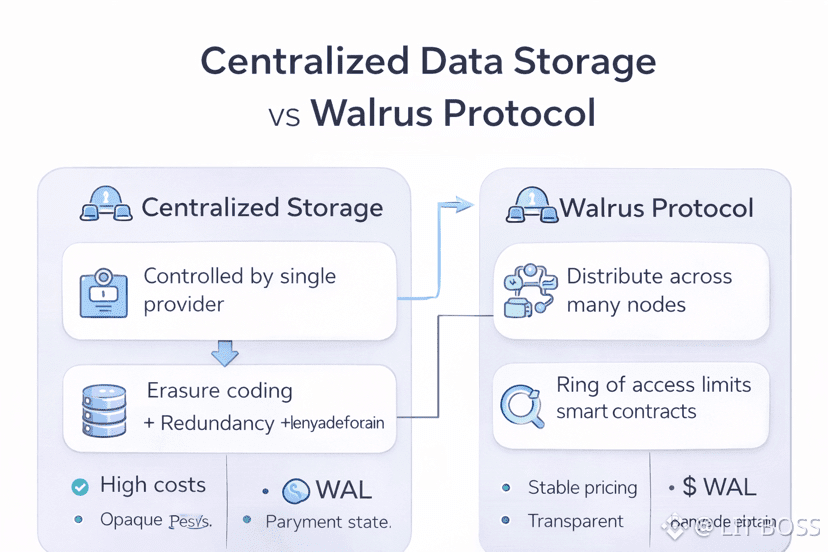 This architectural separation is important because it removes a silent weakness that many Web3 apps still carry. A lot of applications look decentralized on the surface, but behind the scenes they depend on centralized cloud providers to store their data. When those providers go down, change policies, or face legal pressure, the app quietly breaks. Walrus replaces that dependency with a decentralized storage layer that is designed to survive normal failure. Instead of assuming someone will always be there to maintain servers, it assumes things will go wrong and builds around that assumption. For developers, this means fewer fragile dependencies. For enterprises, it means predictable behavior under stress. For users, it means apps that keep working instead of silently degrading over time.
$WAL is not just an accessory in this design. It is how participation is structured. Staking, governance, and incentives are tied to maintaining the health of the network, not just speculative activity. This keeps control distributed and discourages central points of failure. What makes Walrus feel different is that its architecture is not designed to impress in a demo. It is designed to hold up years later, when data has aged, teams have changed, and conditions are no longer ideal. Infrastructure like this often goes unnoticed at first, but it becomes essential as systems grow. Walrus feels like it is building for that phase of Web3, when reliability matters more than novelty. #Walrus 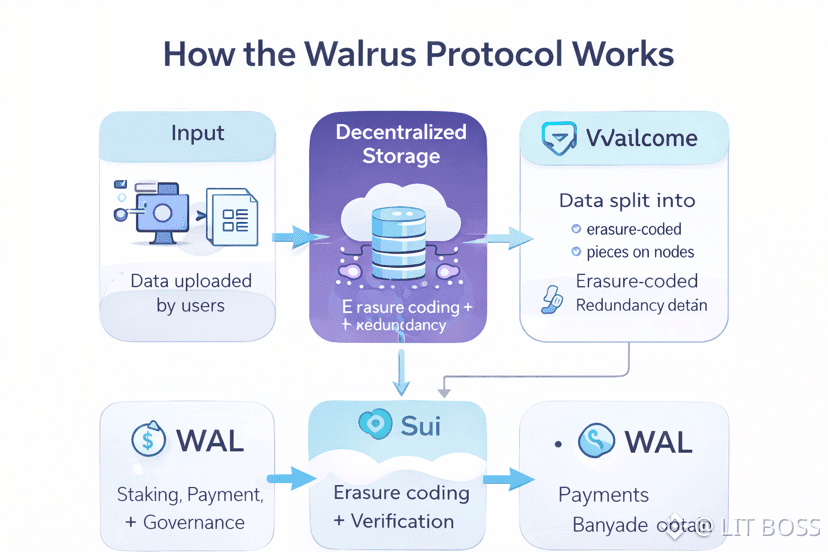
How Walrus Is Turning Data Into a Real Market for AI
AI systems are only as good as the data they learn from, yet most high-quality datasets today are locked away by large platforms. Access is controlled, prices are high, and transparency is limited. This creates a bottleneck where innovation depends on permission rather than participation. Walrus takes a different path. Instead of relying on centralized gatekeepers, @walrusprotocol enables decentralized data markets where anyone can store, share, and access datasets without asking for approval. The idea is simple but powerful: data should be open to verification, not controlled by a few entities.
Trust is the hardest problem in data markets, and Walrus addresses it directly. Rather than asking users to trust storage providers, the protocol uses cryptographic proofs to show that data is actually stored and remains available over time. Buyers don’t need promises or contracts behind closed doors, they can verify the facts themselves. This reduces disputes, lowers risk, and makes data transactions much clearer. For AI developers, this matters a lot. Training models on unreliable or unverifiable data can break entire systems. Walrus makes reliability something you can check, not assume.
Cost and reuse are another big advantage. Large AI datasets are expensive to store, especially if they need to stay accessible for many different models. Walrus uses erasure coding to reduce storage costs while keeping data durable. Because availability and integrity can be proven, the same dataset can be reused across multiple AI projects without losing value. This turns data into a long-term asset instead of a one-time resource, increasing incentives for data creators to participate.
Governance is built into the system as well. By integrating with the Sui blockchain, Walrus treats datasets as on-chain objects. Ownership is visible, access rules can be defined in advance, and smart contracts can handle payments or time-limited usage automatically. Nothing changes behind the scenes. The rules are transparent and enforced by code, not by trust.
What Walrus is really doing is changing how we think about data. Instead of static files locked behind platforms, data becomes a verifiable, tradable asset with clear rules. For AI to grow in a fair and open way, the focus needs to shift from who controls data to how data is verified. $WAL supports this system by aligning incentives around storage, access, and long-term reliability. That’s why Walrus matters far beyond storage alone. #Walrus


