
Traders dealing with regulated assets often face the dilemma of transparency versus privacy—Dusk's Hedger resolves this on its EVM layer. By combining zero-knowledge proofs with homomorphic encryption, Hedger enables privacy-preserving yet auditable transactions directly on DuskEVM, tailored for financial use cases where compliance is mandatory. This setup allows traders to execute positions on Dusk without exposing sensitive details, while DUSK tokens handle the gas for these secure operations, creating a utility-driven environment in the Dusk ecosystem.
Hedger Basics: Privacy Engine for DuskEVM
Hedger functions as the dedicated privacy component for Dusk Network's DuskEVM, an EVM-compatible execution layer that went live in the second week of January 2026. Designed to support confidential transactions on Dusk, Hedger integrates homomorphic encryption and zero-knowledge proofs to process data privately while maintaining full compatibility with standard Solidity contracts. According to official sources, Hedger evolved from earlier tools like Zedger, shifting focus to EVM environments to enable scalable privacy in Dusk. For traders, this means interacting with DeFi or RWA protocols on DuskEVM without public ledger exposure, as Hedger obscures details like trade amounts or wallet states. DUSK is crucial here, covering gas fees for Hedger's computations, which tie into Dusk's economic incentives for network security.
Zero-Knowledge Proofs in Hedger: Verifying Without Exposing
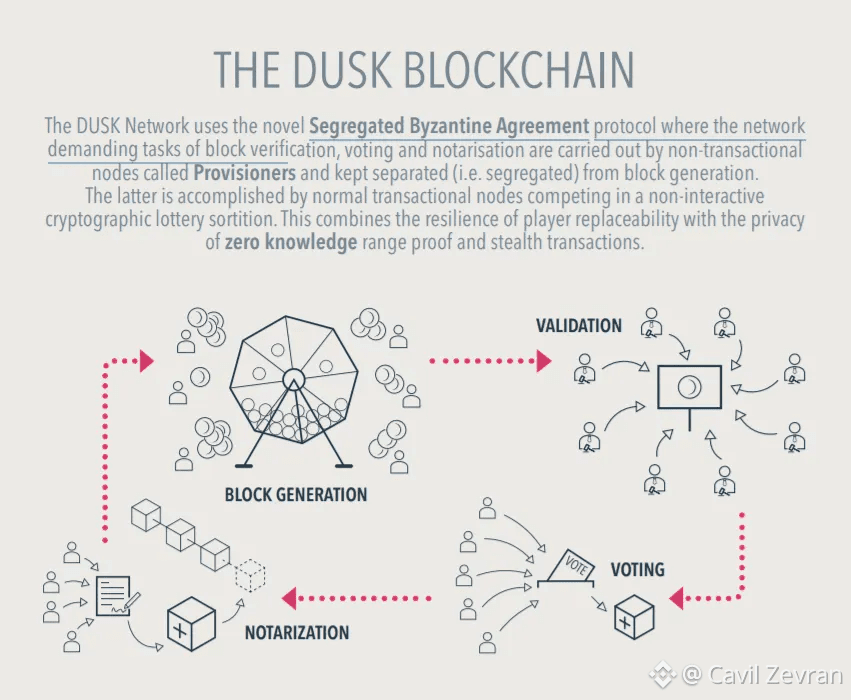
Zero-knowledge proofs form a cornerstone of Hedger in Dusk Network, allowing traders to prove transaction validity—such as sufficient funds or compliance adherence—without revealing the underlying data. In Dusk's implementation, these proofs are succinct, ensuring efficient verification by validators on Dusk's Layer 1. This mechanism is intended to support regulated scenarios where traders need to confirm actions privately on DuskEVM. For example, a proof might attest to a trade's legitimacy in a Dusk-based DEX without disclosing position sizes, reducing risks like front-running. DUSK fuels this process, as generating and submitting proofs consumes gas paid in DUSK, rewarding stakers who secure Dusk's consensus and maintain the ecosystem's integrity.
Homomorphic Encryption: Encrypted Computations on Dusk
Hedger employs homomorphic encryption in Dusk Network, enabling computations on encrypted data without decryption, based on schemes like ElGamal over elliptic curves. This allows DuskEVM to handle operations such as aggregating trades or calculating yields privately, preserving confidentiality throughout the workflow. Official sources indicate Hedger's encryption is optimized for financial computations in Dusk, ensuring that even complex trades remain hidden from unauthorized views. Traders benefit by executing strategies on Dusk without data leaks, but must account for the computational intensity, which elevates DUSK gas costs in the Dusk ecosystem. This feature positions Dusk as a venue for discreet positioning in regulated markets.
Auditable Transactions: Compliance Built-In for Dusk Traders
Hedger ensures transactions on Dusk Network are auditable through selective disclosure, where traders can reveal specific proof elements to regulators while keeping the rest confidential. This aligns with standards like MiCA in the EU, allowing DuskEVM to support compliant DeFi without compromising privacy. In Dusk, auditors access verifiable data on demand via disclosure keys generated during Hedger operations, making it suitable for institutional trades. For retail traders on Dusk, this means participating in RWA pools with assurance that compliance doesn't require full transparency. DUSK's utility extends to these audits, as fees for proof verifications contribute to Dusk's staking rewards, incentivizing a secure network.
Step-by-Step: Executing a Private Trade via Hedger on Dusk
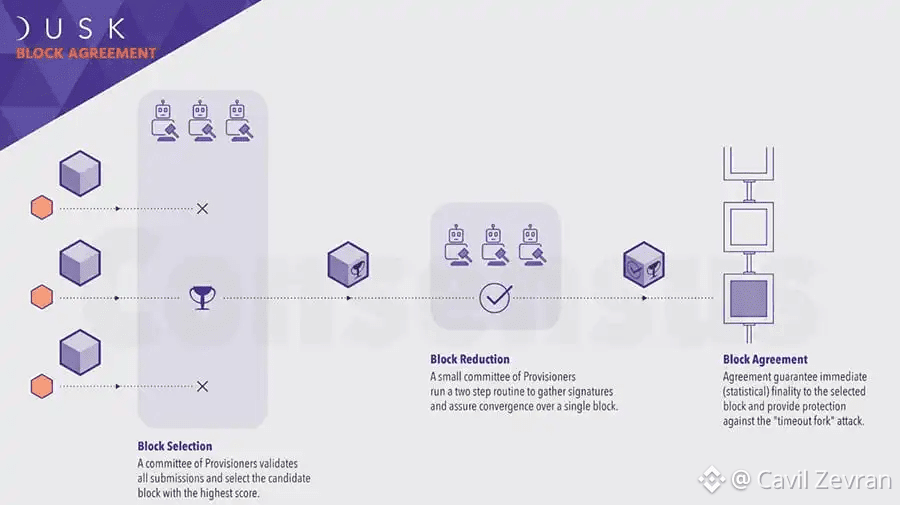
To execute a private trade on Dusk Network using Hedger, traders follow a structured process on DuskEVM. First, connect a compatible wallet funded with DUSK to Dusk's RPC endpoint, ensuring sufficient gas for privacy ops. Select a contract—such as a DEX on Dusk—and input encrypted parameters via Hedger, which generates a zero-knowledge proof confirming validity without exposure. Submit the transaction to Dusk's network, where validators verify the proof succinctly using Dusk's Succinct Attestation consensus. Settlement finalizes on Dusk's Layer 1, updating states privately. If compliance requires, use selective disclosure to share proofs. This workflow minimizes risks for traders, though proof generation adds latency, a constraint in time-sensitive Dusk trades. DUSK deducts fees at each step, supporting the ecosystem's validators.
DUSK Token Utility in Hedger Operations
DUSK plays a pivotal role in Hedger's functionality on Dusk Network, serving as the gas token for all privacy-preserving executions on DuskEVM. Each Hedger transaction—generating proofs or encrypting data—consumes DUSK proportional to complexity, creating demand as traders engage in compliant activities. Stakers earn DUSK rewards for validating these ops, with a minimum stake of 1,000 DUSK required after a 2-epoch maturity in Dusk. This ties DUSK to network security, as higher privacy usage boosts fee redistribution. Traders holding DUSK can stake to offset costs, but the 7-day unbonding period in Dusk demands planning for liquidity. Overall, Hedger amplifies DUSK's utility in regulated scenarios within the Dusk ecosystem.
Trade-Offs: Privacy Overhead in Dusk's Hedger System
While Hedger delivers robust privacy on Dusk Network, it introduces trade-offs in performance and user experience. Zero-knowledge proof generation and homomorphic encryption increase latency—often seconds more than transparent trades on DuskEVM—potentially impacting high-frequency positioning. DUSK gas fees rise accordingly, as these mechanisms demand more computation from Dusk's validators. Traders must optimize by batching transactions to mitigate costs in Dusk, though this limits spontaneity. On the upside, Dusk's modular architecture allows scaling, but initial constraints suit strategic, regulated plays over rapid flips in the ecosystem.
Institutional Use Cases: RWAs on Hedger-Enabled Dusk
Hedger is particularly suited for real-world asset tokenization in Dusk Network, enabling institutions to trade tokenized securities privately yet compliantly on DuskEVM. Through partnerships like NPEX—a regulated Dutch exchange with MTF, Broker, and ECSP licenses—DuskTrade, launching in 2026, will bring over €300M in assets on-chain using Hedger for confidential handling. Traders can access fractional RWAs on Dusk, executing buys or sells with proofs verifying ownership without revealing portfolios. This shifts dynamics for yield farming in Dusk, where privacy protects against competitive insights. DUSK funds these use cases, with fees from institutional volumes enhancing staking yields in the Dusk ecosystem.
Scaling Privacy: Hedger's Future in Dusk's Modular Setup
As Dusk Network evolves, Hedger scales within its multilayer architecture, separating execution on DuskEVM from settlement on DuskDS for efficiency. This allows traders to handle larger volumes of private transactions without bottlenecks in Dusk. Official sources note Hedger's compatibility with EIP-4844 for reduced data costs, optimizing DUSK gas for privacy ops. However, as adoption grows—potentially from DuskTrade—traders should anticipate variable fees during peaks in Dusk. The design prioritizes compliant scalability, making Hedger a reliable tool for long-term positioning in the ecosystem.
Trading Strategies: Leveraging Hedger for Edge on Dusk
Traders can build strategies around Hedger's privacy on Dusk Network, such as arbitraging RWAs without signaling intentions on DuskEVM. Use encrypted orders in Dusk's obfuscated books to accumulate positions discreetly, settling via proofs for compliance. Monitor DUSK staking metrics as proxies for network health, staking portions for rewards while trading unlocked DUSK. Constraints like encryption overhead suit swing trades over scalps in Dusk, but the auditability attracts institutional liquidity, tightening spreads in the ecosystem.
Hedger strengthens Dusk Network's appeal for compliant trading by delivering privacy that's verifiable and efficient. Through zero-knowledge and homomorphic tools, traders execute secure positions on DuskEVM without unnecessary exposure. As Dusk integrates more RWAs, Hedger positions DUSK as a key utility for regulated ecosystems.
