

When most blockchains talk about layers, they are talking about scaling. Layer-2s, rollups, sidechains, and data layers are all attempts to make blockspace cheaper and faster. But none of them solve the real bottleneck that prevents blockchains from becoming financial infrastructure.
That bottleneck is trust.
Financial systems do not collapse because they are slow. They collapse because the wrong people can see, manipulate, or abuse information. Traders need privacy. Regulators need transparency. Issuers need control. Markets need fairness. These are not technical problems. They are trust problems.
Dusk’s layered design exists because no single blockchain reality can satisfy all of these at once.
Instead of forcing everything into one public ledger, Dusk separates financial reality into multiple cryptographic layers, each optimized for a different form of trust.
This is what makes @Dusk fundamentally different from every other chain.
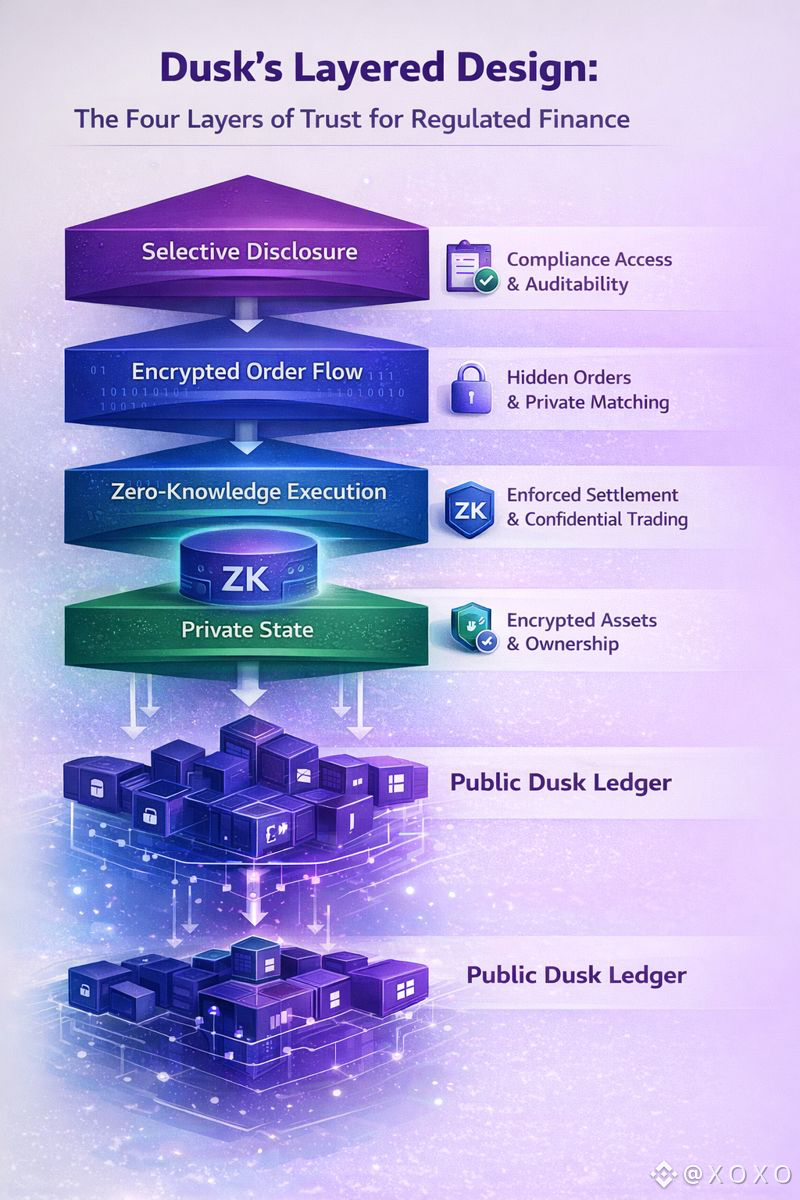
The first layer is Private State.
On Dusk, ownership of assets, balances, and positions exist in encrypted form. Zero-knowledge proofs allow the network to verify that state transitions are valid without revealing the data. This means users can hold tokenized stocks, funds, or RWAs without exposing their wealth or strategy.
This mirrors how real finance works. Your broker knows your portfolio. The market does not.
The second layer is Execution.
Trades, settlements, and asset transfers are executed inside zk circuits. The rules of the market are enforced mathematically. If a trade violates margin rules, settlement rules, or asset logic, it simply cannot occur. But again, the details remain hidden.
This replaces clearing houses and exchange back offices with cryptography.
The third layer is Order Flow.
On public chains, orders sit in a mempool where anyone can see them. That is why MEV exists. Dusk removes this entirely. Orders are encrypted and matched privately. No one can front-run, copy, or manipulate incoming trades.
This is what turns Dusk into a real market rather than a bot battlefield.
The fourth layer is Selective Disclosure.
Dusk allows identities, regulators, and issuers to have cryptographic access to the data they need. Ownership, transactions, and compliance can be audited without exposing them publicly. This is how regulated assets can exist onchain.
Put together, these layers form something that no other blockchain has: multiple simultaneous realities.
Traders see private markets.
Regulators see compliance.
Issuers see cap tables.
The public sees settlement.
All of them are true. None of them leak into the others.
This layered design is why Dusk can host tokenized securities, private trading, and regulatory-grade finance at the same time.
It is not hiding data. It is routing trust.
And that is the future of onchain finance.
My take
Blockchains tried to make one truth fit everyone. Dusk realized finance needs many truths, all cryptographically enforced. That is how real capital moves onchain.