

In the design of high-stakes financial infrastructure, the most dangerous flaw isn't a bug in the code—it is architectural entanglement. When the rules of execution are woven too tightly into the logic of settlement, a failure in one inevitably compromises the other.At Dusk, we operate under a different set of maxims. We treat the protocol not as a monolithic stack, but as a series of strictly governed islands. This is the core of our philosophy: Isolation is the ultimate safeguard.
The Separation of Execution and Settlement
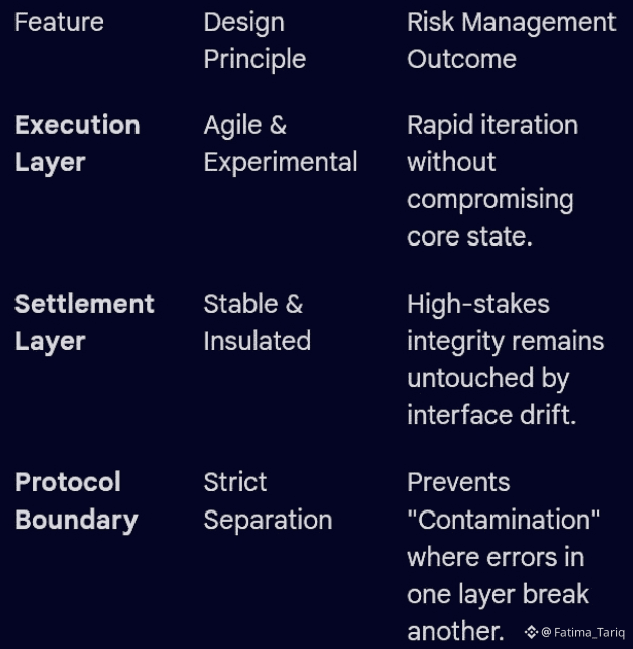
Innovation requires a degree of freedom that settlement cannot afford. By decoupling execution from settlement, we create a sandbox for evolution.Execution is where the complexity lives—it can experiment, iterate, and adapt to user needs.Settlement is the bedrock. It remains stable, insulated, and indifferent to the churn of the layers above it.This separation ensures that a logic error in a complex smart contract or an experimental interface cannot "reach down" and corrupt the underlying truth of the ledger.

Defining the Protocol Boundary
The "Protocol Boundary" is the line where experimentation ends and the rules of the system begin. We ensure that the rules defining “what counts” as a valid transaction are not dragged along with downstream interface changes.Without this boundary, systems suffer from upstream contamination. A mistake in an auxiliary service begins to bleed into the core logic, eventually requiring a hard fork or a systemic reset to fix a localized error. At Dusk, we draw these boundaries proactively. We do not wait for a collision to realize we need a wall.
Blast-Radius Control: Architecture as Strategy
We view clean design not as an aesthetic preference, but as a risk-management strategy. Every connection in a system is a potential vector for failure. By enforcing strict architectural separation, we implement "blast-radius control."If an error occurs within the execution layer, its impact is mathematically and logically confined. It cannot cascade into the settlement layer. This containment is essential for institutional robustness; in high-stakes or regulated environments, "moving fast and breaking things" is only acceptable if you have clearly defined what is allowed to break.

Institutional Robustness and the Future of Settlement
For a protocol to be truly "institutional-grade," it must be predictable. Predictability comes from the assurance that the core settlement logic is protected from the "noise" of the rest of the stack.By prioritizing these boundaries early in our design phase—rather than retroactively patching them in after a crisis—Dusk ensures a level of stability that can support the most demanding financial applications. We build for the long term, where the integrity of the settlement is the only metric that truly matters.
Comparative Analysis of Risk Containment
The Engineering Philosophy
Proactive over Reactive: Boundaries are drawn before the code is shipped, preventing the "drift" that leads to entanglement.
Insulated State: The core state of the protocol should never be aware of the complexities of the application layer.
Principled Rigor: We value the discipline of saying "no" to features that threaten to bridge the gap between execution and settlement.
