
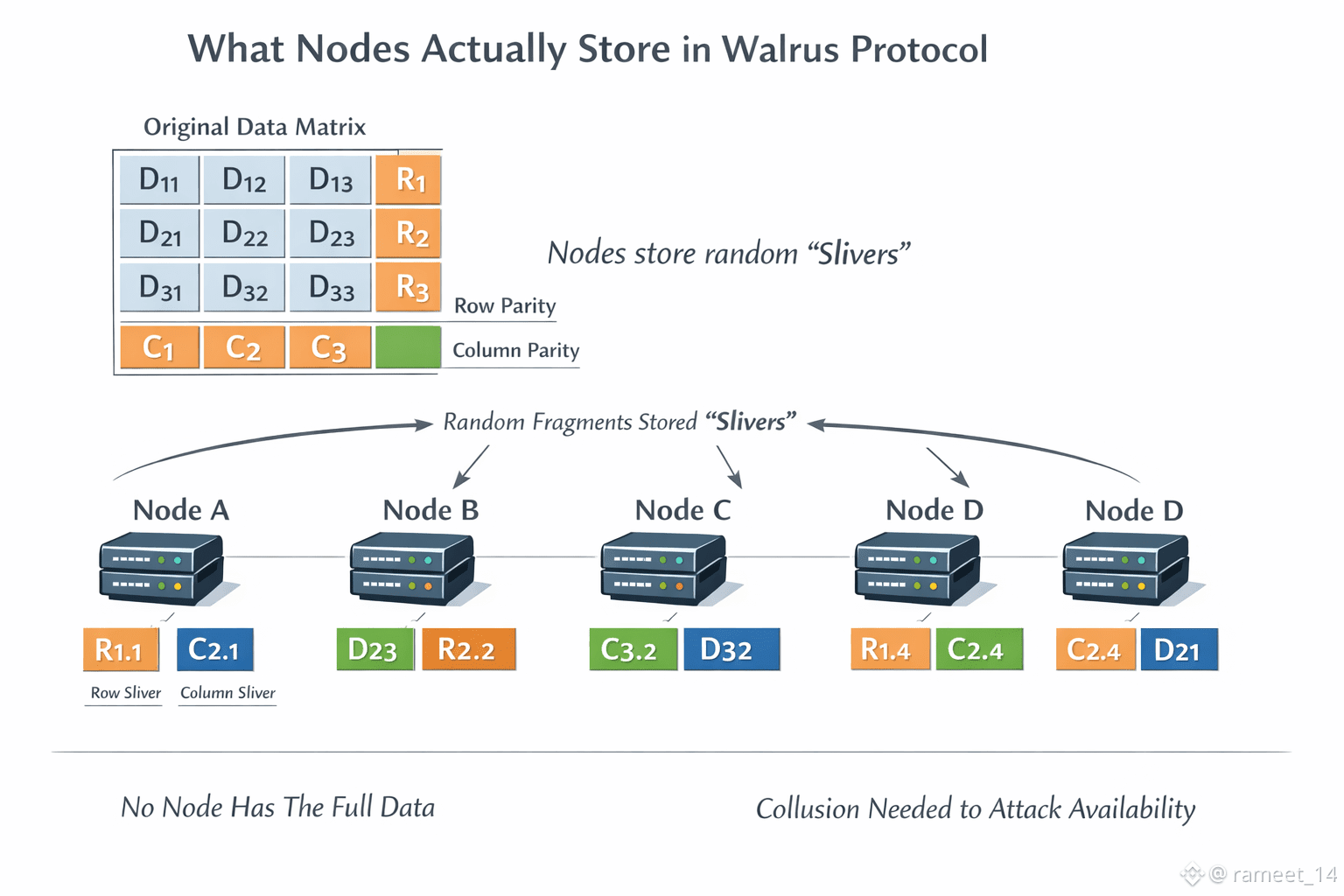
Decentralized storage is revolutionizing how data is preserved and shared in Web3. But beneath the surface of any storage network lies a critical question: what do nodes actually store? In Walrus Protocol, this is where the magic of RedStuff erasure coding comes in.
The Building Blocks of Storage
Unlike traditional storage systems where nodes might keep full copies of files, Walrus uses slivers — tiny, encoded fragments of a larger dataset.
A sliver is a single fragment derived from either:
a row code, or
a column code
from a two-dimensional encoding of the original blob. This design is part of what makes Walrus both efficient and secure.
Nodes Store Only a Random Subset
Every node in the Walrus network doesn’t hold entire rows or columns. Instead, each node stores a small, randomly assigned subset of slivers. This approach has multiple advantages:
Efficiency: Nodes only store a fraction of the data, reducing storage costs and bandwidth requirements.
Resilience: Losing a single node doesn’t endanger the entire blob — the data can be reconstructed from remaining slivers.
Scalability: As more nodes join the network, the system can store larger datasets without replicating full copies across every node.
Security Through Fragmentation
Storing only slivers also strengthens security:
No single node has meaningful information alone: Even if a node is compromised, it cannot reconstruct the original blob.
Collusion is required to attack availability: An attacker would need to control a significant portion of nodes storing overlapping slivers to disrupt access.
This design ensures that data availability is robust even in adversarial environments, which is critical for decentralized applications that depend on reliable storage.
Why This Matters
By storing slivers rather than entire files, Walrus achieves a balance between efficiency, security, and reliability:
Data is protected from malicious nodes
Storage costs remain low
The network can scale to accommodate massive datasets, from NFTs and AI models to decentralized applications
In essence, slivers are the secret to making decentralized storage both practical and secure.
In Walrus Protocol, nodes don’t just store files — they store carefully encoded slivers that, when combined across the network, ensure data is always available, private, and resilient. This is the core principle that enables Walrus to provide efficient, Byzantine-resilient storage at scale.

