
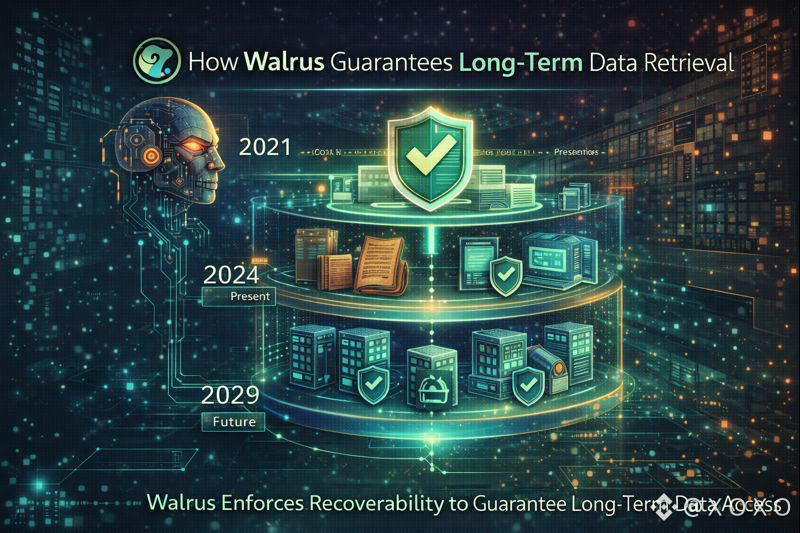


Digital systems do not fail because data disappears. They fail because data becomes unreachable when it is needed most. In decentralized environments, this problem is amplified. Nodes go offline. Storage providers exit. Incentives change. What remains is a growing archive of information that technically exists but cannot be reliably retrieved. Walrus was built to eliminate that uncertainty.
Traditional decentralized storage networks focus on persistence. If data was written once, it is considered safe. In practice, this assumption is fragile. Over time, providers drop files, hardware fails, and networks fragment. The longer data is expected to live, the more likely it is to become unavailable.
Walrus approaches the problem differently. It treats data retrieval as a continuously enforced obligation rather than a one-time event.
When data enters Walrus, it is encoded into fragments using erasure coding. These fragments are distributed across many independent operators. The network only needs a subset of these fragments to reconstruct the full dataset. This means retrieval does not depend on any specific machine, location, or provider. It depends on mathematics.
More importantly, Walrus continuously checks that the data remains reconstructable. Operators must prove that they still hold their assigned fragments. If some fail or disappear, the system automatically recreates and redistributes the missing pieces. This keeps the data above a safety threshold that guarantees future recovery.
This is what creates long-term retrieval guarantees. Walrus does not just store files and hope they are still there years later. It actively maintains their recoverability.
For blockchains, this is critical. Rollups depend on historical data to verify state transitions. If that data becomes unavailable, the chain becomes unverifiable. Walrus ensures that history remains accessible for as long as the network exists.
For AI systems, this is equally important. Models and agents rely on long-term memory. If training data, model checkpoints, or decision logs disappear, intelligence degrades. Walrus allows decentralized AI to have stable, verifiable memory over long time horizons.
For enterprises and institutions, retrieval guarantees are what turn decentralized storage into usable infrastructure. They need to know that contracts, records, and datasets will still be accessible in the future without trusting a single provider.
Walrus achieves this by aligning cryptography and economics. Operators are incentivized to maintain availability because their rewards depend on continuous proof. The network enforces recovery when availability drops. This creates a self-sustaining system where data remains retrievable by design.
Long-term data is only valuable if it remains accessible. Walrus is one of the first systems that makes that promise enforceable.
My take
Storage preserves the past. Retrieval guarantees make the past usable. Walrus understands that difference, and that is why it is becoming a foundation for long-term decentralised systems.