
As blockchain systems mature, the most serious failures tend to be quiet. Chains keep running. Apps stay online. But something underneath starts to slip. Old data becomes harder to fetch. Verification paths grow fragile. Confidence weakens slowly, not through collapse, but through uncertainty. Walrus is built around the idea that this kind of degradation is not rare. It is what happens when data is not treated as a long-term responsibility.
In modular architectures, this problem gets worse. Execution handles computation. Settlement handles finality. Interfaces handle users. Data cuts across all of them and across time. It has to be there long after transactions finish and long after incentives change. When that assumption fails, every other layer inherits the risk. Walrus exists to deal with that dependency directly instead of pushing it to the edges.
Early blockchains avoided this by default. Everything lived onchain, so availability was guaranteed, but at high cost. As systems scaled, data was pushed offchain to stay affordable. In many cases, availability became something people assumed rather than something the system enforced. Walrus pushes back on that. Data is not expected to persist. It is required to persist.
Its design allows large data to live outside execution layers while still being anchored cryptographically. That keeps costs down without losing verifiability. More importantly, it defines responsibility. Data is not written once and forgotten. It is maintained over time, with incentives aligned toward keeping it available rather than just accepting it upfront. That shift matters.
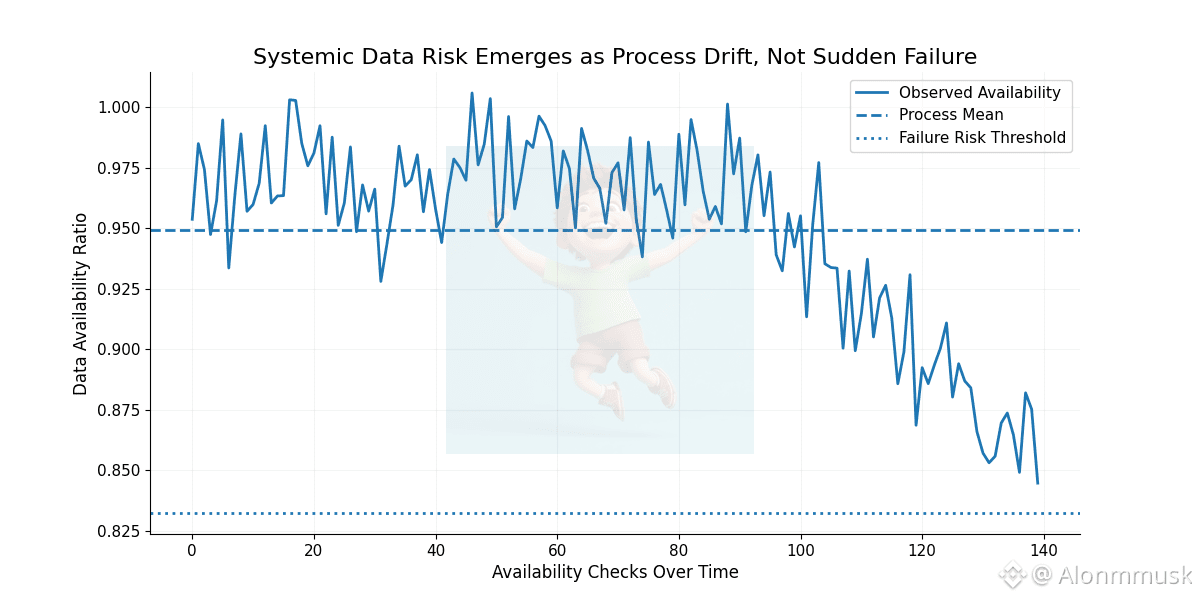
Time is where most systems fail. Data usually does not disappear immediately. It fades as participants lose interest or incentives weaken. Walrus is built for that delayed failure mode. Storage providers are rewarded for staying reliable over long periods, not just for showing up briefly. This reduces the chance that data quietly vanishes once attention moves on.
For rollups and Layer 2 systems, this reliability is not optional. Their security depends on historical data for verification and dispute resolution. If that data becomes unreliable, execution correctness stops meaning much. Walrus gives these systems a place where continuity can be assumed instead of engineered around.
Clear economics reinforce that trust. Infrastructure meant to last cannot rely on unpredictable costs. Developers need to plan for months and years, not short deployment windows. Walrus emphasizes economics that are easier to reason about over time, which is often the difference between experimentation and real infrastructure.
Neutrality also matters. Walrus does not try to influence execution design or application behavior. It does not compete for users or liquidity. It provides a service that many systems can rely on at the same time without giving up control. Infrastructure that stays neutral tends to integrate more easily and last longer.
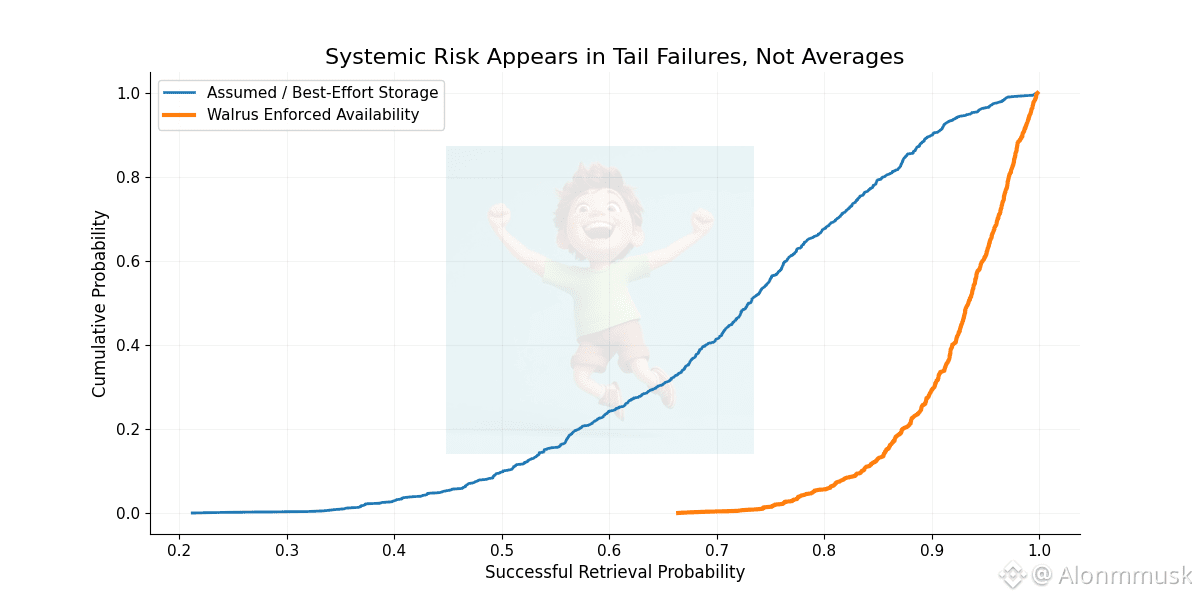
The builders drawn to Walrus tend to care about guarantees, not visibility. They work on rollups, archival systems, and data-heavy applications where failure cannot be reversed easily. For them, success is measured by absence. No missing history. No broken verification. No slow erosion of trust.
As blockchains handle more real value, tolerance for hidden fragility drops. Users may not talk about data availability, but they feel it immediately when systems cannot reconstruct state. In mature environments, that is unacceptable. Walrus aligns with that reality by focusing on the least visible layer and treating it with seriousness.
What defines Walrus most clearly is restraint. It does not expand beyond data availability. It does not chase adjacent narratives. Each design choice points back to the same goal. Keep data accessible. Keep it verifiable. Keep it sustainable over time.
In complex systems, reliability often shows up as something that does not happen. No data loss. No silent failure. No assumptions breaking years later. Walrus is built for that quiet requirement, strengthening the foundations long after execution is done.
For educational purposes only. Not financial advice. Do your own research.
@Walrus 🦭/acc #Walrus #walrus $WAL

