
In many blockchain systems, data availability is treated as a solved problem once information is published somewhere. A transaction is executed. A blob is stored. A reference exists. From that moment on, availability is often assumed rather than guaranteed. Walrus is built around the recognition that this assumption is one of the most fragile points in modern blockchain architecture.
As the ecosystem shifts toward modular design, execution and data are increasingly separated. This separation improves scalability, but it also changes the risk profile of the system. Execution layers move fast and evolve quickly. Data, however, must remain stable across those changes. It must persist through upgrades, incentive shifts, and declining attention. When it does not, systems do not fail loudly. They lose their ability to verify themselves.
Early blockchains avoided this problem by storing everything onchain. Availability was guaranteed, but costs scaled poorly. As usage expanded, the industry externalized data to reduce overhead. In many cases, availability became an implicit promise rather than an enforceable property. Data existed as long as it was convenient for someone to keep it available. Walrus challenges that model by treating availability as a responsibility that must be maintained over time.
The protocol’s architecture reflects this shift. Walrus allows large data blobs to live outside execution environments while anchoring their existence cryptographically. This preserves verifiability without forcing base layers to absorb unsustainable storage costs. More importantly, it clarifies accountability. Data is not merely accepted and forgotten. It is subject to ongoing incentives that reward continued availability rather than one-time submission.
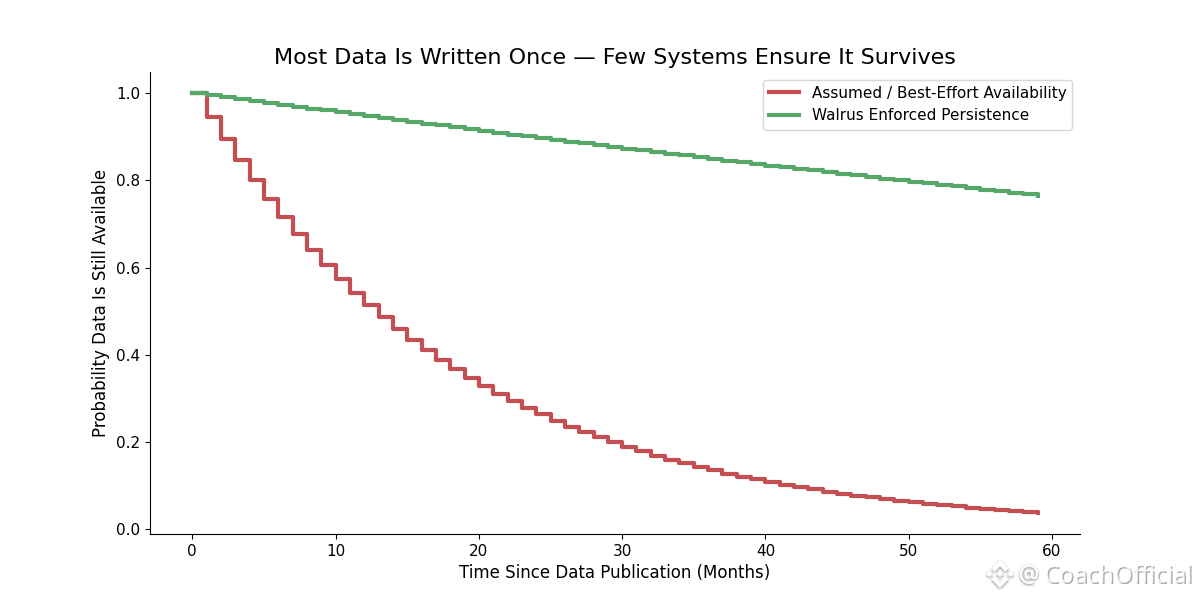
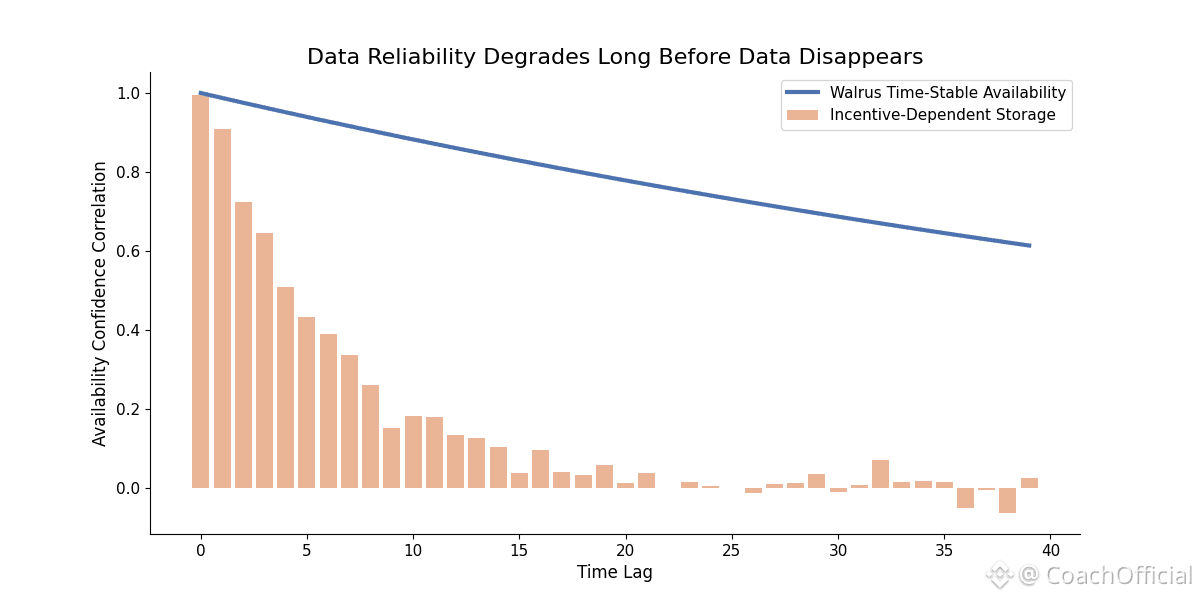
Time is the critical variable here. Data availability is rarely tested at the moment data is posted. It is tested months or years later, when incentives weaken and participants disengage. Many systems perform well under initial conditions and fail quietly over time. Walrus is designed for that delayed test. Its incentive structure encourages storage providers to remain engaged long after the initial activity has passed.
For rollups and Layer 2 systems, this distinction is foundational. Their security models rely on in practice, access to historical data for state reconstruction, verification, and dispute resolution. Without reliable availability, fraud proofs lose meaning and trust assumptions degrade. Walrus provides a layer where these systems can depend on continuity rather than redundancy. Instead of each application managing its own fallback mechanisms, availability becomes a shared, enforceable service.
This has important implications for system design. When availability is uncertain, developers are forced to plan for failure. They build complexity into applications to handle missing data and degraded verification paths. Walrus absorbs much of this uncertainty. By offering dependable availability, it generally allows developers to simplify assumptions and focus on application logic rather than data survival. Simplicity, in this context, is a security feature.
Economic predictability reinforces this reliability. Infrastructure meant to support long-lived systems cannot rely on volatile or opaque pricing models. Developers and operators need to understand what availability costs today and what it is likely to cost over time. Walrus emphasizes clearer economic structures that make long-term planning possible. This predictability is often what separates experimental deployments from infrastructure that can support real usage.
Another defining characteristic is neutrality. Walrus does not attempt to influence execution layers, application behavior, or governance choices. It does not compete for users or liquidity. It provides a service that multiple systems can depend on simultaneously without ceding control. This neutrality is essential for infrastructure that sits beneath many independent ecosystems. Shared layers endure when they complement rather than compete.
The ecosystem forming around Walrus reflects these priorities. Builders are not chasing rapid visibility or short-term metrics. They are working on rollups, archival systems, and data-intensive applications where failure cannot be undone easily. These teams care about guarantees more than features. For them, the value of Walrus lies in what does not happen. No missing history. No broken verification paths. No gradual erosion of trust.
There is also a broader industry context reinforcing Walrus’s relevance. As blockchain systems handle more real economic value, tolerance for hidden fragility declines. Users may not understand data availability conceptually, but they experience its absence immediately when systems fail to verify or reconstruct state. In mature environments, these failures are unacceptable. Walrus aligns with this shift by focusing on the least visible but most consequential layer of the stack.
What ultimately defines Walrus is discipline. It does not expand its mission beyond data availability. It does not chase execution narratives or application trends. Each design decision reinforces the same objective. Keep data accessible. Keep it verifiable. Keep it economically sustainable. That clarity builds credibility over time.
In complex systems, reliability is rarely defined by speed or novelty. It is defined by persistence. The ability to remember accurately under changing conditions. Walrus is building for that requirement, ensuring that as blockchain systems scale and modularize, their memory does not decay.
As modular architectures continue to mature, layers like Walrus become less optional and more foundational. They may never be visible to end users, but they shape whether entire ecosystems can withstand time. Walrus is building for that quiet role, where dependability matters more than attention.
For educational purposes only. Not financial advice. Do your own research.
@Walrus 🦭/acc #Walrus #walrus $WAL

