

When I examine the architecture of the @Dusk Network, what stands out immediately is not a single feature or upgrade, but a deliberate architectural philosophy. This is a system designed from the ground up with modularity as its organizing principle. Rather than forcing every function into a single, tightly coupled chain, Dusk separates responsibilities across distinct layers. The result is an infrastructure that avoids the structural congestion common in monolithic designs and instead creates space for specialization, flexibility, and long-term scalability.
From my research, this modular approach is not an abstract design choice. It directly reflects the network’s focus on regulated and institutional use cases, where privacy, performance, and predictability are non-negotiable. By separating consensus, settlement, and application logic, Dusk reduces systemic friction and allows each component to evolve without destabilizing the whole.
By early 2026, the Dusk ecosystem had matured into a clearly defined three-layer stack. This structure is not cosmetic. It establishes clear boundaries between responsibilities while preserving a unified network experience. What I observe here is a careful balance: institutional participants can interact with regulated assets in a controlled environment, while developers retain access to familiar tooling, including Solidity-based workflows.
This separation matters. In many blockchains, regulatory constraints, privacy features, and execution environments collide inside the same layer, producing complexity and inefficiency. Dusk avoids this by design. Each layer performs its role without overreaching, which reduces bloat and allows the network to remain adaptable as requirements change.
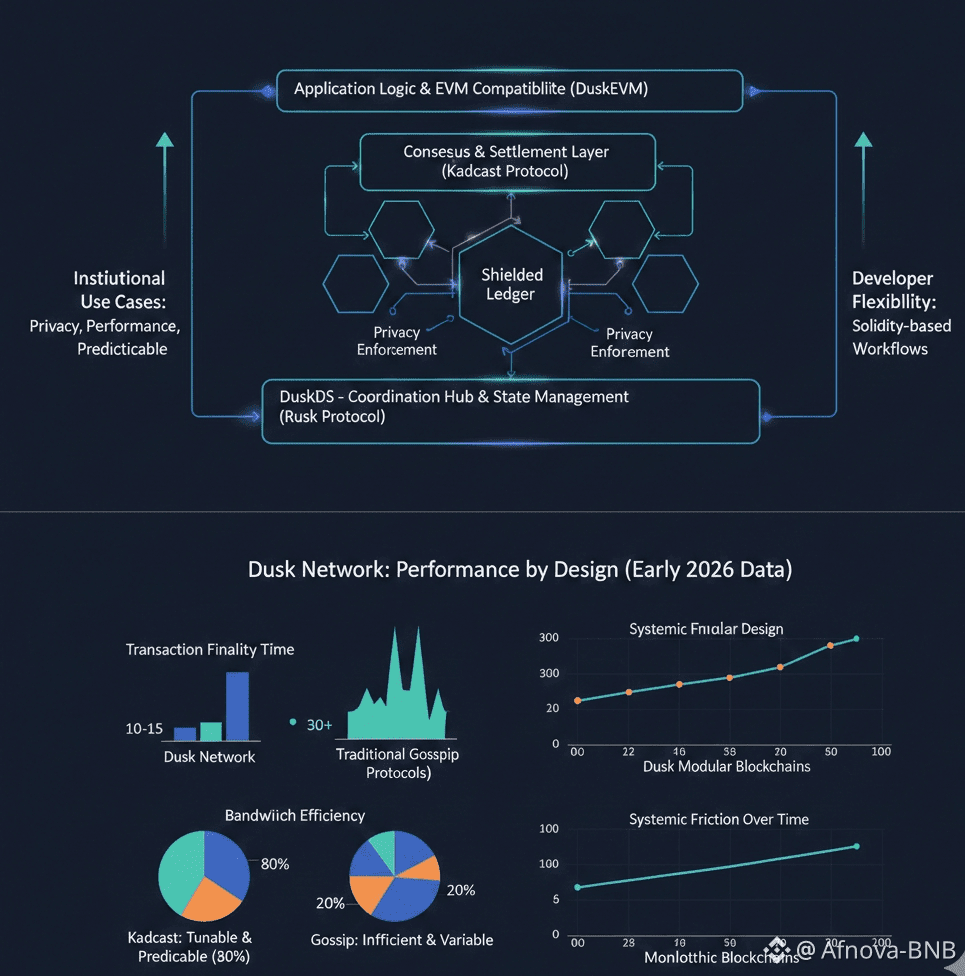
At the center of this architecture sits DuskDS, which functions as the network’s coordination hub. Through my analysis, it becomes clear that DuskDS is not just an administrative layer but the backbone of state management and communication. It relies on the Rusk protocol, a reference implementation written in Rust, to handle state transitions and node interactions with precision and consistency.
The importance of this layer became especially visible during the December 2025 network upgrade, known as the DuskDS L1 Upgrade. This upgrade significantly enhanced data availability and node performance, laying the groundwork for seamless integration with DuskEVM. Rather than bolting new functionality onto an aging core, the upgrade reinforced the modular foundation, ensuring that expansion did not come at the cost of stability.
What stands out to me is how this evolution supports the concept of a “Shielded Ledger.” Sensitive commercial data is protected at the protocol level, not through external add-ons or application-level workarounds. Privacy is embedded into the structure itself, making it a native property of the network rather than an optional feature.
One of the most striking conclusions from my research is that Dusk treats privacy as an infrastructural concern. Instead of relying on patches or specialized applications to hide sensitive information, the network’s modular design ensures that confidentiality is preserved by default. This is particularly relevant for institutional participants, where exposure of transactional or commercial data can carry real-world consequences.
By keeping privacy enforcement within the core layers of the network, Dusk minimizes the risk of leakage and reduces the operational burden on developers and institutions alike. The architecture itself becomes the guardian of sensitive data.
Beyond internal structure, Dusk’s networking layer reveals another intentional design choice. To meet the demands of financial systems, where latency and availability are critical, the network implements the Kadcast protocol for block propagation. From what I observe, this is a decisive move away from traditional gossip-based approaches.
Kadcast is built on a structured overlay topology derived from the Kademlia algorithm. This structure enables efficient and predictable broadcast behavior. Unlike gossip protocols, which can consume excessive bandwidth and produce inconsistent propagation times, Kadcast allows overhead to be tuned. This gives the network control over performance rather than leaving it to probabilistic outcomes.
The practical result is faster and more reliable communication across the network, supporting transaction finality in the range of 10 to 15 seconds. For trading systems and institutional workflows, this predictability is not just an advantage it is a requirement.
Stepping back, what I see in Dusk’s modular architecture is a network that treats structure as strategy. Every layer, upgrade, and protocol choice reinforces the same objective: to deliver privacy, performance, and adaptability without compromise. Instead of chasing short-term scalability fixes, Dusk builds a foundation capable of supporting complex, regulated financial activity over time.
This is not architecture for its own sake. It is architecture with intent measured, deliberate, and aligned with the realities of institutional blockchain adoption.
